Wednesday, February 26, 2014

Sina Weibo Censors Terms Critical of Chen Guangbiao - Guy Who Wanted to Buy the New York Times

On January 5, 2014, the state-sponsored Global Times published a letter from Chen Guangbiao entitled “I Intend to Buy The New York Times, Please Don’t Take It as a Joke.” An excerpt: 
I had the idea of purchasing The New York Times when I first placed an advertisement in it in December, 2012, claiming China's sovereignty over the Diaoyu Islands. I find Americans know little about a civilized and open China that has been enjoying unprecedented development. The tradition and style of The New York Times make it very difficult to have objective coverage of China. If we could purchase it, its tone might turn around. Therefore I have been involved in discussing acquisition-related matters with like-minded investors.
On January 8, 2014, the Global Times published a report entitled “Chinese Businessman Helps Immolation Victims Undergo Surgeries in NY.”An excerpt:
Two former Falun Gong practitioners who suffered horrific burns after setting themselves on fire in Beijing in 2001 will undergo surgery at a hospital in New York, Chinese businessman and philanthropist Chen Guangbiao said Tuesday.

Chen said he was paying personally for a series of medical procedures the two women will receive. The total amount is expected to exceed $2 million, including traveling, lodging and some other expenses.
On January 11, the Global Times published an editorial entitled “Diaosi, Goddesses and Rise of China.” An excerpt:
Chinese recycling tycoon Chen Guangbiao's high-profile attempt to buy the New York Times has drawn mockery both in China and abroad.

Some have compared the prestigious newspaper to a goddess and ridiculed Chen. A man who lives off "collecting waste iron and bronze" trying to touch their goddess? No way!

The metaphor well describes the West's image of itself. The West has led modern civilization for hundreds of years. It is no surprise that it looks down on the rest of the world.
On January 14, 2014, China’s official news agency Xinhua published an article entitled “A History of Chen Guangbiao’s Family Fortune: Selling Fake Medical Equipment Gained the First Batch of Funds” (陈光标发家史:卖假医疗设备赚第一桶金).

These screenshots show that the article, originally available here - http://news.xinhuanet.com/gangao/2014-01/14/c_126000961.htm - was subsequently deleted.


These screenshots were taken on January 15, and show that Sina Weibo was censoring searches for “Chen Guangbiao First Batch of Funds”(陈光标 第一桶金) and “Chen Guangbiao Cheats Hoodwinks” (陈光标 欺骗 忽悠).

Tuesday, February 25, 2014

Sina Weibo Censors Title of Video Game - "Battlefield 4"

On December 31, 2014, the state-sponsored Global Times published an article entitled “Video Game World Trapped in Cold War Mindset.” An excerpt:
China's ban on Battlefield 4: China Rising, a recent war simulation game designed by US company Electronic Arts, has stirred up interesting reactions back in the US.
. . . .
It is interesting to compare the Chinese elements in US video games and Hollywood blockbusters. There is an argument that while the US gaming industry, which has not switched focus to the China market, risks offending the Chinese without much hesitance, Hollywood movies like Iron Man 3 already kowtow to Beijing's stupendous box office returns by squeezing in China-related plots. Nonetheless, as China will reportedly lift the ban on sales of video game consoles, along with the launching of the China (Shanghai) Pilot Free Trade Zone earlier this year, the US gaming industry will likely follow suit.
This screenshot was taken on December 27, 2013, and shows that Sina Weibo was censoring searches for “Battlefield 4” (占地4).


Monday, February 24, 2014

2014 Tiananmen Censorship Season Begins On Sina Weibo With "Return to Tiananmen"

These screenshots show that Sina Weibo has begun censoring searches for "Return to Tiananmen" (重回天安门).

Sunday, February 23, 2014

Global Times Editor Hu Xijin Ponders Why So Many Wealthy Chinese Want to Emigrate

Global Times Editor Hu Xijin's Weibo
On February 13, 2014, the state-sponsored Global Times published an editorial entitled “Wealthy Migration Shouldn’t be Politicized” (“富人移民潮”的政治含义被夸大了). An excerpt:
Canada announced Wednesday the cancellation of the Immigrant Investor Program popular among wealthy Chinese.
. . . .
Chinese account for more than half of the immigrants who'll face mounting immigration difficulties with Ottawa shuttering the wealth-based visa scheme.
. . . .
In final analysis, maintaining the prosperity and stability of China conforms with the interests of the wealthy.
According to Forbes:
[A]mong the 59,000 applications pending for the program, more than 45,000 were from mainland Chinese. Data from some Canadian provinces indicated that about 99 per cent of applicants are mainland Chinese.
According to the Wall Street Journal:
[In 2013,] 6,895 Chinese nationals were issued visas through the [United States’ investor visa] program, outpacing all other nationalities by a wide margin, according to State Department data. South Koreans, the next largest group, were issued 364.
The Global Times’ editorial posed the following questions:
What has driven rich Chinese and the middle-class to migrate to the West? Does a lack of freedom and democracy in China's society make them feel insecure both physically and financially?
The Global Times did not answer those questions.

On February 12, 2014, Hu Xijin (胡锡进), editor of the Global Times, posted this on his Sina Weibo:
Occasionally the Global Times will publish articles on on extremely sensitive topics, but will not put them online. The reason for this is that that the online public opinion ecology will intensify their sensitivity, and this acts at cross purposes with our intent to desensitize these issues. Our explorations can only begin offline, with the hope that society will gradually adapt. Progress is a difficult thing.
环球时报现在有时会刊登话题超敏感的文章,但该文不上网。原因是网上的舆论生态会加剧该文的敏感性,与我们让敏感话题脱敏的初衷南辕北辙。我们的探索只能先从网下开始,期待社会逐渐产生适应性。前进是项艰难的事情。
The following day (the day of the editorial’s publication), Hu posted this on his Sina Weibo:
I met an old friend, very wealthy, opened his own medium-sized company. The kind of guy who will spend 20, 30 thousand on a vacation to Hainan, but who has nothing but complaints about the country. I asked him why, and he said the most important reasons were unhappiness, air, and food safety, no right to speak, not to mention the country's politics. He said a man has aspirations, but there is no way to have any impact in this country. Today, everyone in China feels unhappy, and feels they're not getting what they should be getting. This truly is a problem.
遇一老友,很有钱,自己开个不大不小的公司,去海南度个假花二三十万的人,但对国家一肚子牢骚。问他为什么,他说不痛快,空气,食品安全,最重要的,没有话语权,对国家政治说不上话。他说,男人嘛,都要有点抱负,但影响国家无门。中国现在人人觉得不开心,都觉得有些该得到的没得到。这的确是问题。

Saturday, February 22, 2014

Sina Weibo Censors Professor Chen Hongguo's Resignation Announcement

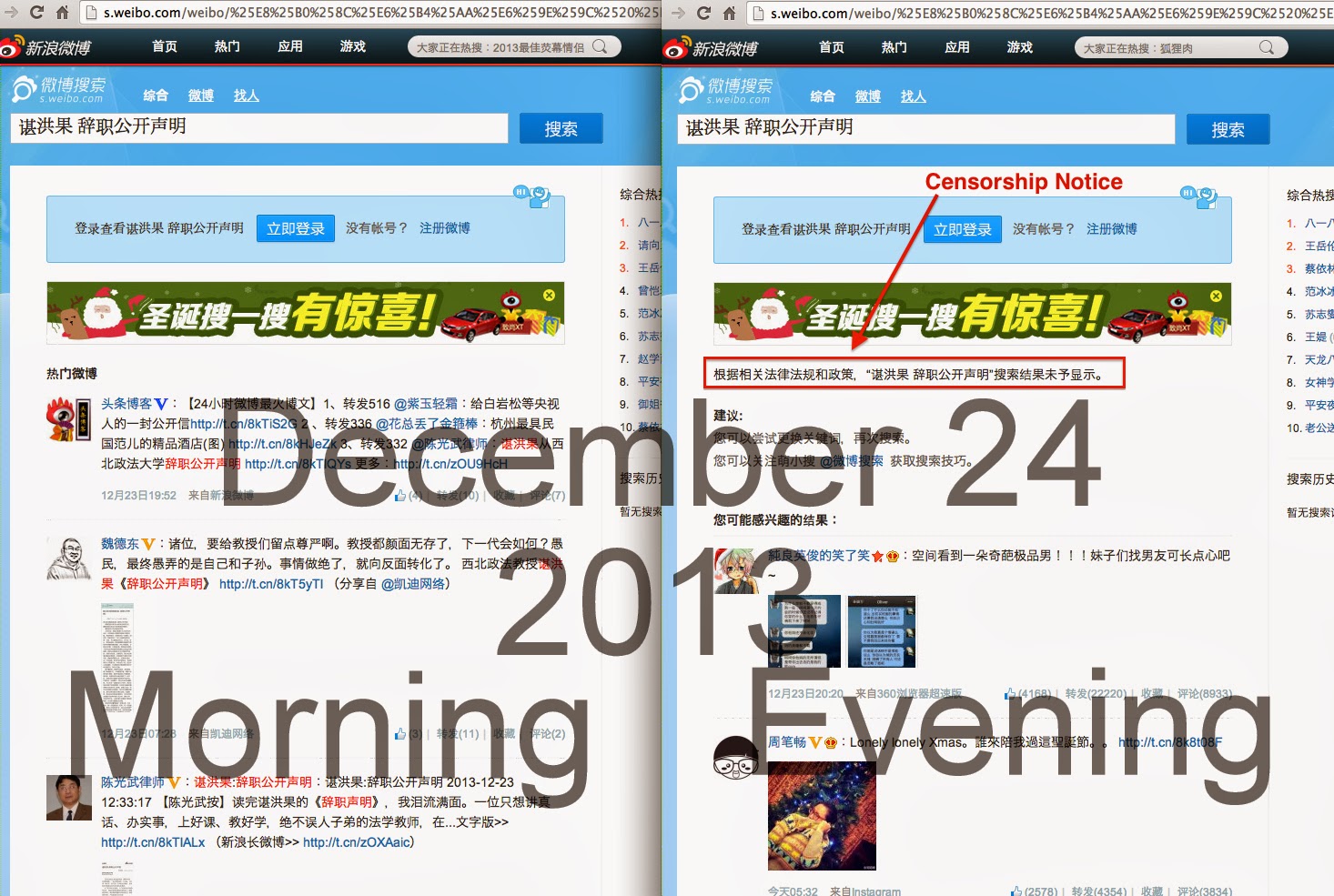
At 10:15 am on December 23, 2013, Chen Hongguo (谌洪果), an associate professor of law at Northwest University of Politics and Law in Shaanxi Province, posted the following announcement on his Sina Weibo:
This morning I have submitted my resignation letter to the school. I now publish this “Open Announcement of Resignation.” Let us be calm and rational, and exercise our rights appropriately as ordinary citizens.
今天早上我已经向学校提交了辞职申请。现在此发布《辞职公开声明》。让我们做温和理性、善待权利的普通公民。
His post included an image of his Public Announcement of Resignation.

These screenshots show that within hours his post was deleted.


Later that evening Chen posted this:
Explanation: Although my resignation announcement was deleted, I will nevertheless remain rational, respectful, and well-intended. Things are difficult for me, but I will go on loving. Taking things as they come, for the sake of my family’s happiness.
说明:我的辞职声明虽然被删了。但我会一如既往保持理性、尊重和善意。我自己很艰难,但我会继续爱。走一步看一步吧,为了家的幸福。
On January 27, 2014, the state-sponsored Global Times published an editorial entitled “Renegade Scholars.” An excerpt:
Chen has tried to invite prominent scholars to give lectures to his students but ran into difficulty with the school authorities. In 2012, Chen started organizing a book club among students called Citizens for Self-governance and Cooperation, to read and discuss works such as On Liberty by John Stuart Mill, and Science as a Vocation by Max Weber, among others. The school ordered Chen to shut it down, but Chen's teaching position remained intact.

The fracas escalated when the school tried to stop him from attending an academic conference in Hong Kong. Chen went anyway, and when he came back, his exit-entry permit was revoked. He tried applying for a new one but the school stalled the process, Chen wrote on his Weibo.
. . . .
The main reason for his resignation was that he felt that space for academic exchanges and teaching was getting narrower, Chen wrote in the public letter.
These screenshots show that, the day after Chen posted his resignation letter, Sina Weibo began censoring “Chen Hongguo Open Announcement of Resignation” (谌洪果 辞职公开声明).


These screenshots show that the text of Chen’s announcement was also removed from his Sina blog.

Thursday, February 20, 2014

Qihoo and Sina Weibo Censor Searches Related to Report on Offshore Holdings of China's Elite

As noted previously by this blog, on January 21, 2014, the International Consortium of Investigative Journalists published an article on its web site entitled “Leaked Records Reveal Offshore Holdings of China’s Elite” (机密文件披露中国精英的海外资产). Some excerpts:
Close relatives of China’s top leaders have held secretive offshore companies in tax havens that helped shroud the Communist elite’s wealth, a leaked cache of documents reveals.

The confidential files include details of a real estate company co-owned by current President Xi Jinping’s brother-in-law and British Virgin Islands companies set up by former Premier Wen Jiabao’s son and also by his son-in-law.

美国一家独立新闻组织取得的机密档案和资料库显示,中国高层领导的近亲在加勒比海避税天堂持有隐秘的离岸公司,有助中共精英在海外隐藏巨额财富。

这些文件包括国家主席习近平的姐夫在海外与他人合伙的地产公司注册资料,以及前国务院总理温家宝的儿子、女婿注册的BVI(英属维尔京群岛)公司。
These screenshots show that a post on Sina Weibo showing an image with a list of Chinese people’s who names were mentioned in the report was blocked.

 These screenshots show that shortly after the publication of the report, Sina Weibo began censoring the following terms:
  • ICIJ
  • China Offshore Finance Secrets Leaked (中国离岸金融解密).
  • China’s Secret Offshore Tax Havens (中国秘密离岸避税港).


These screenshots show that shortly after the publication of the report, Qihoo began censoring search results for “China Offshore Finance Secrets Leaked” (中国秘密离岸避税港).


See also: Watch Website of International Consortium of Investigative Journalists Disappear From Baidu 

Tuesday, February 18, 2014

Watch Website of International Consortium of Investigative Journalists Disappear From Baidu

On January 21, 2014, the International Consortium of Investigative Journalists published an article on its web site entitled “Leaked Records Reveal Offshore Holdings of China’s Elite” (机密文件披露中国精英的海外资产). Some excerpts:
Close relatives of China’s top leaders have held secretive offshore companies in tax havens that helped shroud the Communist elite’s wealth, a leaked cache of documents reveals.

The confidential files include details of a real estate company co-owned by current President Xi Jinping’s brother-in-law and British Virgin Islands companies set up by former Premier Wen Jiabao’s son and also by his son-in-law.

美国一家独立新闻组织取得的机密档案和资料库显示,中国高层领导的近亲在加勒比海避税天堂持有隐秘的离岸公司,有助中共精英在海外隐藏巨额财富。

这些文件包括国家主席习近平的姐夫在海外与他人合伙的地产公司注册资料,以及前国务院总理温家宝的儿子、女婿注册的BVI(英属维尔京群岛)公司。
These screenshots show that, in the days following the report’s release, the ICIJ’s web site, www.icij.org, disappeared from Baidu’s search results.


The ICIJ’s files were published at http://offshoreleaks.icij.org. These screenshots show that on January 25, the last link to that site disappeared from Baidu.

Translation: Sun Daluo's Court Judgment for Sharing Books and Articles

The PRC government sentenced Sun Zhiming (孙志明, who wrote under the alias Sun Daluo (孙大骆)) to one year imprisonment for the crime of "di...