Thursday, August 22, 2013

Baidu and Sina Weibo Censorship on Day One of Bo Xilai's Trial

On August 22, 2013, China's official news service Xinhua published an article entitled "Bo Xilai Stands Trial for Bribery, Embezzlement, Abuse of Power." An excerpt:
Bo Xilai, former Communist Party of China chief of Chongqing Municipality, stood open trial Thursday on charges of taking bribes, embezzlement and abuse of power at the Jinan Intermediate People's Court in east China's Shandong Province. 
The trial started at 8:43 a.m. The official microblog account of the court will update the trial proceedings.
These screenshots were taken on August 22, and show that Baidu and Sina Weibo were apparently not censoring searches for "Bo Xilai."


These screenshots also show, however, that Sina Weibo was censoring searches for "Cherish the Memory of Bo Xilai" (怀念 薄熙来) and "Support Bo Xilai" (拥护 薄熙来), both Sina Weibo and Baidu were censoring searches for "Chongqing Model" (重庆模式), and Baidu had banned users from opening a PostBar (Tieba 贴吧) forum on "Bo Xilai," and a search for "Bo Xilai" on Baidu's Knowledge (Zhidao 知道) product returned no results.


Wednesday, August 21, 2013

Communist Party Magazine: "China Could Not Endure the Consequences of Losing Control of Public Opinion"

On August 16, 2013, the Chinese Communist Party's flagship magazine, Seeking Truth, published an editorial entitled "Take Up the Cause of Insisting on a Marxist Approach to News" (自觉坚持马克思主义新闻观). Some excerpts:

Why is it not possible for China to implement a Western news system? The answer is very simple: China is a socialist country, and its political and economic systems are completely different from the West. So how could its news system be the same?
. . . .
One major aspect of Western criticisms of China's news system is that China has no independent media.
. . . .
Westerners often say that, when the media is owned by the State, there is a power monopoly. As we see it, when the private sector operates the media, there can only be a capital monopoly, a money monopoly. Socialist countries will not permit the news media to be privatized, and this is a fundamental difference with capitalist news system. In China, each political Party, civic organization, and social group operates a separate news organization, and is integrated with a readership of a specific scope, and together they serve the people and socialism, dividing the work, cooperating, competing, and broadly reflecting every aspect of social discourse. . . . The Party will never allow itself to become a representative of some interest group, will never allow itself to become a representative of some minority, will never allow it to have its own special interests. Therefore, for the Party to manage the media is in the best interests of safeguarding the interests of the country and the people.
. . . .
Perhaps the degree of freedom enjoyed by China's traditional media is slightly less than that enjoyed by the media in developed Western countries, in particular the reporting by the Party's newspapers, magazines, radio, and television outlets. But the reason for this has nothing to do with the concept of news or the news system, but rather with issues facing the nation at this stage of its development.
. . . .
The security and stability risks facing China clearly more numerous and significant than those facing the United States. The past 30 years of opening and development have created a miracle of historic proportions, but the process of rapid social change and transformation has also led to the accumulation of a large amount of social contradictions and problems, and these contradictions and problems have become increasingly pronounced in recent years.
. . . .
At its current stage, China could not endure the consequences of losing control over public opinion. . . . The overall quality of government agency administration and the ranks of Party officials is not high enough, and they are finding it very difficult to adapt to the challenges posed by excessively open public opinion. Excessively critical public opinion will damage popular trust in government and jeopardize government administration. Enemy forces at home and abroad are wreaking havoc in China, and there has been no change in the schemes to Westernize and divide China. Given this situation, if left alone to become excessively open, public opinion will inevitably bring about dire consequences.
. . . .
Why should our media focus on positive propaganda? Because pro-active and positive matters represent what is mainstream in our society, and passive and negative things are the tributaries. Only by insisting on positive propaganda do we truly reflect our society's basic character and show a complete picture. This is our approach to news, and it is an approach that seeks truth from the facts.
. . . .
Without the mainstream media's unrelenting positive propaganda, our society would not be able to preserve its stability.

自觉坚持马克思主义新闻观

中国为什么不能实行西方的新闻体制?答案其实很简单:中国是社会主义国家,政治制度、经济制度都和西方不同,新闻体制又怎么会一样?
. . . .
西方批评中国的新闻体制,很重要的一点就是批评中国没有独立媒体。
. . . .
西方人常说,媒体属于国家所有,就是权力垄断;在我们看来,私人办媒体,只能是资本垄断、金钱垄断。社会主义国家不会允许新闻媒体私有化,这是与资本主义新闻体制的根本区别。在我们国家,各个政党、人民团体和其他社会组织举办不同的新闻机构,各自联系一定范围的群众,既有分工,又有合作,也有竞争,广泛反映各方面社会舆论,共同为人民服务、为社会主义服务。. . . .党不允许成为某些利益集团的代表,不允许成为少数人的代表,不允许有自己的特殊利益。所以,党管媒体更有利于媒体维护国家和人民利益。
. . . .
也许,现在中国的传统媒体,主要是党报党刊、电台电视台报道的自由度,要比西方发达国家媒体的自由度小一些。造成这种状况的原因,并不在于新闻理念、新闻体制,而在于国家所处的发展阶段和所面临的问题。
. . . .
中国面临的安全、稳定方面的风险显然要比美国多、比美国大。中国30多年的改革开放,在创造了世界发展史上奇迹的同时,也经历了急剧的社会变革和转型,积累了大量社会矛盾和问题,这些矛盾和问题近年来正集中地凸现出来。
. . . .
现阶段的中国,承受不了舆论失控的后果。. . . . 各级政府机关的管理水平和干部队伍的整体素质还不高,很难适应舆论过度开放带来的挑战,舆论的过度批评会损害政府威信、妨害政府施政;境内外敌对势力搞乱中国、西化分化中国的图谋始终没有改变。在这样的情况下,如果放任舆论环境过度开放,将不可避免地带来严重后果。
. . . .
为什么我们的媒体要以正面宣传为主?那是因为,积极、正面的事物是我们社会的主流,消极、负面的东西是支流,坚持正面宣传为主才能真实反映我们这个社会的本质和全貌。这就是我们的新闻观,是一种实事求是的新闻观。
. . . .
没有主流媒体坚持不懈的正面宣传,我国社会大局不可能保持稳定。

Sunday, August 18, 2013

Global Times and Xinhua Report Porn Movie As Video of an Actual US Prison Execution

In July 2013, the Beijing-based Xilu Net (西陆网 - ) web site published a series images from a video under the title "Record of American Female Prisoner Executed by Lethal Injection: Her Corpse is Almost Raped Post Mortem." (美国女囚注射死刑实录:死后差点被奸尸) According to Xilu:
Mike is a medic at an American prison, its exact address cannot be disclosed because it is classified. I'd say he's a doctor, but in fact he's also responsible for additional duties.
马克,美国一座监狱的医疗人员,具体地址不便透露,因为这是机密,我说是医生,其实也负责某些额外工作。
Original URL: http://pic.xilu.com/zutu/201307/50176789/50176789_297958.html

On August 1, the Communist Party Youth League's Guang Ming Net (光明网) published the same series of images (with the Xilu watermark) on its web site, this time under the title "Record of Female Prisoner's Execution Shows This World's Darkest Side" (女囚死刑实录 揭世界最黑暗一面)

Original URL: http://it.gmw.cn/2013-08/01/content_8478339_38.htm

On August 3, the Global Times (published by the Communist Party mouthpiece the People's Daily), published the same series of images (with the Xilu watermark as well as a Baidu PostBar (Tieba 贴吧) watermark) on its web site with the same title used by Guang Ming Net.

Original URL: http://look.huanqiu.com/photo/2013-08/2703191_40.html

On August 6, China's official news agency Xinhua and the State Council Information Office's China.com.cn both published the same series of images (again with the Xilu and Baidu PostBar watermarks) on their web sites, again with the same title as Guang Ming Net.

Original URLs:
The State Council Information Office's web site added the following context:
The criminal is a very young woman, and is somewhat South American in appearance. Its said her name is Annie, a drug trafficker. Ah, she couldn't live the good life, but why seek out death, I stick out a hand and look at her coldly, today her sentence will be carried out . . . .
犯人是个很年轻的女孩,长的有些南美人的样子,据说是叫安妮,贩毒罪名,哎……好好的日子不过,为什么要寻死呢,我插着手冷冷看着她,今天就是她的行刑日……
On August 6, the Out of My Face Blog noted:
I have since identified the source of these images on a site specializing in rape themed pornography: http://xxxrape.net/necro/523-lethal-injection.html 
After Out of My Face reported this, China's state-run media outlets deleted the story and images from their web sites.

Saturday, August 17, 2013

China's Weibos, News Sites, and Search Engines Censor Story About Shanghai Judge's Alleged Corruption

Excerpt from complaint
from 70 of Cui Yadong's
former subordinates.
On August 9, 2013, the state-sponsored China Daily published an article entitled "Shanghai Judges Sacked Over Prostitution Scandal." Some excerpts:
The municipal legislature of Shanghai decided on Thursday to sack four senior judges from the city's higher court over their alleged hiring of prostitutes at a nightclub. 
Chen Xueming, was sacked by the Standing Committee of Shanghai Municipal People's Congress, from his posts as a member of the Shanghai Municipal Higher People's Court's judicial committee, chief of No 1 civil court and judge. 
Zhao Minghua was dismissed from his posts as deputy chief of the No 1 civil court and judge. Ni Zhengwen was fired from his post as judge of the higher court. 
The legislative session also approved the removal of Wang Guojun from his posts as deputy chief of the higher court's No 5 civil court and judge. 
The four had all served the city's higher court. They were placed under official scrutiny after a netizen released video footage that appears to show them soliciting prostitutes at the Hengshan Resort in Shanghai on the night of June 9. 
Investigators found the four, along with a manager at a state-owned company in Shanghai, spent a night in the resort's nightclub where they allegedly hired prostitutes.
. . . .
Cui Yadong, acting president of the municipal higher court, urged that lessons be learned from the scandal and called for "zero tolerance" toward any undiscipline or law violations.
That same day the state-sponsored Guangming Daily quoted Cui as saying:
Right now the Chinese Communist Party is launching an extensive mass line educational campaign to concentrate on and address the "four winds" issue, and for this incident to come out at this time is having a severely negative impact on the what the Party and the government is trying to accomplish. It has also provided an opportunity for foreign enemy forces to attack the Party, the government, the socialist system of justice, and Shanghai's Party cadres.
当前,中国共产党正在深入开展党的群众路线教育实践活动,集中整治“四风”问题,这一事件发生在此期间,对党的事业和国家法治建设造成了巨大影响和损害,也给境内外敌对势力借机攻击党和政府、攻击社会主义司法制度、攻击上海党政干部队伍提供了可乘之机。
On August 16, 2013, China's largest state-sponsored media outlets, including Xinhua, the China Daily, and the People's Daily, published reports with titles such as "Shanghai High Court Judge Reported for Corruption, Stole Six Tons of Mautai a Year" (上海高院代院长被举报贪腐 每年偷拿6吨茅台) and "70 Step Forward to Report Cui Yadong Shows Difficulties in Calming Public Wrath" (崔亚东遭“70名下属实名举报”是众怒难平). Here's an excerpt from one of the reports:
Cui Yadong, the Shanghai Higher Court's acting President and Party Secretary who caused an uproar with his talk of "hostile forces" during Shanghai's "Judges Group Whoring," is now the subject of accusations of corruption by 70 subordinates from his time in Guizhou's Public Security Office. The 16 accusations include claims catering to the interests of property developers, building a 1,442 ping villa in the sky, and every year appropriating six tons of Maotai, truly shocking.
上海“法官集体嫖娼”中,因“敌对势力”言论引起哗然的上海高院党组书记、代院长崔亚东“后院”起火——他在贵州省公安厅任职时的70名下属,实名举报其贪腐。所列16项内容,包括对开发商重大利益输送、建成面积达1442平方米空中别墅、每年偷拿6吨茅台酒等,触目惊心。
These screenshots show that the article had been deleted by the following morning.

Original URLs:
These screenshots were taken on August 17, and show that both Sina Weibo and Tencent Weibo were censoring searches for "Cui Yadong."

Sina Weibo was also censoring searches for "Shanghai High Court." (上海高院)

These screenshots show that China's major search engines were censoring searches for "Cui Yadong Reported."
Baidu censors "Cui Yadong Report," but not
"Cui Yadong" or "Report." 

These screenshots show that on August 17 Baidu shut down its Cui Yadong PostBar (Tieba 贴吧) forum and deleted posts associated with the corruption allegations.


Wednesday, August 14, 2013

China's Weibos, News Sites Censor Report on Group Suicide Attempt in Beijing

On August 14, 2013, the English web site of the state-sponsored China Radio International published an article entitled "Group Suicidal Attempt Fails in Beijing." Some excerpts:
More than ten people failed in their attempt to commit suicide together by drinking pesticide in Beijing on Tuesday, thanks to the arrival of police and medical personnel.
The incident occurred at about 11 a.m. in a busy street near Beijing West Railway Station.
. . . .
Reporters from Beijing Youth also found that several patients were wearing T-shirts bearing the Harbin Railway Bureau logo.
On August 14, CRI's Chinese language web site also published an article on the matter entitled "A Mass Suicide Takes Place in Beijing, Over Ten People Drink Pesticide and Collapse on the Sidewalk" (北京发生一起群体自杀事件 十余人喝农药倒路边) here - http://gb.cri.cn/42071/2013/08/14/5892s4217309.htm. But as these screenshots show, that article was deleted within hours.

The original Chinese language report appeared on the state-sponsored Beijing Youth web site here - http://bjyouth.ynet.com/3.1/1308/14/8203182.html on the morning of August 14. As these screenshots show, it was also deleted the same day.
The story was also deleted from other web sites where it was reposted:


These screenshots, taken on August 14, show that Sina Weibo was censoring "Suicide Pesticide," but not "Suicide" or "Pesticide."

These screenshots, taken on August 14, show that Sina Weibo was censoring "A Mass Suicide Takes Place in Beijing," but not "A Mass Takes Place in Beijing" or "A Mass Suicide Takes Place."
The story can still be found at the following links:


Caijing also has photos from the hospital available here - http://photos.caijing.com.cn/2013-08-14/113169114.html

Thursday, August 8, 2013

Global Times Deletes Article About Censorship of Social Media

Last week this blog noted that the state-sponsored Global Times had published an article entitled "Hackers, Bloggers and Professors Team Up to Tap into Blocked Microblog Content." Some excerpts:
From the list of blocked keywords provided on the website, it is also clear when some words become sensitive and when such scrutiny is lifted.
For instance, the name of Bo Xilai, former Party chief of Chongqing who was recently prosecuted on corruption charges, was banned from searches until July 25, the day the news of his prosecution was announced.
. . . .
China's regulation on Internet information lists nine types of banned content, most of which concerns national security, state unity, rumors, pornography and violence. But in practice it isn't always clear where the line is and in the event of a breaking incident, certain words or phrases that are otherwise normal might become sensitive for a period of time.
Data provided by Greatfire has been used by other researchers to get to grips with Internet restrictions. In May, for instance, two professors from Northwestern University in the US used its data to study how the GFW affects users' online behavior.
That article, which was originally available here - http://www.globaltimes.cn/content/799621.shtml - has been deleted. The following video shows what happens when a user tried to access the article on August 2.

The Global Times has been known to repost deleted articles, so perhaps this one will return as well.

Monday, August 5, 2013

Searching for Information About Milk Powder Safety on China's Web Sites: From Sanlu to Yili to Fonterra

On August 5, 2013, China.org.cn, a web site operated by the Chinese government's State Council Information Office, published an op-ed entitled "New Zealand Needs to Start Building Trust in the Long-Term." Some excerpts:
But with yet another trade imbroglio, this one Fonterra's botulism scare, surely it's time to ask the New Zealand government: "Where's the quality control?" 
Fonterra might have come away with some credit had it moved quickly to isolate the affected produce and implement a recall, but when such a problem takes more than a year to come to light, it's elevated from an industry event to a national issue.
. . . .
While it's true the government isn't responsible for the contamination of Fonterra produce, it should be held accountable for the fact that nothing was done to identify the problem before it was dispatched to export markets and domestic customers.
This screenshot was taken on August 5, 2013, and shows that a search for "Fonterra Botulism" (恒天然 肉毒杆菌) returned over 170,000 results.

Yili Milk Powder


On June 15, 2012, the state sponsored Global Times reported:
Dairy producer Mongolia Yili Industrial Group Co said yesterday that it has started recalling most of its Quanyou series formula milk powder produced from November 2011 to May 2012 since Wednesday, due to excessive mercury content which is harmful to the nervous system.
The screenshots, taken the same day, show that while searches on Sina Weibo returned results for "Yili" (伊利) and "Milk powder" (奶粉), searches for "Yili milk powder" (伊利 奶粉) and "Yili mercury" (伊利 汞) returned no results, just a censorship notice.

Sanlu Milk Powder and Li Changjiang


On December 28, 2009, the state-sponsored China Daily published an article entitled "Tainted Milk Official in New Role." Some excerpts:
A government minister who lost his job over last year's tainted baby formula scandal has been appointed deputy head of a department leading China's war on porn. 
Li Changjiang, 65, former head of the top quality agency, is now vice-director of the National Office Against Pornographic and Illegal Publications.
. . . .
Li resigned as minister of the General Administration of Quality Supervision, Inspection and Quarantine days after the Sanlu milk scandal was exposed last September. 
The State Council had made a statement that the quality administration had to bear "supervision responsibility for the milk food contamination". 
The tainted formula killed six children and led to more than 300,000 more suffering urinary tract problems, such as kidney stones.
These screenshots were taken in December 2009, and show that searches on Baidu and Youdao for "Poison Milk Official Who Stepped Down Li Changjiang Reinstated" (毒奶粉下马的李长江复职) returned no results, just a censorship notice.

Zhao Lianhai and Kidney Stone Babies

In 2010, Zhao Lianhai (赵连海) was sentenced to 2½ years imprisonment for "disturbing social order" after he started the "Home for Kidney Stone Babies" (结石宝宝之家, jieshibaobao.com) web site and attempted to lead parents in getting restitution and treatment for their children who had been poisoned by Sanlu's melamine-tainted milk powder.

These screenshots were taken in November 2010, and show that the state-sponsored newspaper Southern Weekend posted, and then deleted, an article entitled "Kidney Stone Baby Father Zhao Lianhai's Lawyer is Dismissed" (结石宝宝父亲赵连海律师被解除委托).

This screenshot was also taken in November, 2010, and shows that Baidu was restricting search results for "Zhao Lianhai" to a white list of about a dozen web sites controlled by the central government and the Communist Party.

On November 2, 2011, China's state-run media reported that a Beijing court had ordered Hudong (互动) CEO Pan Haidong (潘海东) to pay 120,000 yuan in compensation and publish 30 days' of apologies to Baidu for making defamatory statements including: "Baidu once took 3,000,000 yuan to help the Sanlu Group block negative information about the Sanlu melamine poisoned milk powder incident" (百度曾帮助三鹿集团屏蔽三聚氰胺毒奶粉事件的负面消息并借此挣了300万). According to the report:
This court's decision not only held that Pan Haidong should be held responsible as a public figure for spreading malicious rumors, it also washed Baidu clean of the misrepresentations and misunderstandings it had suffered from some Internet users who did not know the facts. 
此没有事实依据的言论被法庭认定判定为“已构成用侮辱及诽谤方式侵害百度公司名誉权的侵权行为”。此次法庭的判决,一方面追查了潘海东作为公众人物恶意传谣应负的责任,一方面也洗清了百度在此问题上曾经遭受一些不明真相网友的误传和误解。
Zhao continued to campaign after his release, and in January 2012 he tried to launch a poll on Sina Weibo asking people whether they supported Sina's censorship of the phrase "Kidney Stone Babies." Here's a translation of his poll:
Do You Support Sina Weibo Blocking Keywords Related to "Kidney Stone Babies"?
Participants: 438
According to Baidu's Baike Entry on Kidney Stone Babies:
"Kidney Stone Babies" (结石宝宝) refers to those infants who became ill with "twin recurring kidney stones" and "urethra kidney stones" as a result of ingesting infant formula containing melamine from Sanlu and other brands. This was a phrase that arose after China's 2008 Sanlu Milk Powder Incident, and expressed the concern and pity people had for these children.
However, in the years following the Kidney Stone Babies incident, all information about assisting Kidney Stone Babies published on Sina Weibo has been completely blocked by Sina Weibo. So I want to ask: What law does the phrase Kidney Stone Babies actually violate? What regulation does it violate? As a large media broadcasting company, Sina is not only not helping Kidney Stone Babies, on the contrary, it is for a long time blocked searches relating to Kidney Stone Babies. Their behavior flies in the face of the bottom line for social morality. I demand that Sina must stop blocking the phrase Kidney Stone Babies and Apologize!
Sina Must Stop Blocking the Phrase Kidney Stone Babies and Apologise: 437 (100%)
Support Sina's Censorship: 1 (0%).
This screenshot was taken on the same day Zhao launched his poll, and shows that a search on Sina Weibo for "Kidney Stone Babies" returned no results, just a censorship notice.


These screenshots show that, within hours after Zhao launched the poll, Sina deleted it.

Here's Zhao's Weibo posts about the censorship:
9:36 pm Its really weird: Sina sent me a system notice clearly saying: "Your poll 'Do You Support Sina Blocking Phrases Relating to Kidney Stone Babies?' has been deleted." But when I look now its still possible to vote at this address http://t.cn/Sa5Ar7, and there are currently 413 people who have voted for "Sina Must Stop Blocking the Phrase Kidney Stone Babies and Apologise"!
好奇怪:新浪发来的系统通知明明说“你支持新浪微博屏蔽结石宝宝相关词条吗?”这个投票被删除,但发现目前还可以投票呢,投票地址:http://t.cn/Sa5Ar7 目前投给“新浪必须解除所有结石宝宝词条屏蔽并道歉”这一项的已达到413人! 
9:59 pm Damn! The Sina Poll has been completely deleted http://t.cn/Sa5Ar7. The last time I checked there were over 455 vote for "Sina Must Stop Blocking the Phrase Kidney Stone Babies and Apologize," and the number of voters was growing rapidly, with only one vote for "Support Sina's Censorship." Its really gratifying to see those supporters in just four hours. Censors - we will not forget!
他娘的!新浪那个投票还是被彻底删除了 http://t.cn/Sa5Ar7 ,最后我看到的投票数字是455投给“新浪必须解除所有结石宝宝词条屏蔽并道歉”这一项,并且投票速度逐渐在加快,只有1票投给“支持新浪屏蔽”。短短4个小时看到的支持让人欣慰!删吧,咱先记上!
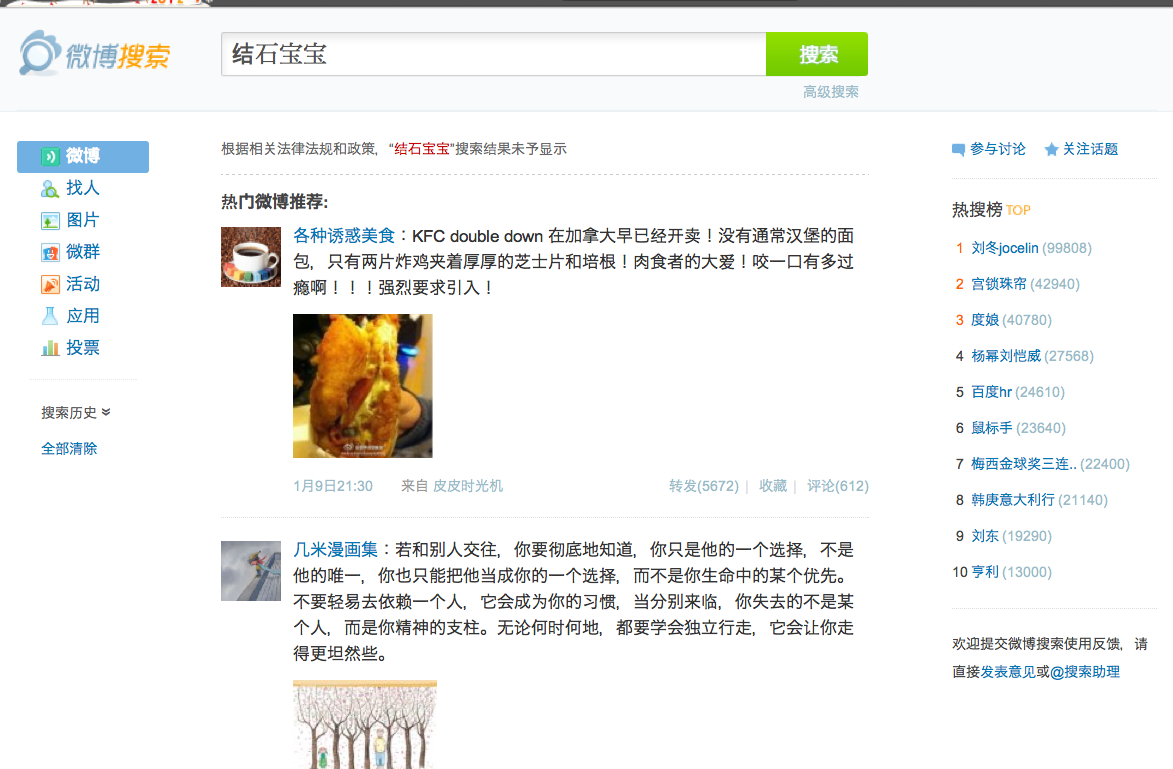
These screenshots were taken on August 5, 2013, and show that Sina Weibo was not censoring search results for "Zhao Lianhai" or "Kidney Stone Babies.

These screenshots were taken the same day, and show that Baidu was still banning users from creating PostBar (Tieba 贴吧) forums about "Zhao Lianhai" and "Kidney Stone Babies."

Translation: Sun Daluo's Court Judgment for Sharing Books and Articles

The PRC government sentenced Sun Zhiming (孙志明, who wrote under the alias Sun Daluo (孙大骆)) to one year imprisonment for the crime of "di...