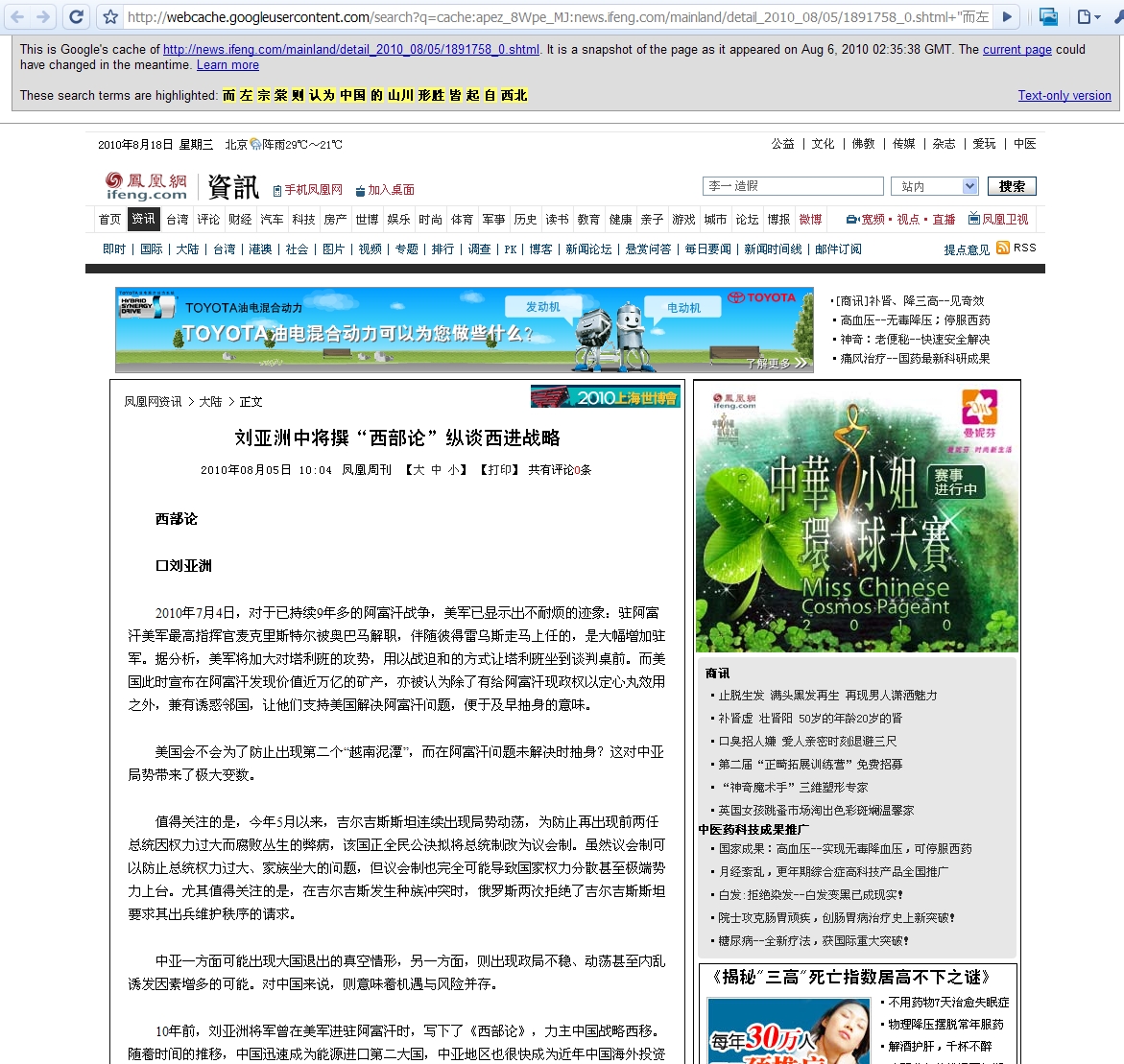
Between April 9 and 11, 2022, an article titled "Epidemic Prevention Strategies to Minimize Loss of Life" (生命损失最小化的防疫策略) by Liang Jianzhang (梁建章) was deleted from the following PRC-based news outlets: Caixin, Phoenix, and Sina:


Liang originally posted the article on his Tencent Weixin account on April 8, 2022 at https://mp.weixin.qq.com/s/LdaMgSMrY2YcqZ5w3jaIhA. As of April 11, however, that essay had been replaced with a notice reading: "Upon Receipt of Relevant Complaints, This Content Violates the 'Administrative Provisions on Internet User Public Account Information Services'" (接相关投诉,此内容违反《互联网用户公众账号信息服务管理规定》). The original post is archived at https://web.archive.org/web/20220409095426/https://mp.weixin.qq.com/s/LdaMgSMrY2YcqZ5w3jaIhA

Below is a machine translation of Liang's censored essay.
Epidemic Prevention Strategies to Minimize Loss of Life
2022-04-08 10:36
It has been more than two years in the fight against the epidemic. Under the guidance of the concept of life comes first, the government resolutely implemented policies such as the lockdown of Wuhan in the early stages of the epidemic, which reduced the number of infections and deaths to a minimum in a short period of time, and achieved world-renowned epidemic prevention achievements. But two years later, the virus has evolved from Alpha to Omicron. Compared with the previous strains, on the one hand, the virus has reduced toxicity and the mortality rate has dropped significantly; on the other hand, the transmissibility has been greatly enhanced, which makes our "anti-infection strategy" more expensive. This essay analyzes how to balance the benefits and costs through the impact of different epidemic prevention strategies on life expectancy, and then chooses the strategy with the least loss of life.
Two Anti-Epidemic Strategies
Infection prevention strategy: Quarantine policies are the mainstay, which includes a large number of nucleic acid tests and epidemiological investigations, as well as the closure and control of localities or even entire municipalities. The purpose is to block the infection chain and eliminate the infection to the greatest extent possible.
Death prevention strategy: Focus medical resources on treating seriously ill patients. For high mortality groups such as the elderly, vaccination is strengthened, and effective specific drugs are introduced to minimize the number of deaths.
Model diagram of epidemic prevention strategy:
The above diagram shows the logic of the model. For strains with high mortality and strong transmissibility, the anti-infection strategy is better, because the cost of infection prevention is low and the benefits are high. Conversely. For strains with low mortality and weak infectivity, the strategy of preventing death is better.
From the above model, it can be seen that the key to the selection of the best strategy is to quantitatively analyze and compare the extra cost and life loss of the "anti-infection strategy" relative to the "anti-death strategy."
1) Life loss due to infection prevention strategy = loss of life expectancy due to economic loss of isolation and containment.
This loss rises with the spread of the virus.
2) Life loss from death prevention strategies = loss of life expectancy due to death from infection.
This gain decreases as the virulence of the virus decreases.
The relationship between GDP per capita and average life expectancy
We can analyze the relationship between average life expectancy and per capita GDP by studying the historical data of various countries. It is an obvious fact: the higher the per capita income of a country, the longer its life expectancy. Because rich countries are more able and willing to invest in health care, infrastructure and environmental governance, thereby reducing mortality and increasing life expectancy.
Figure 1 Relationship between per capita GDP (USD) and average life expectancy in some countries in 2019

Source: World Bank
Note: The abscissa has been logged, and the actual per capita GDP value is marked after the name of some countries
It can be seen that the per capita income is halved, and the average life expectancy is reduced by 1-3 years; China's per capita GDP in 2010 was about 45% of that in 2020, and the life expectancy was reduced by 2.5 years.
Figure 2 The relationship between per capita GDP and average life expectancy in China's provinces

Source: World Bank, National Bureau of Statistics
Note: The abscissa has been processed by log, and the graph also shows the historical data of China and the corresponding per capita GDP
From the above figure, we can also see the relationship between per capita GDP and average life expectancy in various regions of China. The richer the province, the longer the life expectancy. In modern peacetime, there have indeed been periods (if infrequently) of sharp declines in per capita income, such as when the Soviet Union collapsed, during 1991-1993, per capita income fell by 20% and life expectancy fell by four years. So in the face of a 50% change in income, even a very conservative estimate will lead to a one-year reduction in per capita income. To put it into perspective, for every 1% decrease in per capita GDP, life expectancy will decrease by about 5 days.
Statistical Life Value
We can also test this hypothesis through the theory of Value of Statistical life in economics. In the field of economics, "statistical life value" is a relatively mature concept, which refers to how much a society is willing to spend to reduce mortality. Some people may be disgusted by this concept, thinking that there is no need to calculate the value of life, because life is supposed to be priceless. From an ethical standpoint alone, the above point of view is certainly not wrong. However, in the actual operation process, regardless of work life, business operation or social management, a balance must be pursued between reducing the risk of death and input cost. As for how to find this balance, it is necessary to calculate the "statistical life value" scientifically and rationally.
For example, companies and governments also need to balance risk and cost when providing various means of transportation and transportation infrastructure. For example, when the government designs a road, if it builds more lanes, or sets up special non-motorized lanes, or wider sidewalks, etc., it is possible to reduce the fatality rate of traffic accidents. But obviously not all roads have such a setup. Does this mean that the designer disregarded the safety of life? it's not true. As a designer, if a seemingly absolutely safe road costs 10 billion to build regardless of the cost, it is very likely that this road cannot be built at all, leaving ordinary people with nowhere to go. So for such a construction project, how much is it worth to spend to reduce the mortality rate? Here, there is also an implicit calculation of the balance of life value. In fact, economists have already calculated the value of life in an economic sense based on data from various countries. Chinese scholars have also done some research on this [1] [2], and concluded that the value of China's vital statistics is generally in the range of 1 million to 7.2 million, and we will temporarily take the value of 5 million.
The Cost of Infection Prevention Strategies
Assuming that the economic loss of 1% of GDP due to large-scale isolation and control, then it is one trillion. According to the calculation of "statistical life value" of 5 million, it may increase the risk of accidental death by 200,000 (persons). If the average life expectancy is reduced by 20,000 days per accidental death, 200,000 people will be 4 billion days, and overall, the average life expectancy in China will be reduced by about 3 days. The calculation of this loss of life expectancy does not take into account the impact of secondary deaths on life expectancy caused by the lack of timely treatment of other diseases due to the occupation of a large number of medical resources by tasks such as nucleic acid testing.
Therefore, combining the previous two methods of calculating the cost of life, a loss of 1% of GDP will reduce the average life expectancy by 3-5 days, which is the cost of isolation and containment required by the infection prevention strategy.
The next question is, how much GDP will Omicron cause? This is of course difficult to calculate, but we have a preliminary analysis, that is, the stronger the transmissibility, the stricter the closure and control measures will inevitably be, and the greater the loss of GDP will be. The strength of transmissibility can be expressed by R0 (basic infection number), and the value of R0 is simply understood as "one person gets sick, how many other people he can infect". The initial Alpha is R0=2-4 (the R0 of influenza is also around 2), the R0 of Delta is about 4, the transmissibility of Omicron is very strong, and the R0 is about 10, which is much stronger than any previous strains, so yes The GDP cost of its anti-infection strategy is also much higher.
In the past two years, we have adopted an anti-infection policy, which has successfully blocked Alpha and Delta, and only paid a relatively small loss of GDP as the price. However, the transmissibility of Omicron is several times that of Alpha and Delta, and a large-scale isolation is often required, so the economic loss of preventing and controlling Omicron may be far greater than 1% of GDP. For example, not long ago, Shenzhen was only closed and controlled for a week, causing a loss of 60-70 billion. According to a study by Professor Song Zheng of the Chinese University of Hong Kong [3], the closure of first-tier cities like Shanghai for one month will reduce the real GDP of the whole of China by 4%. In fact, with the increasing spread of the virus, precise epidemic prevention has become almost impossible, and the frequency of city closures has to be greatly increased. According to statistics, in the first quarter alone, Shanghai, Changchun, Harbin, Xi'an, Shenzhen, etc. have implemented or are undergoing city-wide lockdowns, and more than a dozen first- and second-tier cities have had large-scale partial lockdowns. The closure and control of these cities alone will cause a loss of more than 4% of China's GDP in the first quarter. Moreover, the overall economy is already under great downward pressure. If a large-scale lockdown is imposed for a long time, it will cause negative effects such as rising unemployment and an increase in the number of people returning to poverty. Not to mention the secondary loss of life caused by the occupation of medical resources.
After calculating the cost of the anti-infection strategy, let's calculate the relative benefit of the anti-infection strategy, that is, how many deaths and life expectancy are avoided, and then we need to estimate the fatality rate of different variants. According to a study conducted by British scholars on confirmed cases of different variants in the second half of 2021, the case fatality rate of Alpha is about 1.1% [4]; according to a study of patients infected with Omicron and Delta variant viruses in Ontario, Canada. A retrospective whole population matched cohort study [5], the Delta case fatality rate was 0.3%; according to the statistics of the 2018 influenza season published by the US CDC [6], the case fatality rate of influenza is about 0.1%. The main preliminary research and data show that Omicron is different from previous strains and generally does not invade the lungs. Therefore, the fatality rate of Omicron is much lower than that of previous strains, and may even be lower than that of influenza. We will analyze Omicron in detail later. of the fatality rate.
Influenza Prevention Strategies
We use this model to calculate epidemic prevention strategies against influenza. Since the fatality rate of influenza is about 0.1%, if it is very pessimistically estimated that 50% of the population will be infected (the actual infection rate will be much lower than 50%), it will cause a mortality rate of 5/10,000. Assuming that the average life expectancy of patients who die is 70 years (assuming that the average life expectancy of patients is 80 years), then each patient who dies will be shortened by an average of 10 years of life. Then in terms of mortality rate of 5 in 10,000, life expectancy is reduced by almost 1.8 days (10 years x 5 in 10,000). Therefore, on average, a large-scale influenza outbreak has an impact on the entire human society, equivalent to a reduction in life expectancy of about 1.8 days. For the infection prevention strategy, the gain is only 1.8 days of life lost. However, as we calculated earlier, if we adopt a large-scale infection prevention strategy, only the loss of 1% of GDP will reduce the average life expectancy by 3-5 days. Because of this, we cannot use large-scale isolation and sealing to prevent infection. control strategies to prevent influenza.
The Best Strategy for Dealing with Initial Strains of Covid-19
We can calculate the earliest mutant virus Alpha in the early stage of the epidemic. If Alpha's case fatality rate is 1%, which is about 20 times that of influenza, then the loss of life expectancy is not 1.8 days but 40 days. Then the relative benefit of the infection prevention strategy of large-scale isolation is 40 days. Far greater than the 3-5 day life cost of 1% of GDP. Therefore, for the Alpha virus, the strategy of preventing infection is better than the strategy of preventing death, and it was the right choice to decisively shut down Wuhan at the beginning.
Best Strategy Against Omicron
Let's analyze how to deal with Omicron. First of all, logically, if the fatality rate of Omicron is higher than that of Alpha, and the transmissibility is weaker than that of Alpha, then an infection prevention strategy should be adopted. Adopt a death-prevention strategy. In detail, if a large area is isolated, the resulting loss of life expectancy is: the percentage loss of GDP * (3-5) days (for simplicity, it will be calculated as 4 days later); infection prevention can avoid death and thus obtain The benefit of life expectancy is: (case fatality rate) S*10 years*50% (assuming that 50% of the whole population will eventually be infected), that is, S*3652*50% days.
Compare the life loss caused by the two strategies, that is, when the percentage loss of GDP * 4 days < S * 3652 days * 50%, the anti-infection strategy should be adopted, otherwise the anti-death strategy should be adopted.
From this, it is possible to calculate the threshold value of the fatality rate S of the death prevention strategy under the assumption of different GDP losses: when the GDP loss is 0.5%, the threshold value of S = 0.12%, that is, when the case fatality rate is less than 0.12%, the death prevention strategy should be adopted. Strategy; when GDP loses 1%, S's threshold = 0.22%; when GDP loses 2%, S's threshold = 0.44%, when GDP loses 4%, S's threshold = 0.88%. According to the current level of closure and control required for Omicron, the loss to GDP is at least 4%. It can be seen that even if the fatality rate of Omicron is slightly higher than that of influenza, because of the strong transmissibility of Omicron, the cost of preventing infection may be much higher than that of influenza, and a strategy of preventing death should be adopted. We can be sure that Omicron is much more transmissible than the flu. So what is the fatality rate of Omicron?
Omicron's Case Fatality Rate
According to research data released by Ontario, Canada, the case fatality rate of Omicron is about 0.03%. However, since European and American countries no longer require nucleic acid tests and no longer accurately count the number of infected people, the calculation of the fatality rate is not accurate. However, Asian countries are still counting the number of infected people more accurately, so we can look at the case fatality rate statistics of some Asian countries that are closer to ours.
According to reports, based on the cumulative number of deaths and positive cases from January to February 21, 2022 by the Japanese Ministry of Health and Welfare, the confirmed case fatality rate of Omicron is estimated to be 0.13% [7]. According to the Korea Centers for Disease Control and Prevention (KDCA), since December last year, the case fatality rate of the Korean Omicron variant is about 0.18% [8]. Through the data of the past two weeks, we found that the recent confirmed case fatality rate has been reduced to 0.1% [9]. According to the statistics of the case fatality rate in the past 28 days by the Ministry of Health of Singapore, this value is only 0.05% [10]. Through the data of the past two weeks, we found that the confirmed case fatality rate in Singapore in the past two weeks was only 0.03%. Similarly, according to the analysis of confirmed and fatal cases in Vietnam in the past 28 days, the case fatality rate is about 0.03% [11].
Look at Hong Kong, China. According to the epidemic data released by the Hong Kong government [12], there were 7,732 deaths in the fifth wave of the epidemic, and the cumulative number of confirmed and reported cases was 1,150,607 (2021.12.31-2022.4.1), and the calculated case fatality rate was 0.67%. However, since Hong Kong has never had a complete national nucleic acid, it is likely that there are many confirmed cases that are not included in the statistics. The Faculty of Medicine of the University of Hong Kong has calculated through a mathematical model that the actual number of infections far exceeds the official reports or statistics. This estimate has reached 4 million [13]. According to this estimate, the actual fatality rate is below 0.2%, but it is still relatively high.
Case fatality rate in some Asian countries, vaccination status of elderly people and proportion of deaths, proportion of population over 80 years old
Remarks: The vaccination rate and the proportion of deaths in the elderly are from the government websites or public information of each country/region, and the population proportion is from the United Nations database
Explanation of confirmed case fatality rate: South Korea: data from the national statistical database, data time is 2022.3.17-3.31; Singapore: data source Singapore Ministry of Health, data calculation time is 2022.3.17-3.31; Japan: data source Japan Daily News, calculation Time January-February 2022; Hong Kong, China: Data from Hong Kong Department of Health and University of Hong Kong, calculated from December 2021 to April 4, 2022; Vietnam: Data from Johns Hopkins University, calculated from March 2022 .8-4.6; Mainland China data is from the National Health Commission, and the calculation time is from January to March 2022.
It can be seen that the general mortality rate of Omicron is close to or even much lower than that of influenza, with the exception of Hong Kong, China.
Why is the Fatality Rate in Hong Kong so High?
To explain the high death rate in Hong Kong, we need to look at the age distribution of those who died. According to the figures in the third column of the above table, it is not difficult to see that the elderly are the main group of deaths. In Hong Kong, the vaccination rate of the elderly over the age of 80 is only 43%, while the vaccination rate of the elderly in other countries exceeds 90%. According to the data, both domestic vaccines and MRNA vaccines are highly effective in preventing severe illness and death. Therefore, it is not difficult to conclude that the vaccination rate of the elderly in Hong Kong is much lower than that of Singapore, which is the main reason for the high mortality rate in Hong Kong. If Hong Kong, China, can increase the vaccination rate of the elderly to the level of other countries, the case fatality rate can also be reduced to about 0.1%, which is similar to the level of influenza.
The overall vaccination rate in China is relatively high, and the full-course vaccination rate for people over 60 years old has reached 80%. China's overall proportion of 80-year-olds in the total population is only half that of Hong Kong, but the vaccination rate of the elderly over 80 is still relatively low, not reaching the level of Singapore and Japan. The case fatality rate of Omicron in China that we recently observed is already very low. In the first quarter of this year, the case fatality rate of the new coronavirus in mainland China was only 0.004%, which was an order of magnitude lower than that of Singapore. The case fatality rate in Jilin, where the epidemic was more severe, was 0.007% in the same period. Shanghai is 0 [14]. If we continue to increase the vaccination rate of the elderly, we can maintain the fatality rate of Omicron at the level of Vietnam and Singapore, which is 5/10,000, then the reduction of the cost of life expectancy from the death prevention strategy will be less than 1 day, and now it is estimated that the prevention of infection The loss of GDP caused by the strategy will exceed 4%, and the reduction in life expectancy is 16 days, which is much higher than the impact of the death prevention strategy. If the case fatality rate is maintained at 5 per 10,000 (50% infection rate), the number of deaths per year is more than 300,000. More than 3 million people die of cancer in China every year, and the five-year survival rate of cancer in China is 20% lower than that in Japan and South Korea. If we use 1% of GDP to improve the overall medical level, then cancer alone may save a lot. 600,000 people have room for improvement.
Let's review the epidemic prevention model diagram again:

Conclusion
For the current variant of the new coronavirus with high transmission rates but relatively low infection mortality rates, if a mortality prevention strategy is to be adopted, the focus should be on increasing the vaccination rate of high mortality risk groups such as the elderly over 80 years old. The domestic vaccine is also effective in preventing death. Therefore, we must increase the vaccination rate of the elderly as soon as possible. If the mortality rate continues to remain at a very low level, we should actively switch to the death prevention strategy. The anti-death strategy is not a "flattening" policy that is completely ignored, but to allow people with cold symptoms to self-isolate and test, freeing up valuable medical resources for the rescue and observation of critically ill and elderly people, so as to reduce the mortality rate. drop to lowest. Adopting different anti-epidemic strategies in the future does not mean that China's previous prevention and control was in vain. On the contrary, according to our model, the previous anti-infection and containment strategies were very correct, and they won more than two years of precious time. In the stage when the vaccination rate is still relatively low and the virus toxicity is relatively high, a large number of deaths can be avoided at a relatively small cost.
Summary
This essay established a model to analyze and compare the impact of different epidemic prevention strategies against different viruses on life expectancy. It concludes that the best strategy for epidemics such as Alpha and Delta is the anti-infection strategy. Omicron, however, is completely different from those previous strains. The mortality rate of Omicron is much lower and the transmissibility is much stronger, resulting in a substantial increase in the cost of the anti-infection strategy. According to the Omicron case fatality rate statistics in most countries and regions, if the Omicron case fatality rate is close to that of influenza, the life cost of the death prevention strategy is lower. The high mortality rate in Hong Kong is likely due to the low vaccine penetration rate among the elderly. Whether the strategy of the future is to prevent infection or prevent death depends on when we can achieve universal vaccination rates for the elderly.
We believe that as long as we adhere to the concept of people first and life comes first, take into account the life and work order of the people, adopt optimal epidemic prevention strategies scientifically and rationally, and efficiently allocate medical resources and social resources to deal with various diseases including Omicron , the overall loss of life can be minimized.
[2] ZhaoYang,PanLiu,XinXu: Estimation of social value of statistical life using willingness-to-pay method in Nanjing, China
[3] Jingjing Chen, Wei Chen, Ernest Liu, Jie Luo, and Zheng (Michael) Song:The Economic Cost of Lockdown in China: Evidence from City-to-City Truck Flows.
https://www.econ.cuhk.edu.hk/econ/images/Documents/Truck_Flow_and_COVID19_220315.pdf
[4]medRxiv:
https://www.medrxiv.org/content/10.1101/2022.03.05.22271084v1.full#F1
[5]The Journal of the American Medical Association:
https://jamanetwork.com/journals/jama/fullarticle/2789408#:~:text=There%20were%2053%20hospitalizations%20(0.6,%25)%20among%20matched%20Delta%20cases
[6]Centers for Disease Control and Prevention:
https://www.cdc.gov/flu/about/burden/2018-2019.html
[7]日本厚生劳动省:https://covid19.mhlw.go.jp/en/
[8]https://www.reuters.com/world/asia-pacific/skorea-says-omicron-covid-variant-75-less-likely-kill-than-delta-strain-2022-02-22/
[9]韩国统计厅:https://kosis.kr/covid_eng/covid_index.do
[10]新加坡卫生部:https://www.moh.gov.sg/covid-19/statistics
[11]约翰霍普金斯大学:
[12]衞生署衞生防護中心和醫院管理局:
https://www.coronavirus.gov.hk/pdf/5th_wave_statistics/5th_wave_statistics_20220401.pdf
[13]香港大学医学院孔繁毅等:
http://www.med.hku.hk/en/news/press//-/media/HKU-Med-Fac/News/slides/20220314-sims_wave_5_omicron_2022_03_14_final.ashx
[14]国家卫生健康委员会:http://www.nhc.gov.cn/