Showing posts with label Academia. Show all posts

Tuesday, September 12, 2023

Science with PRC Characteristics: CAS Academics Must "Toe Party Line"

 On September 6, 2023, the state sponsored media outlet Caixin published an article titled "China’s Top Academics Told to Toe Party Line With Public Statements." https://www.caixinglobal.com/2023-09-06/chinas-top-academics-told-to-toe-party-line-with-public-statements-102101001.html

Some excerpts:

China’s top science academy has updated its code of conduct with new rules that require members ensure their public statements are “in line with the general policy of the Central Committee of the Communist Party of China” and prohibit openly expressing academic views unrelated to their field of expertise.

The Chinese Academy of Sciences (CAS) code of conduct, which consists of 33 articles in six chapters, is an update of a version released nine years ago.
. . . .
Compared to the 2014 version, the latest code adds a chapter that specifies what CAS scientists are prohibited from doing.
Specifically, the new version the Chinese Academy of Sciences Code of Conduct (中国科学院院士行为规范(试行)) contains the following provisions:

Article 2: Abide by the Constitution, laws and regulations, improve political standing, enhance awareness of responsibility, respect moral integrity, model love of the Party and love of country, and be an example for scientific researchers.

Article 3: Set an example of cherishing the fatherland and serving the people. To improve our country's independent innovation capabilities, enhance our country's comprehensive national strength, promote our country's scientific and technological progress, economic development, ecological protection, and improvement of people's livelihood, and serve national security and national decision-making.

Article 19 Consciously accept social supervision and correctly address doubts and criticisms. When making public statements, be consistent with the major policies of the Party Central Committee.

第二条 遵守宪法和法律法规,提高政治站位,增强责任意识,尊崇道德操守,做爱党爱国的模范和科研人员的榜样。

第三条 做胸怀祖国、服务人民的表率。为提高我国自主创新能力,增强我国综合国力,推动我国科技进步、经济发展、生态保护、民生改善,服务国家安全和国家决策作出贡献。

第十九条  按规定出席评审会议,超脱部门、单位和学科的利益,郑重负责地履行选举权利。关注新兴和交叉学科的发展,注意学科平衡。

The previous version of the Code of Conduct (available here: http://www.jskx.org.cn/web/artlist/777928) did not contain any mention of the terms "Party" (党), "fatherland" (祖国), "national security" (国家安全) or "love the country" (爱国).

Thursday, August 10, 2023

Translation: Law Firm's Petition to Abolish Offense Used to Prosecute Pure Speech Crimes

 On August 6, 2023, this document was posted on Twitter.

The document was titled "Legislative Proposal on Abolishing the Crime of Disturbing the Peace," and the image of the envelope posted along with it indicated it was sent by Yu Zhaoyan of the Shandong Xiaolin Law Firm to the "Legislative Affairs Commission of the National People's Congress Standing Committee."

The NPC is the only governmental body with the power to interpret the Constitution and supervise its enforcement. PRC courts do not have the power either to apply constitutional provisions in the absence of concrete implementing legislation or to strike down laws or regulations that are inconsistent with the Constitution. Therefore, anyone who believes that courts are applying laws in a manner that violates the Constitution have no recourse other than to petition the NPC, as the Xiaolin Law Firm has done here.

The crime of disturbing the peace (寻衅滋事, also commonly literally translated as "picking quarrels and provoking troubles." For more on why I have chosen to translate this as "disturbing the peace," see "State Prosecutions of Speech in the People's Republic of China: Cases Illustrating the Application of National Security and Public Order Laws to Political and Religious Expression, pp. 21-22, https://ssrn.com/abstract=4168412) is often used to prosecute political speech, both online and in physical venues. The following examples are all from 2019:

  • A court found Dong Zehua & Yuan Shuai guilty of disturbing the peace on the grounds that Dong "wore a T-shirt with sensitive markings on it and took photos in Tiananmen Square and posted the photos online" and Dong and Yuan "interviewed foreigners in Tiananmen Square and made inquiries into sensitive topics." See "State Prosecutions," pp. 513-515).
  • A court found Jie Ruixue guilty on the grounds that she "stood in an area crowded with tourists in the vicinity of the national flag pole in Tiananmen Square wearing a white t-shirt upon which was written 'Freedom of Speech, Vindicate June Fourth, Oppose Repeating the Tragedy.'" See "State Prosecutions," pp. 516-18).
  • A court found an individual surnamed Wang guilty of disturbing the peace on the grounds that he used Twitter to repost, like, and comment on a large number of posts relating to major domestic incidents, including: 
    • Hu Wei proves the authenticity of Guo Wengui's revelations;
    • The Communist Party of China controls all the resources . . . the working people can only get a piece of the pie;
    • If China has the best socialist system in the world, why is the quality of each generation lower than the last?;
    • The Communist Party seizes power in order to kill people;
    • The Communist Party of China will never open the Internet . . . their end is at hand;
    • The Communist Party of China has become an interest group and will devour the private sector;
    • Content about 'June Fourth,' 'Tibet,' and 'The Mirror Group.' See "State Prosecutions," p. 715.
  • A court found an individual surnamed Cheng guilty of disturbing the peace on the grounds that he used Twitter to post and repost 471 tweets on the Internet that denigrated and berated others, and denigrated the image of the Party and the government. See "State Prosecutions," p. 717.
  • A court found an individual surnamed Xu guilty of disturbing the peace on the grounds that he used Twitter to post and repost content that "berated Party and State leaders, and assailed the socialist system, soldiers, and police groups." See "State Prosecutions," pp. 717-718.

This is not the first time someone has noted problems with the crime of disturbing the peace. For example:

Most of those in domestic academic circles have either resolutely opposed, or hold a very negative attitude toward, the crime of disturbing the peace. Many scholars in criminal law circles have published papers discussing the flaws associated with determining what constitutes the crime of disturbing the peace, including determining the standard for the offense, the difficulty of judicial application, and generally focusing on opposing the existence of the crime of disturbing the peace and restricting the scope of application of the crime. (国内学界对寻衅滋事罪的态度大多都持坚决反对或者十分消极的态度,刑法学界很多学者都曾发表论文论述寻衅滋事罪的犯罪构成缺陷、罪名认定标准、司法适用困境,总体上以反对寻衅滋事罪的存在和限制该罪名适用范围两方面为主.)

"Three Characteristics of the 'Judicial Interpretation of the Crime of Disturbing the Peace.'" (寻衅滋事罪司法解释"三性"审视), Academics (学术界), Issue No. 5, May, 2020. See http://blog.feichangdao.com/2020/09/prc-scholars-judicial-interpretation-on.html.

The Shandong Xiaolin Law Firm

To: The Legislative Affairs Commission of the National People's Congress Standing Committee

Legislative Proposal on Abolishing the Crime of Disturbing the Peace

Legislative Affairs Commission of the National People's Congress Standing Committee

Director Shen Chunyao:

In the course of many years of practice we have handled several disturbing the peace cases, among which there have been at least three cases where we did not think it constituted a crime, but which were nevertheless ruled to have constituted a crime with sentences of probation imposed. In another case, after the court session, the procuratorate withdrew the prosecution and made a decision not to prosecute without prejudice.

We deeply feel that the ambiguity of the crime of disturbing the peace has seriously affected the public's reasonable expectations of rights and obligations, and has damaged the authority and credibility of the criminal law. In accordance with the "Legislation Law of the People's Republic of China" (hereinafter referred to as the "Legislation Law") and the principle of legally prescribed crimes and punishments, we proffer this legislative proposal to your committee, proposing that the crime of disturbing the peace be abolished.

1. Problems Found in Judicial Practice

The crime of disturbing the peace originated from the crime of hooliganism stipulated in Article 160 of the 1979 Criminal Law. After it was separated from the crime of hooliganism, it gradually replaced the crime of hooliganism and became a new "crime of hooliganism." In current judicial practice, the existence of the crime of disturbing the peace is one of the main reasons for the selective law enforcement by law enforcement agencies. Disturbing the peace is used as a catch-all clause to punish certain behaviors in the gray area between administrative punishment and criminal punishment. For example, those engaging in actions such as publishing negligent remarks on the Internet, petitioning, appealing, and making accusation are often accused of disturbing the peace. In fact, such an accusation not only deprives citizens of their right to freedom of speech and their power of supervision, it also violates the principle of restraint in criminal law.

Calls for the abolition of the crime of disturbing the peace continues to be voiced in criminal law academic and judicial practice circles. Zhu Zhengfu and other deputies to the National People's Congress have been calling for the abolition of the crime of disturbing the peace. Luo Xiang and other university professors also believe that this crime will inevitably be abused in judicial practice because of the enormous conflict between the ambiguity of the provisions and the principle of legal certainty, and suggest that the crime of disturbing the peace be abolished.

2. Model Cases That Raise Issues

Case 1. Zhu Yuzhen's family in Huainan disturbed the peace. Zhu Yuzhen and her ex-husband were charged with the crime of disturbing the peace because they reported on the Internet that the Huainan government had illegally expropriated land and undertaken violent demolitions. It was understood that Zhu Yuzhen's family had no choice but to appeal after resorting to legal procedures against the government's forced demolition. Later, Zhu Yuzhen's ex-husband posted several videos on Douyin reflecting the illegal forced demolitions and his situation during his stay in Beijing. He was charged with the crime of disturbing the peace, and Zhu Yuzhen was also subsequently charged with the crime of disturbing the peace. Prior to this, Zhu Yuzhen's nearly 80-year-old parents were also convicted of disturbing the peace for defending their son.

Case 2. a villager was sentenced to the crime of disturbing the peace for collecting tolls on a pontoon bridge. Huang Deyi, a villager in Taonan City, Jilin Province, and 18 others were convicted of disturbing the peace for charging fees for building a pontoon bridge. The court ruled that Huang Deyi and others built a pontoon bridge to collect bridge tolls, and intercepted passing vehicles to collect bridge tolls. This is a case of taking other people’s property by force, causing bad social impact, disrupting social order, with severe circumstances, constituting the crime of disturbing the peace. Huang Deyi refused to accept the judgment and filed a complaint with the court, which has been accepted for review by the court.

Case 3. Tang Hui, a "petitioner mother," was subjected to reeducation through labor, and she and her brother Tang Shike were charged with disturbing the peace. Prosecutors filed three charges of disturbing the peace. In the "ectopic pregnancy" and "alkaline poisoning" disturbing the peace cases, the prosecution accused the two of disturbing the peace by using improper treatment as an excuse to put pressure on the hospital through malicious reports, insults and threats to hospital staff, and illegal petitions in Beijing demanding "medical compensation." In the case of "wild camphor trees being logged," the prosecution accused them of "illegally logging wild camphor trees in hilly land" and carrying out acts of "disturbing the peace" by means of malicious false reporting, making a scene, and abusing, chasing, and intercepting government employees, making trouble in public places, and posting false posts on the Internet. The case is currently being tried.

After the publication of the above three cases, people from all walks of life unanimously condemned them, which once again sparked heated discussions calling for the "abolition of the crime of disturbing the peace." It is generally believed that the above-mentioned behaviors that should be regulated by administrative laws and regulations have been regulated by criminal laws, which seriously deviates from natural justice and humanist principles, and does not conform to legal common sense.

We believe that Zhu Yuzhen's family were legitimately exercising the public's rights of supervision and freedom of speech when they reported on matters such as law enforcement chaos and judicial injustice, and they are identified as suspected of constituting the crime of disturbing the peace, which seriously reduces citizens' belief in the law. Professor Xu also said that Zhu Yuzhen's family was "wiped out by the judiciary."

Huang Deyi and others did not disturb social public order by building bridges and charging fees. In the absence of plans by relevant government departments to build bridges, the construction of bridges met the expectations of the people to a certain extent. Fees were only paid voluntarily and were not mandatory. In addition, there was no provocative motive to make something out of nothing or create a pretext to cause trouble. This behavior did not harm society, did not infringe on the legitimate rights and interests of others, and did not infringe on anyone's legal interests. It was a violation of the criminal law's principle of restraint to identify it as a crime.

The three cases involving Tang Hui and others were borne out of rights defense. There was a reason for everything they did, there was no coercion, even if the manner of rights protection was somewhat fierce. Since 2019, the Supreme People's Court and the Supreme People's Procuratorate have continuously advocated that "criminal trials should take into account the principles of natural justice, State law, and human conditions." Criminal trials should not be indifferent to public opinion or mechanically impose justice, and should not deviate from human nature and common sense. In practice, one of the root causes of judicial deviation from public opinion is the shortcoming of the legislation of the crime of disturbing the peace, and it is the ambiguity of the legal provisions of the crime of disturbing the peace that leads to judicial uncertainty.

3. Proposal to Abolish the Crime of Disturbing the Peace

(1) Flaws in Legislation and Judicial Interpretation

First, the description of the crime is vague. Expressions such as "arbitrary," "willfully," "severe circumstances," "offensive circumstances," and "causing severe disorder in public venues" are too vague, and these are the key constituent elements for the determination of this crime. Judicial interpretation has not eliminated the ambiguity of this crime in the determination of criminal boundaries. There has been significant controversy among professionals in judicial theory and practice  about the expression of relevant provisions, and it is even more difficult for ordinary people to distinguish them.

Second, the acts of pursuing or obstructing others and creating a disturbance violate the "Public Security Administrative Punishments Law," or they may be involved in other crimes. If all of them are convicted and punished according to the crime of disturbing the peace, it may lead to excessive attention to maintaining social order, and then excessive infringement of personal legal interests.

Third, although Articles 2, 3, 4, and 5 of the Interpretation of the Supreme People's Court and People's Procuratorate on Issues Concerning the Application of Law for Criminal Cases of Disturbing the Peace (hereinafter referred to as the "Interpretation on Handling Disturbing the Peace") are a detailed list of how the relevant behavior types and methods in Article 293 of the Criminal Law may be carried out, because the list itself is not exhaustive, and the interpretation itself also retains vague expressions, it cannot fundamentally address the problem of the law's opacity.

Fourth, the "Interpretation on Handling Disturbing the Peace" stipulates the subjective motives of the crime of disturbing the peace, stipulating that a perpetrator shall be deemed to have "disturbed the peace" when they make trouble out of nothing by seeking excitement, venting their emotions, acting the hero, etc., and commits the acts stipulated in Article 293 of the Criminal Law. However, the provisions on this subjective motive remain ambiguous, so it is impossible for them to actually limit the expansion of the offense of disturbing the peace, and it may still lead to the subjective imputations by the judiciary.

(2) Corresponding Solutions

Article 5 of the "Legislation Law" stipulates that "legislation shall conform to the provisions, principles, and spirit of the Constitution." Article 6 stipulates that "legislation shall uphold and develop people's democracy throughout the process, respect and protect human rights, and safeguard and promote social fairness and justice." Article 7(2) stipulates that "legal norms shall be clear, specific, targeted, and enforceable."

The ambiguity of the crime of disturbing the peace violates the above-mentioned provisions of the Legislative Law and the principle of legally prescribed crimes and punishments, leading to selective law enforcement by the judiciary and serious damage the authority and credibility of the criminal law. Accordingly, we propose to abolish the crime of disturbing the peace and divide it into other crimes. After the crime of disturbing the peace is abolished, the four different forms of the crime of disturbing the peace can be dealt with by the crime of intentional injury, crime of insult, crime of robbery, crime of intentionally destroying property, and the crime of gathering crowds to disturb order in public places. If the circumstances of the behavior are relatively minor, administrative penalties may be imposed in accordance with the Public Security Administrative Punishments Law.

The aforementioned proposals are hereby offered to the honorable Commission for legislation.

Respectfully submitted to Legislative Affairs Commission of the National People's Congress Standing Committee.

Proposed by: The Shandong Xiaolin Law Firm

Lawyer Lan Qingzhou
Lawyer Ma Xiaolin
Lawyer Yu Zhaoyan
Zhang Wenpeng
Lawyer Yu Kai

August 2, 2023

Contact information:

Lawyer Yu Kai: [INTENTIONALLY OMITTED]
Lawyer Yu Zhaoyan: [INTENTIONALLY OMITTED] 


山东晓临律师事务所

致全国人民代表大会常务委员会法制工作委员会

关于废除寻衅滋事罪的立法建议

全国人民代表大会常务委员会法制工作委员会

沈春耀主任:

我们在多年执业过程中曾办理了数起寻衅滋事案,其中至少有三起案件,我们认为不构成犯罪,但依然判决认定构成犯罪判处缓刑;还有一起案件,在法院开庭后检察院撤回起诉,作出存疑不起诉决定。

我们深感寻衅滋事罪罪状表述的模糊性,严重影响了公众对权利义务的合理预期,损害了刑法的权威和公信力。现依据《中华人民共和国立法法》(以下简称《立法法》》及罪刑法定原则,向贵委员会提出立法建议,建议废除寻衅滋事罪。

一、司法实践中发现的问题

寻衅滋事罪来源于1979年刑法第160条规定的流氓罪,其从流氓罪中分解出来后,逐渐代替流氓罪,成为了新的“流氓罪”。在当前司法实践中,寻衅滋事罪的存在,是导致执法机关选择性执法的主要原因之一,一些处在行政处罚与刑事处罚模糊地带的行为,大多被以寻衅滋事罪作为兜底条款进行处罚。比如网络上发表失察言论的行为以及上访、申诉、控告等行为,常常被指控涉嫌寻衅滋事。实际上,如此指控不仅剥夺了公民的言论自由权,使公权力缺乏监督,更违背了刑法的谦抑性原则。

刑法学界、司法实务界关于废除寻衅滋事罪的呼声不断。朱征夫等人大代表一直呼吁废除寻衅滋事罪;罗翔等大学教授也认为,本罪由于规定的模糊性与罪刑法定原则存在巨大的冲突,以至于不可避免地会在司法实践中存在被滥用的情况,建议废除寻衅滋事罪。

二、典型存疑案例

案例一,淮南朱玉珍一家满门被寻衅滋事案。朱玉珍及其前夫因在网络上反映淮南政府违法征地、暴力强拆现象,被指控涉嫌寻衅滋事罪一案,目前已到检察院审查起诉阶段。据了解,朱玉珍一家人在针对政府强拆一事诉诸法律程序无果后,无奈进行上访,后朱玉珍前夫在抖音上发布了几条反映违法强拆和其在北京期间情况的视频,就被指控涉嫌寻衅滋事罪,之后朱玉珍也被指控涉嫌寻衅滋事罪。在此之前,朱玉珍年近八十的父母也因为替儿子伸冤被判寻衅滋事罪。

案例二,村民搭浮桥收费被判寻衅滋事罪案。吉林洮南市村民黄德义等18人因为搭浮桥收费,被判寻衅滋事罪。法院判决认定:黄德义等人搭建浮桥收取过桥费,拦截过往车辆收取过桥费,属于强拿硬要他人财物,造成恶劣社会影响,破坏社会秩序,情节严重,构成寻衅滋事罪。黄德义不服判决,向法院提出申诉,目前法院已受理审查。

案例三,被劳教的“上访妈妈”唐慧及其哥哥唐世科被控寻衅滋事案。检方共指控了三起寻衅滋事案。其中“宫外孕”和“碱中毒”寻衅滋事案中,检方指控二人以治疗不当为由,通过恶意举报、辱骂、威胁医院工作人员和赴省进京非法上访等方式给医院施压,索要“医疗赔偿款”,实施寻衅滋事行为。“野生樟树被采伐”寻衅滋事案中,检方指控二人以“自留山中的野生樟树被非法采伐”为由,通过恶意虚假报、撒泼耍赖、辱骂、追逐、拦截国家机关工作人员、在公共场所起哄闹事和网络虚假发帖等手段,实施寻衅滋事行为。该案目前已开庭。

上述三个案例公布后,各界一致口诛笔伐,再次引发了呼吁“废除寻衅滋事罪”的热议,大家普遍认为上述本应由行政法律法规规制的行为,上升到由刑法规制,严重背离了天理、人情,不符合法律常识。

我们认为,朱玉珍一家人反映执法乱象、司法不公等现象,是正当行使公权力的监督权和言论自由权,将其认定为涉嫌构成寻衅滋事罪,严重降低了公民对法律的信仰。徐教授亦称,朱玉珍一家被“司法灭门”。

黄德义等人建桥及收费行为并未扰乱社会公共秩序,在政府相关部门未规划建造桥梁的情况下,建桥一定程度满足了民众的期待,收费也仅是自愿缴纳并无强制,且没有无事生非和借故生非的寻衅动机。该行为没有危害社会,没有侵害他人合法权益,没有法益侵害性,将其认定为犯罪违反了刑法的谦抑性原则。

唐慧等涉及的三起案件均是出于维权,是事出有因,并非强拿硬要,只是维权方式有些激烈。最高人民法院、最高人民检察院自2019年开始,不断倡导“刑事审判要兼顾天理国法人情”,刑事审判不能对民意无动于衷,搞机械司法,不能背离人之常情,世之常理。实践中,导致司法背离民意的根本原因之一是寻衅滋事罪立法上存在的弊端,是寻衅滋事罪法律规定的模糊性导致了司法的不确定性。

三、建议废除寻衅滋事罪

(一)立法及司法解释存在缺陷

第一,本罪罪状表述模糊。“随意”“任意”“情节严重”“情节恶劣”“造成公共场所秩序严重混乱”等表述过于模糊,而这些又是认定构成本罪的关键构成要件,司法解释也没有消除本罪在犯罪界限认定上的模糊性。理论和司法实践界专业人士对相关条文的表述争议就很大,普通群众更难以辨别。

第二,追逐、拦截他人,起哄闹事的行为,违反《治安管理处罚法》或可能涉嫌其他罪名,如果全部按照寻衅滋事罪进行定罪处罚,可能会导致因过分注重维护社会秩序,进而过分侵害个人法益。

第三,《最高人民法院、最高人民检察院关于办理寻衅滋事刑事案件适用法律若干问题的解释》(以下简称“《办理寻衅滋事的解释》”)第二条、第三条、第四条、第五条虽然对刑法第二百九十三条相关行为类型和行为方式进行了细化列举,但由于列举本身难以穷尽,加上解释本身也保留了模糊性表述,不能从根本上解决法律规定的不明确问题。

第四,《办理寻衅滋事的解释》对寻衅滋事罪的主观动机进行了规定,规定行为人为寻求刺激、发泄情绪、逞强耍等,无事生非,实施刑法第二百九十三条规定的行为的,应当认定为“寻衅滋事”。但关于该主观动机的规定仍然存在模糊性,不可能真正限制寻衅滋事罪名扩大化,依然可能导致司法机关主观归罪。

(二)相应解决措施

《立法法》第五条规定“立法应当符合宪法的规定、原则和精神。”第六条规定“立法应当坚持和发展全过程人民民主,尊重和保障人权,保障和促进社会公平正义。”第七条第二款规定“法律规范应当明确、具体,具有针对性和可执行性。”

寻衅滋事罪的模糊性规定,违反了《立法法》上述规定和罪刑法定原则,导致司法机关选择性执法,严重损害了刑法的权威和公信力。据此,我们建议废除寻衅滋事罪,将其分解到其他犯罪中。寻衅滋事罪废止后,寻衅滋事罪的四种不同形式的行为可分别由故意伤害罪、侮辱罪、抢劫罪、故意毁坏财物罪、聚众扰乱公共场所秩序罪来处理。行为情节较轻的,可以依照治安管理处罚法进行行政处罚。

以上建议,敬请贵委员会立法参考。

此致

全国人民代表大会常务委员会法制工作委员会

建议人:山东晓临律师事务所

兰庆洲律师
马晓临律师
于兆燕律师
张文鹏
于凯律师

2023年8月2日

联系方式:

于凯律师: [INTENTIONALLY OMITTED]
于兆燕律师: [INTENTIONALLY OMITTED]

Friday, April 22, 2022

Covid-19 Series: PRC Websites Delete Editorial by "China's Top Respiratory Disease Expert"

Shortly after midnight on April 19, 2022, the PRC government news service Xinhua published an article titled "Scientifically Implement 'Dynamic Zeroing' To Win the Initiative for China's Development." (科学精准落实“动态清零”,为中国发展赢得主动). Some excerpts:

Despite facing the most severe epidemic prevention and control situation since 2020, China adhered to the general policy of "dynamic zeroing" and won the tough battles one by one.
. . . .
Adhering to the "dynamic zeroing" is to race against the virus, to create a safe and stable development environment for China's economy, and to fight for the time and space for the follow-on science-based and orderly opening up.
. . . .
China has made it clear to the world that by striving to achieve the greatest prevention and control effect at the least cost, and to minimize the impact of the epidemic on economic and social development, great things can be accomplished that are beneficial to the people.

尽管面临2020年以来最严峻的疫情防控形势,中国坚持“动态清零”总方针不动摇,取得了一个个硬仗的胜利。

. . . . 

坚持“动态清零”,就是与病毒赛跑,以快制快、快速识别、快速处置、快速切断疫情传播链条,为中国经济创造安全平稳的发展环境,也为后续基于科学、有序的开放争取时间与空间。

. . . .

中国向世人昭示:努力用最小的代价实现最大的防控效果,最大限度减少疫情对经济社会发展的影响,就能办成有利于人民的大事。

Later the same day Xinhua published an English language article under the title "World Experts Deem Dynamic Zero-COVID Approach Best Choice for China, Boon for World." The "experts" cited in that article were:

  • "China's leading epidemiologist Liang Wannian" 
  • "Gerald Mbanda, a Rwandan researcher and publisher"
  • "Bulent Ertugrul, an expert from Reyap Hospital in Istanbul"

Neither article mentioned Zhong Nanshan (钟南山) who, according to the state-sponsored media outlet Global Times, is "China's top respiratory disease expert." 

On April 19, 2022, Hong Kong's South China Morning Post published an article titled "China's Top Expert Writes of Eventual Return to Normal, but Article Deleted at Home." An excerpt:

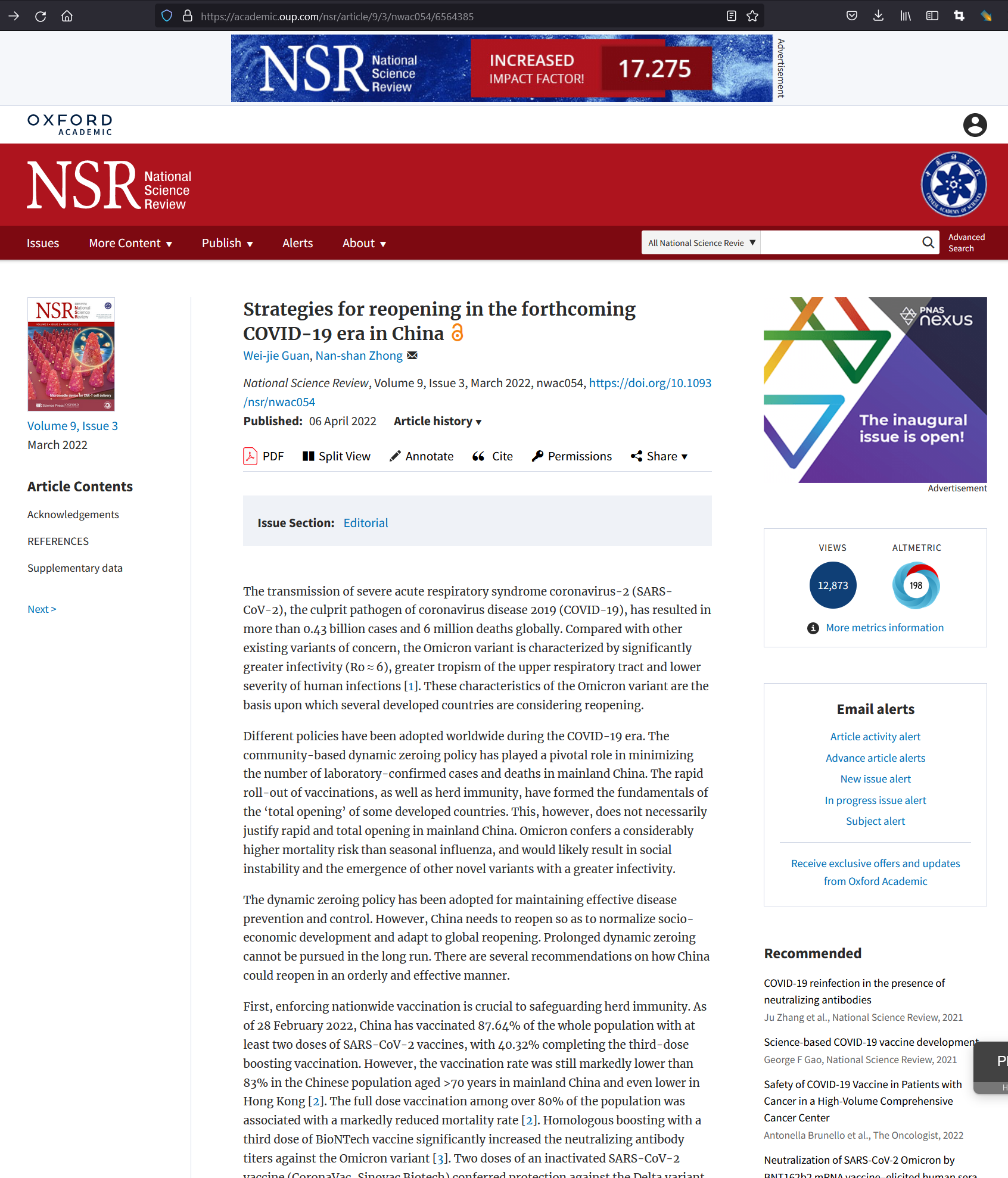
China's top Covid-19 expert Zhong Nanshan has said the country cannot pursue "dynamic zero-Covid" in the long term and should reopen to bring social and economic development back to normal, and adapt to global reopening.

The editorial titled "Strategies for reopening in the forthcoming Covid-19 era in China" was published in the English-language National Science Review journal on April 6. A Chinese translated copy of the article was published on mainland news sites on Monday but has since been deleted.

Zhong's original English language article is available here:


Below are two examples of the deletions of the Chinese language translation of Zhong's article:

ZhongChengWang

At 3:04 p.m. on April 19, 2022, the government license website Zhongchengwang (operating under the sponsorship of the Professional Committee of Livable Cities and Urban and Rural Governance of China National Architecture Research Association (中国民族建筑研究会宜居城市与城乡治理专业委员会)) published an article titled "Academician Zhong Nanshan's Latest Article: It is Impossible to Achieve Prolonged Dynamic Zeroing" (钟南山院士最新文章:长期的动态清零是不可能实现的). Some excerpts:
On April 6, 2022, the National Science Review (NSR) published an English editorial article jointly signed by Academician Zhong Nanshan, mentioning that in the long run, long-term dynamic zero cannot be achieved, and China needs to promote social and economic development and reopen, and put forward five strategic suggestions. Recommendations included increasing vaccination rates, prioritizing the use of antigen kits in the community, accelerating drug development, conducting follow-up studies on cases to adjust the minimum quarantine period, and adjusting policies in designated cities or regions.
. . . .
The dynamic zeroing policy has been adopted for maintaining effective disease prevention and control. However, China needs to reopen so as to normalize socio-economic development and adapt to global reopening. Prolonged dynamic zeroing cannot be pursued in the long run.


2022年4月6日,《国家科学评论》(National Science Review, NSR)刊发了钟南山院士联合署名的英文社论文章,提到长远来看,长期的动态清零无法实现,中国需要为了社会经济正常发展而重新开放,并提了五点策略建议。建议包括提高疫苗接种率、在社区中优先使用抗原试剂盒、加快药物研发、对病例进行随访调查研究以调整最短隔离时间,以及在指定城市或地区调整政策等。
. . . .
为了保持有效的疫情防控,中国采取了动态清零策略。但是,中国需要重新开放,以使社会经济发展正常化并适应全球重新开放。长远来看,长期的动态清零是不可能实现的。

These screenshots show that the article was deleted the next day and replaced with a notice saying "The article you accessed has been withdrawn!" (您访问的文章已撤回!).

 Original URL: http://www.gtkjgh.org.cn/zhongcheng/news/show/id/16554

NetEase

At 4:30 p.m. on April 19, 2022, the government-licensed media outlet NetEase published an article titled "Zhong Nanshan: Prolonged Dynamic Zeroing Cannot be Achieved, Pilot Investigations are Crucial" (钟南山:长期动态清零无法实现,试点调查至关重要). The content was substantially similar to the Zhongchengwang article. These screenshots show that the article was deleted the next day, and NetEase was redirecting people attempting to access it to the NetEase home page.

Original URL: https://www.163.com/dy/article/H5B3N2420511DC8A.html
Archive: https://archive.ph/7grh9 

Impact on Search Results

The impact of these deletions on search results is illustrated by these two screenshots showing Baidu search results for "Zhong Nanshan Prolonged Dynamic Zeroing" (钟南山 长期动态清零) on April 20 (left) and April 21 (right). 

Below are translations of the top three "news" results from each of those days as shown in the above screenshots:


Tuesday, April 12, 2022

Covid-19 Series: Censored Essay on Covid Strategies for China

Between April 9 and 11, 2022, an article titled "Epidemic Prevention Strategies to Minimize Loss of Life"  (生命损失最小化的防疫策略) by Liang Jianzhang (梁建章) was deleted from the following PRC-based news outlets: Caixin, Phoenix, and Sina:

 Caixin: https://web.archive.org/web/20220408071721/https://opinion.caixin.com/2022-04-08/101867209.html

 Phoenix: https://web.archive.org/web/20220409165217/https://news.ifeng.com/c/8F45EVlqK1j

Sina: https://k.sina.com.cn/article_1946109133_73ff44cd01900xqcp.html

Liang originally posted the article on his Tencent Weixin account on April 8, 2022 at https://mp.weixin.qq.com/s/LdaMgSMrY2YcqZ5w3jaIhA. As of April 11, however, that essay had been replaced with a notice reading: "Upon Receipt of Relevant Complaints, This Content Violates the 'Administrative Provisions on Internet User Public Account Information Services'" (接相关投诉,此内容违反《互联网用户公众账号信息服务管理规定》). The original post is archived at https://web.archive.org/web/20220409095426/https://mp.weixin.qq.com/s/LdaMgSMrY2YcqZ5w3jaIhA 

According to Wikipedia, Liang earned his bachelor's and a master's degree in computer science from the Georgia Institute of Technology. In 2011, he earned a PhD in Economics from Stanford University. He is a co-author of the book "Too Many People in China?," which analyzed the impact of the one-child policy and the adverse effects of demographic changes on China's economy, and a 2018 book, "The Demographics of Innovation."

Below is a machine translation of Liang's censored essay.

Epidemic Prevention Strategies to Minimize Loss of Life

2022-04-08 10:36

It has been more than two years in the fight against the epidemic. Under the guidance of the concept of life comes first, the government resolutely implemented policies such as the lockdown of Wuhan in the early stages of the epidemic, which reduced the number of infections and deaths to a minimum in a short period of time, and achieved world-renowned epidemic prevention achievements. But two years later, the virus has evolved from Alpha to Omicron. Compared with the previous strains, on the one hand, the virus has reduced toxicity and the mortality rate has dropped significantly; on the other hand, the transmissibility has been greatly enhanced, which makes our "anti-infection strategy" more expensive. This essay analyzes how to balance the benefits and costs through the impact of different epidemic prevention strategies on life expectancy, and then chooses the strategy with the least loss of life.

Two Anti-Epidemic Strategies

Infection prevention strategy: Quarantine policies are the mainstay, which includes a large number of nucleic acid tests and epidemiological investigations, as well as the closure and control of localities or even entire municipalities. The purpose is to block the infection chain and eliminate the infection to the greatest extent possible.

Death prevention strategy: Focus medical resources on treating seriously ill patients. For high mortality groups such as the elderly, vaccination is strengthened, and effective specific drugs are introduced to minimize the number of deaths.

Model diagram of epidemic prevention strategy:


The above diagram shows the logic of the model. For strains with high mortality and strong transmissibility, the anti-infection strategy is better, because the cost of infection prevention is low and the benefits are high. Conversely. For strains with low mortality and weak infectivity, the strategy of preventing death is better.

From the above model, it can be seen that the key to the selection of the best strategy is to quantitatively analyze and compare the extra cost and life loss of the "anti-infection strategy" relative to the "anti-death strategy."

1) Life loss due to infection prevention strategy = loss of life expectancy due to economic loss of isolation and containment.

This loss rises with the spread of the virus.

2) Life loss from death prevention strategies = loss of life expectancy due to death from infection.

This gain decreases as the virulence of the virus decreases.

The relationship between GDP per capita and average life expectancy

We can analyze the relationship between average life expectancy and per capita GDP by studying the historical data of various countries. It is an obvious fact: the higher the per capita income of a country, the longer its life expectancy. Because rich countries are more able and willing to invest in health care, infrastructure and environmental governance, thereby reducing mortality and increasing life expectancy.

Figure 1 Relationship between per capita GDP (USD) and average life expectancy in some countries in 2019


Source: World Bank

Note: The abscissa has been logged, and the actual per capita GDP value is marked after the name of some countries

It can be seen that the per capita income is halved, and the average life expectancy is reduced by 1-3 years; China's per capita GDP in 2010 was about 45% of that in 2020, and the life expectancy was reduced by 2.5 years.

Figure 2 The relationship between per capita GDP and average life expectancy in China's provinces


Source: World Bank, National Bureau of Statistics

Note: The abscissa has been processed by log, and the graph also shows the historical data of China and the corresponding per capita GDP

From the above figure, we can also see the relationship between per capita GDP and average life expectancy in various regions of China. The richer the province, the longer the life expectancy. In modern peacetime, there have indeed been periods (if infrequently) of sharp declines in per capita income, such as when the Soviet Union collapsed, during 1991-1993, per capita income fell by 20% and life expectancy fell by four years. So in the face of a 50% change in income, even a very conservative estimate will lead to a one-year reduction in per capita income. To put it into perspective, for every 1% decrease in per capita GDP, life expectancy will decrease by about 5 days.

Statistical Life Value

We can also test this hypothesis through the theory of Value of Statistical life in economics. In the field of economics, "statistical life value" is a relatively mature concept, which refers to how much a society is willing to spend to reduce mortality. Some people may be disgusted by this concept, thinking that there is no need to calculate the value of life, because life is supposed to be priceless. From an ethical standpoint alone, the above point of view is certainly not wrong. However, in the actual operation process, regardless of work life, business operation or social management, a balance must be pursued between reducing the risk of death and input cost. As for how to find this balance, it is necessary to calculate the "statistical life value" scientifically and rationally.

For example, companies and governments also need to balance risk and cost when providing various means of transportation and transportation infrastructure. For example, when the government designs a road, if it builds more lanes, or sets up special non-motorized lanes, or wider sidewalks, etc., it is possible to reduce the fatality rate of traffic accidents. But obviously not all roads have such a setup. Does this mean that the designer disregarded the safety of life? it's not true. As a designer, if a seemingly absolutely safe road costs 10 billion to build regardless of the cost, it is very likely that this road cannot be built at all, leaving ordinary people with nowhere to go. So for such a construction project, how much is it worth to spend to reduce the mortality rate? Here, there is also an implicit calculation of the balance of life value. In fact, economists have already calculated the value of life in an economic sense based on data from various countries. Chinese scholars have also done some research on this [1] [2], and concluded that the value of China's vital statistics is generally in the range of 1 million to 7.2 million, and we will temporarily take the value of 5 million.

The Cost of Infection Prevention Strategies

Assuming that the economic loss of 1% of GDP due to large-scale isolation and control, then it is one trillion. According to the calculation of "statistical life value" of 5 million, it may increase the risk of accidental death by 200,000 (persons). If the average life expectancy is reduced by 20,000 days per accidental death, 200,000 people will be 4 billion days, and overall, the average life expectancy in China will be reduced by about 3 days. The calculation of this loss of life expectancy does not take into account the impact of secondary deaths on life expectancy caused by the lack of timely treatment of other diseases due to the occupation of a large number of medical resources by tasks such as nucleic acid testing.

Therefore, combining the previous two methods of calculating the cost of life, a loss of 1% of GDP will reduce the average life expectancy by 3-5 days, which is the cost of isolation and containment required by the infection prevention strategy.

The next question is, how much GDP will Omicron cause? This is of course difficult to calculate, but we have a preliminary analysis, that is, the stronger the transmissibility, the stricter the closure and control measures will inevitably be, and the greater the loss of GDP will be. The strength of transmissibility can be expressed by R0 (basic infection number), and the value of R0 is simply understood as "one person gets sick, how many other people he can infect". The initial Alpha is R0=2-4 (the R0 of influenza is also around 2), the R0 of Delta is about 4, the transmissibility of Omicron is very strong, and the R0 is about 10, which is much stronger than any previous strains, so yes The GDP cost of its anti-infection strategy is also much higher.

In the past two years, we have adopted an anti-infection policy, which has successfully blocked Alpha and Delta, and only paid a relatively small loss of GDP as the price. However, the transmissibility of Omicron is several times that of Alpha and Delta, and a large-scale isolation is often required, so the economic loss of preventing and controlling Omicron may be far greater than 1% of GDP. For example, not long ago, Shenzhen was only closed and controlled for a week, causing a loss of 60-70 billion. According to a study by Professor Song Zheng of the Chinese University of Hong Kong [3], the closure of first-tier cities like Shanghai for one month will reduce the real GDP of the whole of China by 4%. In fact, with the increasing spread of the virus, precise epidemic prevention has become almost impossible, and the frequency of city closures has to be greatly increased. According to statistics, in the first quarter alone, Shanghai, Changchun, Harbin, Xi'an, Shenzhen, etc. have implemented or are undergoing city-wide lockdowns, and more than a dozen first- and second-tier cities have had large-scale partial lockdowns. The closure and control of these cities alone will cause a loss of more than 4% of China's GDP in the first quarter. Moreover, the overall economy is already under great downward pressure. If a large-scale lockdown is imposed for a long time, it will cause negative effects such as rising unemployment and an increase in the number of people returning to poverty. Not to mention the secondary loss of life caused by the occupation of medical resources.

After calculating the cost of the anti-infection strategy, let's calculate the relative benefit of the anti-infection strategy, that is, how many deaths and life expectancy are avoided, and then we need to estimate the fatality rate of different variants. According to a study conducted by British scholars on confirmed cases of different variants in the second half of 2021, the case fatality rate of Alpha is about 1.1% [4]; according to a study of patients infected with Omicron and Delta variant viruses in Ontario, Canada. A retrospective whole population matched cohort study [5], the Delta case fatality rate was 0.3%; according to the statistics of the 2018 influenza season published by the US CDC [6], the case fatality rate of influenza is about 0.1%. The main preliminary research and data show that Omicron is different from previous strains and generally does not invade the lungs. Therefore, the fatality rate of Omicron is much lower than that of previous strains, and may even be lower than that of influenza. We will analyze Omicron in detail later. of the fatality rate.

Influenza Prevention Strategies

We use this model to calculate epidemic prevention strategies against influenza. Since the fatality rate of influenza is about 0.1%, if it is very pessimistically estimated that 50% of the population will be infected (the actual infection rate will be much lower than 50%), it will cause a mortality rate of 5/10,000. Assuming that the average life expectancy of patients who die is 70 years (assuming that the average life expectancy of patients is 80 years), then each patient who dies will be shortened by an average of 10 years of life. Then in terms of mortality rate of 5 in 10,000, life expectancy is reduced by almost 1.8 days (10 years x 5 in 10,000). Therefore, on average, a large-scale influenza outbreak has an impact on the entire human society, equivalent to a reduction in life expectancy of about 1.8 days. For the infection prevention strategy, the gain is only 1.8 days of life lost. However, as we calculated earlier, if we adopt a large-scale infection prevention strategy, only the loss of 1% of GDP will reduce the average life expectancy by 3-5 days. Because of this, we cannot use large-scale isolation and sealing to prevent infection. control strategies to prevent influenza.

The Best Strategy for Dealing with Initial Strains of Covid-19

We can calculate the earliest mutant virus Alpha in the early stage of the epidemic. If Alpha's case fatality rate is 1%, which is about 20 times that of influenza, then the loss of life expectancy is not 1.8 days but 40 days. Then the relative benefit of the infection prevention strategy of large-scale isolation is 40 days. Far greater than the 3-5 day life cost of 1% of GDP. Therefore, for the Alpha virus, the strategy of preventing infection is better than the strategy of preventing death, and it was the right choice to decisively shut down Wuhan at the beginning.

Best Strategy Against Omicron

Let's analyze how to deal with Omicron. First of all, logically, if the fatality rate of Omicron is higher than that of Alpha, and the transmissibility is weaker than that of Alpha, then an infection prevention strategy should be adopted. Adopt a death-prevention strategy. In detail, if a large area is isolated, the resulting loss of life expectancy is: the percentage loss of GDP * (3-5) days (for simplicity, it will be calculated as 4 days later); infection prevention can avoid death and thus obtain The benefit of life expectancy is: (case fatality rate) S*10 years*50% (assuming that 50% of the whole population will eventually be infected), that is, S*3652*50% days.

Compare the life loss caused by the two strategies, that is, when the percentage loss of GDP * 4 days < S * 3652 days * 50%, the anti-infection strategy should be adopted, otherwise the anti-death strategy should be adopted.

From this, it is possible to calculate the threshold value of the fatality rate S of the death prevention strategy under the assumption of different GDP losses: when the GDP loss is 0.5%, the threshold value of S = 0.12%, that is, when the case fatality rate is less than 0.12%, the death prevention strategy should be adopted. Strategy; when GDP loses 1%, S's threshold = 0.22%; when GDP loses 2%, S's threshold = 0.44%, when GDP loses 4%, S's threshold = 0.88%. According to the current level of closure and control required for Omicron, the loss to GDP is at least 4%. It can be seen that even if the fatality rate of Omicron is slightly higher than that of influenza, because of the strong transmissibility of Omicron, the cost of preventing infection may be much higher than that of influenza, and a strategy of preventing death should be adopted. We can be sure that Omicron is much more transmissible than the flu. So what is the fatality rate of Omicron?

Omicron's Case Fatality Rate

According to research data released by Ontario, Canada, the case fatality rate of Omicron is about 0.03%. However, since European and American countries no longer require nucleic acid tests and no longer accurately count the number of infected people, the calculation of the fatality rate is not accurate. However, Asian countries are still counting the number of infected people more accurately, so we can look at the case fatality rate statistics of some Asian countries that are closer to ours.

According to reports, based on the cumulative number of deaths and positive cases from January to February 21, 2022 by the Japanese Ministry of Health and Welfare, the confirmed case fatality rate of Omicron is estimated to be 0.13% [7]. According to the Korea Centers for Disease Control and Prevention (KDCA), since December last year, the case fatality rate of the Korean Omicron variant is about 0.18% [8]. Through the data of the past two weeks, we found that the recent confirmed case fatality rate has been reduced to 0.1% [9]. According to the statistics of the case fatality rate in the past 28 days by the Ministry of Health of Singapore, this value is only 0.05% [10]. Through the data of the past two weeks, we found that the confirmed case fatality rate in Singapore in the past two weeks was only 0.03%. Similarly, according to the analysis of confirmed and fatal cases in Vietnam in the past 28 days, the case fatality rate is about 0.03% [11].

Look at Hong Kong, China. According to the epidemic data released by the Hong Kong government [12], there were 7,732 deaths in the fifth wave of the epidemic, and the cumulative number of confirmed and reported cases was 1,150,607 (2021.12.31-2022.4.1), and the calculated case fatality rate was 0.67%. However, since Hong Kong has never had a complete national nucleic acid, it is likely that there are many confirmed cases that are not included in the statistics. The Faculty of Medicine of the University of Hong Kong has calculated through a mathematical model that the actual number of infections far exceeds the official reports or statistics. This estimate has reached 4 million [13]. According to this estimate, the actual fatality rate is below 0.2%, but it is still relatively high.

Case fatality rate in some Asian countries, vaccination status of elderly people and proportion of deaths, proportion of population over 80 years old


Remarks: The vaccination rate and the proportion of deaths in the elderly are from the government websites or public information of each country/region, and the population proportion is from the United Nations database

Explanation of confirmed case fatality rate: South Korea: data from the national statistical database, data time is 2022.3.17-3.31; Singapore: data source Singapore Ministry of Health, data calculation time is 2022.3.17-3.31; Japan: data source Japan Daily News, calculation Time January-February 2022; Hong Kong, China: Data from Hong Kong Department of Health and University of Hong Kong, calculated from December 2021 to April 4, 2022; Vietnam: Data from Johns Hopkins University, calculated from March 2022 .8-4.6; Mainland China data is from the National Health Commission, and the calculation time is from January to March 2022.

It can be seen that the general mortality rate of Omicron is close to or even much lower than that of influenza, with the exception of Hong Kong, China.

Why is the Fatality Rate in Hong Kong so High?

To explain the high death rate in Hong Kong, we need to look at the age distribution of those who died. According to the figures in the third column of the above table, it is not difficult to see that the elderly are the main group of deaths. In Hong Kong, the vaccination rate of the elderly over the age of 80 is only 43%, while the vaccination rate of the elderly in other countries exceeds 90%. According to the data, both domestic vaccines and MRNA vaccines are highly effective in preventing severe illness and death. Therefore, it is not difficult to conclude that the vaccination rate of the elderly in Hong Kong is much lower than that of Singapore, which is the main reason for the high mortality rate in Hong Kong. If Hong Kong, China, can increase the vaccination rate of the elderly to the level of other countries, the case fatality rate can also be reduced to about 0.1%, which is similar to the level of influenza.

The overall vaccination rate in China is relatively high, and the full-course vaccination rate for people over 60 years old has reached 80%. China's overall proportion of 80-year-olds in the total population is only half that of Hong Kong, but the vaccination rate of the elderly over 80 is still relatively low, not reaching the level of Singapore and Japan. The case fatality rate of Omicron in China that we recently observed is already very low. In the first quarter of this year, the case fatality rate of the new coronavirus in mainland China was only 0.004%, which was an order of magnitude lower than that of Singapore. The case fatality rate in Jilin, where the epidemic was more severe, was 0.007% in the same period. Shanghai is 0 [14]. If we continue to increase the vaccination rate of the elderly, we can maintain the fatality rate of Omicron at the level of Vietnam and Singapore, which is 5/10,000, then the reduction of the cost of life expectancy from the death prevention strategy will be less than 1 day, and now it is estimated that the prevention of infection The loss of GDP caused by the strategy will exceed 4%, and the reduction in life expectancy is 16 days, which is much higher than the impact of the death prevention strategy. If the case fatality rate is maintained at 5 per 10,000 (50% infection rate), the number of deaths per year is more than 300,000. More than 3 million people die of cancer in China every year, and the five-year survival rate of cancer in China is 20% lower than that in Japan and South Korea. If we use 1% of GDP to improve the overall medical level, then cancer alone may save a lot. 600,000 people have room for improvement.

Let's review the epidemic prevention model diagram again:

Conclusion

For the current variant of the new coronavirus with high transmission rates but relatively low infection mortality rates, if a mortality prevention strategy is to be adopted, the focus should be on increasing the vaccination rate of high mortality risk groups such as the elderly over 80 years old. The domestic vaccine is also effective in preventing death. Therefore, we must increase the vaccination rate of the elderly as soon as possible. If the mortality rate continues to remain at a very low level, we should actively switch to the death prevention strategy. The anti-death strategy is not a "flattening" policy that is completely ignored, but to allow people with cold symptoms to self-isolate and test, freeing up valuable medical resources for the rescue and observation of critically ill and elderly people, so as to reduce the mortality rate. drop to lowest. Adopting different anti-epidemic strategies in the future does not mean that China's previous prevention and control was in vain. On the contrary, according to our model, the previous anti-infection and containment strategies were very correct, and they won more than two years of precious time. In the stage when the vaccination rate is still relatively low and the virus toxicity is relatively high, a large number of deaths can be avoided at a relatively small cost.

Summary

This essay established a model to analyze and compare the impact of different epidemic prevention strategies against different viruses on life expectancy. It concludes that the best strategy for epidemics such as Alpha and Delta is the anti-infection strategy. Omicron, however, is completely different from those previous strains. The mortality rate of Omicron is much lower and the transmissibility is much stronger, resulting in a substantial increase in the cost of the anti-infection strategy. According to the Omicron case fatality rate statistics in most countries and regions, if the Omicron case fatality rate is close to that of influenza, the life cost of the death prevention strategy is lower. The high mortality rate in Hong Kong is likely due to the low vaccine penetration rate among the elderly. Whether the strategy of the future is to prevent infection or prevent death depends on when we can achieve universal vaccination rates for the elderly.

We believe that as long as we adhere to the concept of people first and life comes first, take into account the life and work order of the people, adopt optimal epidemic prevention strategies scientifically and rationally, and efficiently allocate medical resources and social resources to deal with various diseases including Omicron , the overall loss of life can be minimized.

[1]曾贤刚、蒋妍,2010:空气污染健康损失中统计生命价值评估研究,中国环境科学

[2] ZhaoYang,PanLiu,XinXu: Estimation of social value of statistical life using willingness-to-pay method in Nanjing, China

[3] Jingjing Chen, Wei Chen, Ernest Liu, Jie Luo, and Zheng (Michael) Song:The Economic Cost of Lockdown in China: Evidence from City-to-City Truck Flows.

https://www.econ.cuhk.edu.hk/econ/images/Documents/Truck_Flow_and_COVID19_220315.pdf

[4]medRxiv:

https://www.medrxiv.org/content/10.1101/2022.03.05.22271084v1.full#F1

[5]The Journal of the American Medical Association:

https://jamanetwork.com/journals/jama/fullarticle/2789408#:~:text=There%20were%2053%20hospitalizations%20(0.6,%25)%20among%20matched%20Delta%20cases

[6]Centers for Disease Control and Prevention:

https://www.cdc.gov/flu/about/burden/2018-2019.html

[7]日本厚生劳动省:https://covid19.mhlw.go.jp/en/

[8]https://www.reuters.com/world/asia-pacific/skorea-says-omicron-covid-variant-75-less-likely-kill-than-delta-strain-2022-02-22/

[9]韩国统计厅:https://kosis.kr/covid_eng/covid_index.do

[10]新加坡卫生部:https://www.moh.gov.sg/covid-19/statistics

[11]约翰霍普金斯大学:

[12]衞生署衞生防護中心和醫院管理局:

https://www.coronavirus.gov.hk/pdf/5th_wave_statistics/5th_wave_statistics_20220401.pdf

[13]香港大学医学院孔繁毅等:

http://www.med.hku.hk/en/news/press//-/media/HKU-Med-Fac/News/slides/20220314-sims_wave_5_omicron_2022_03_14_final.ashx

[14]国家卫生健康委员会:http://www.nhc.gov.cn/


Sunday, March 6, 2022

PRC Lawyer Proposes Abolishing "Disturbing the Peace" Offense

On March 1, 2022 an article titled "National Committee of the Chinese People's Political Consultative Conference Member Zhu Zhengfu: A Proposal to Abolish the Crime of Disturbing the Peace in Due Course" was published on page 12 of the "People's Political Consultative Daily" (人民政协报). The full article was published by Baidu (https://baijiahao.baidu.com/s?id=1726079190961095864), and a shorter version was published on the website of the People's Political Consultative Conference (http://www.rmzxb.com.cn/c/2022-03-04/3064649.shtml). A full translation of the Baidu version is included below.

Translator's Notes: This is not the first time someone has noted problems with the crime of Disturbing the Peace (寻衅滋事, also commonly literally translated as "picking quarrels and provoking troubles" for more on why I have chosen to translate this as "disturbing the peace," see "State Prosecutions of Speech in the People's Republic of China: Cases Illustrating the Application of National Security and Public Order Laws to Political and Religious Expression, pp. 21-22, https://www.feichangdao.com/publications/state-prosecutions-vol-1). For example, Liu Zhiqiang (刘志强) and Song Haichao (宋海超),  two academics at the Guangzhou University Institute for Human Rights, noted:

Most of those in domestic academic circles have either resolutely opposed, or hold a very negative attitude toward, the crime of disturbing the peace. Many scholars in criminal law circles have published papers discussing the flaws associated with determining what constitutes the crime of disturbing the peace, including determining the standard for the offense, the difficulty of judicial application, and generally focusing on opposing the existence of the crime of disturbing the peace and restricting the scope of application of the crime. (国内学界对寻衅滋事罪的态度大多都持坚决反对或者十分消极的态度,刑法学界很多学者都曾发表论文论述寻衅滋事罪的犯罪构成缺陷、罪名认定标准、司法适用困境,总体上以反对寻衅滋事罪的存在和限制该罪名适用范围两方面为主.)

"Three Characteristics of the 'Judicial Interpretation of the Crime of Disturbing the Peace.'" (寻衅滋事罪司法解释"三性"审视), Academics (学术界), Issue No. 5, May, 2020. See http://blog.feichangdao.com/2020/09/prc-scholars-judicial-interpretation-on.html.

While not mentioned in the reporting about Zhu's proposal, the crime of disturbing the peace is often used to prosecute political speech, both online and in physical venues. The following examples are all from 2019:

  • A court found Dong Zehua & Yuan Shuai guilty of disturbing the peace on the grounds that Dong "wore a T-shirt with sensitive markings on it and took photos in Tiananmen Square and posted the photos online" and Dong and Yuan "interviewed foreigners in Tiananmen Square and made inquiries into sensitive topics." See "State Prosecutions," pp. 513-515).
  • A court found Jie Ruixue guilty on the grounds that she "stood in an area crowded with tourists in the vicinity of the national flag pole in Tiananmen Square wearing a white t-shirt upon which was written 'Freedom of Speech, Vindicate June Fourth, Oppose Repeating the Tragedy.'" See "State Prosecutions," pp. 516-18).
  • A court found an individual surnamed Wang guilty of disturbing the peace on the grounds that he used Twitter to repost, like, and comment on a large number of posts relating to major domestic incidents, including: 
    • Hu Wei proves the authenticity of Guo Wengui's revelations;
    • The Communist Party of China controls all the resources . . . the working people can only get a piece of the pie;
    • If China has the best socialist system in the world, why is the quality of each generation lower than the last?;
    • The Communist Party seizes power in order to kill people;
    • The Communist Party of China will never open the Internet . . . their end is at hand;
    • The Communist Party of China has become an interest group and will devour the private sector;
as well as content about 'June Fourth,' 'Tibet,' and 'The Mirror Group.' See "State Prosecutions," p. 715.
  • A court found an individual surnamed Cheng guilty of disturbing the peace on the grounds that he used Twitter to post and repost 471 tweets on the Internet that denigrated and berated others, and denigrated the image of the Party and the government. See "State Prosecutions," p. 717.
  • A court found an individual surnamed Xu guilty of disturbing the peace on the grounds that he used Twitter to post and repost content that "berated Party and State leaders, and assailed the socialist system, soldiers, and police groups." See "State Prosecutions," pp. 717-718.

National Committee of the Chinese People's Political Consultative Conference Member Zhu Zhengfu: A Proposal to Abolish the Crime of Disturbing the Peace in Due Course

The crime of disturbing the peace is a crime derived from the crime of hooliganism in the 1979 Criminal Law. Article 293 of our country's Criminal Law:

Where one of the following acts of disturbing the peace has been committed that undermines social order, it shall be punished with a fixed term imprisonment, penal detention, or surveillance of no more than five years:

    1. Assaulting another party without cause under offensive circumstances;
    2. Pursuing, obstructing, berating, or intimidating another party under offensive circumstances;
    3. Extorting or willfully damaging or appropriating public or private property where the circumstances are severe; or
    4. Creating a disturbance in a public venue, causing severe chaos in public venue order.

Bringing together other parties on several occasions to engage in the aforementioned acts shall, where there is a severe undermining of social order, be punished with a fixed term imprisonment of not more than five years, and may be further punished with a fine.

Lawyer Zhu Zhengfu, a member of the National Committee of the Chinese People's Political Consultative Conference, said that in practice, the crime has gradually become a new "pocket crime" similar to the crime of hooliganism. The reason is that there are obvious defects in this crime, and many concepts related to this crime are too vague, which not only creates confusion in judicial practice, but also is easily abused, resulting in excessive criminalization in society. To this end, Zhu Zhengfu will submit a proposal for the "Timely Repeal of the Crime of Disturbing the Peace" at the Two Sessions this year.

Zhu Zhengfu believes that the constitutive elements of the crime of disturbing the peace lack of clarity. Clarity is the basic requirement of a legally prescribed punishment. However, it is difficult to accurately define the expression of specific criminal conduct constituting the crime of disturbing the peace. For example, what kind of "pursuing, obstructing" conduct in public venues has the characteristics of undermining social order?  In addition, he believes that the expressions "without cause," "willfully," "severe circumstances" and "causing severe chaos in public venue order" in the crime of disturbing the peace are too vague, and these are the key elements of the crime.

Although the Supreme People's Court and Supreme People's Procuratorate have issued a relevant judicial interpretation (N.B. This is a reference to the Interpretation of the Supreme People's Court and Supreme People's Procuratorate Regarding Certain Issues on the Handling of Cases Applying the Crime of Disturbing the Peace, 最高法、最高检关于办理寻衅滋事刑事案件适用若干问题的解释, which became effective on July 22, 2013) clarifying, for example, that a perpetrator shall have subjective motives such as "seeking excitement, venting emotions, behaving in an arrogant and overbearing manner, or being deliberately provocative," nevertheless in specific cases differing opinions may exist when it comes to subjective judgments about a perpetrator. In practice, some people have been convicted of the crime of "disturbing the peace" because of excessive debt recovery methods. How does one judge subjectively whether a reaction to the recovery of legal debts is being deliberately provocative or done with just cause? The judicial interpretation is still unable to eliminate the ambiguity of the line that demarcates this crime.

In addition, the crime of disturbing the peace overlaps with various other provisions of the criminal law. The behavioral characteristics of this crime stipulated in Article 2 of the Two Supremes' 2013 Judicial Interpretation (N.B. see text of that article included below) overlaps with the crime of intentional injury (If the crime of intentional injury is constituted, the starting point of sentencing can be determined within the corresponding range according to the following different situations: if intentional injury causes one person to be slightly injured, the starting point of sentencing can be determined within the range of fixed term imprisonment of not more than two years and penal detention . . .), Article 3 with the crime of berating, Article 4 with crimes of robbery and intentional destruction of property, and Article 5 with crime of gathering crowds to disrupt public venue order.

Furthermore, there are logical defects in the nature of the crime of disturbing the peace. On the one hand, some of the same acts would not meet the standards for establishing a case under the laws that directly punish those acts, but they can constitute the crime of disturbing the peace. For example:

  • Intentional injury causing minor injury does not constitute the crime of intentional injury, but it may constitute the crime of disturbing the peace;
  • Causing property loss of 2,000 yuan does not meet the standard to establish a case for the crime of intentional destruction of property (the standard is 5,000 yuan), but it can constitute the crime of disturbing the peace (the standard for filing a case is 2,000 yuan).

On the other hand, the starting point for sentencing the crime of disturbing the peace is five years or less, which results in acts that do not constitute an offense with a lighter punishment, but that may constitute the crime of disturbing the peace with a heavier punishment. Zhu Zhengfu said that in this example, something may not constitute the crime of intentional injury or the crime of intentional destruction of property, both of which are punished with sentences of less than three years, but may constitute the crime of disturbing the peace with heavier penalties. This is not only a paradox in the legislative system, it also does not conform to the principle of the degree of punishment being proportional to the degree of culpability.

The most important thing is that the harmful behaviors targeted by the crime of disturbing the peace have been dealt with by corresponding laws, and the abolition of this crime there will not result in any legal gaps. Much of the conduct covered by this crime is covered in the Public Security Administration Punishments Law. For example, Articles 42, 43, and 49 of that law stipulate the punishment standards for insulting, threatening others, intentionally injuring others, and intentionally destroying public or private property. From this it can be seen that "administrative penalties can also be imposed on conduct that does not constitute crimes and endangers the society, and the law will let them go unchecked. Criminal law is not the only means to crack down on conduct that endangers society. Therefore, rejecting the use of vague provisions to gather more conduct within the scope of the criminal law is not only required under the principle that there must be a specific crime for any legally prescribed punishment, it is also the embodiment of restraint in the application criminal law.

The existence of the crime of disturbing the peace to a certain extent is conducive to punishing conduct that endangers social order and maintaining social stability, but the various drawbacks of this crime are also obvious. The selective enforcement of the law by the government agencies ultimately damages the legitimate interests of the people and detracts from the people's respect for, and faith in, the law. Therefore, Zhu Zhengfu proposes that the crime of disturbing the peace should be abolished in due course.

Interpretation of the Supreme People's Court and Supreme People's Procuratorate Regarding Certain Issues on the Handling of Cases Applying the Crime of Disturbing the Peace, Article 2:

Assaulting another party and undermining social order shall, where one of the following situations exists, be deemed to "offensive circumstances" as provided by Article 293(1)(i) of the Criminal Law:

(1) causing minor injuries to more than one person or minor injuries to two or more people;
(2) causing serious consequences such as mental disorder or suicide;
(3) assaulting another party without cause multiple times;
(4) assaulting another party without cause with a lethal weapon;
(5) assaulting without cause the mentally ill, the disabled, vagrants and beggars, the elderly, pregnant women and minors, causing an offensive social influence;
(6) assaulting another party without cause in a public venue, causing severe chaos in public venue order;
(7) other situations with offensive circumstances.

全国政协委员朱征夫:建议适时取消寻衅滋事罪

人民政协网
发布时间: 2022-03-01 14:49人民政协网
关注

全国政协委员朱征夫:建议适时取消寻衅滋事罪

寻衅滋事罪是从1979年刑法流氓罪中分解出的罪名。我国刑法第293条:有下列寻衅滋事行为之一,破坏社会秩序的,处五年以下有期徒刑、拘役或者管制:(一)随意殴打他人,情节恶劣的;(二)追逐、拦截、辱骂、恐吓他人,情节恶劣的;(三)强拿硬要或者任意损毁、占用公私财物,情节严重的;(四)在公共场所起哄闹事,造成公共场所秩序严重混乱的。纠集他人多次实施前款行为,严重破坏社会秩序的,处五年以上十年以下有期徒刑,可以并处罚金。

全国政协委员朱征夫律师表示,在实践中,该罪名逐渐沦为类似于流氓罪的新的“口袋罪”。原因在于该罪名存在明显缺陷,许多与该罪名有关的概念过于模糊,不仅对司法实践构成困扰,也极易被滥用,造成社会过度刑法化。为此,朱征夫将于今年两会提交《适时取消寻衅滋事罪》的提案。

朱征夫认为,寻衅滋事罪的构成要件缺乏明确性。明确性是罪刑法定原则的基本要求,然而,寻衅滋事罪中对于具体犯罪行为的表述难以准确界定。例如,在公共场所怎样的“追逐、拦截”行为才具有破坏社会秩序的特征?另外,他认为,寻衅滋事罪中“随意”“任意”“情节严重”“造成公共场所秩序严重混乱”等表述过于模糊,而这些又是该罪关键的构成要件。虽然两高出台了相关的司法解释,如明确行为人要有“寻求刺激、发泄情绪、逞强耍横等,无事生非”等主观动机,但具体案件中对行为人主观上的判断又可能存在不同意见。实践中就有人因追讨债务方式过激被判寻衅滋事罪,追讨合法债务是无事生非还是事出有因,主观怎么判断?司法解释仍无法消除该罪在犯罪界限上的模糊性。

此外,寻衅滋事罪与多个刑法法条存在竞合。按2013年两高的司法解释规定的该罪的行为特征,第二条(随意殴打他人,破坏社会秩序,具有下列情形之一的,应当认定为刑法第293条第一款第一项规定的“情节恶劣”:①致一人以上轻伤或者二人以上轻微伤的;②引起他人精神失常、自杀等严重后果的;③多次随意殴打他人的;④持凶器随意殴打他人的;⑤随意殴打精神病人、残疾人、流浪乞讨人员、老年人、孕妇、未成年人,造成恶劣社会影响的;⑥在公共场所随意殴打他人,造成公共场所秩序严重混乱的)与故意伤害罪(构成故意伤害罪的,可以根据下列不同情形在相应的幅度内确定量刑起点:故意伤害致一人轻伤的,可以在二年以下有期徒刑、拘役幅度内确定量刑起点……)、第三条与侮辱罪、第四条与抢劫罪、故意毁坏财物罪,第五条与聚众扰乱公共场所秩序罪等均存在竞合。“一个法条惩治的行为与多个法条存在重叠,有重复立法之嫌。”朱征夫说。

再者,寻衅滋事罪存在体系上的逻辑缺陷。一方面,某些同样的行为达不到直接惩治该行为的法条的立案标准,却可以构成寻衅滋事罪。例如,故意伤害致人轻微伤不构成故意伤害罪,但却有可能构成寻衅滋事罪;造成财物损失2000元达不到故意毁坏财物罪立案标准(立案标准为5000元),却可以构成寻衅滋事罪(立案标准为2000元)。另一方面,寻衅滋事罪起刑点为五年以下,这也导致了一个不构成刑罚较轻的罪名的行为,却可能构成刑罚更重的寻衅滋事罪。朱征夫说,正如前例,不构成刑罚均为三年以下的故意伤害罪和故意毁坏财物罪,却可以构成刑罚更重的寻衅滋事罪。这不仅是立法体系上的一个悖论,也不符合罪责刑相适应原则。

最为重要的是,寻衅滋事罪所打击的危害行为,已有相应法律予以处理,取消该罪不会出现法律的空白。朱征夫表示,该罪表述的多种行为,在治安管理处罚法中均有规定,例如该法第42条、第43条、第49条,规定了侮辱、威胁他人、故意伤害他人、故意毁坏公私财物行为的处罚标准,由此可见,“对于不构成犯罪的危害社会的行为,还可以施加行政处罚,法律并非听之任之。对于危害社会的行为,刑法并非唯一打击手段。因此,拒绝利用模糊的规定将更多的行为纳入刑法的考量,这既是罪刑法定原则的要求,也是刑法谦抑性的体现。”

寻衅滋事罪的存在一定程度上有利于惩治危害社会秩序的行为,维护了社会稳定,但该罪名的种种弊端也是显而易见的,其模糊性不仅影响人民群众对权利义务的合理预期,也可能使得执法机关选择性执法,最终损害人民群众的合法利益,减损人民群众对法律的尊重和信仰。因此,朱征夫建议适时取消寻衅滋事罪。

来源:《人民政协报》(2022年03月01日 第12版)

记者:徐艳红

版面编辑:王天奡

新媒体编辑:莫愁

审核:周佳佳

Tuesday, May 11, 2021

An Early Precedent for Prosecuting "Historical Nihilists"

 For more information about how this case shaped the future of China's jurisprudence around people's expressions of views relating to deceased individuals and historical events deemed by the Communist Party of China to be beyond reproach, see "Supreme People's Court Website Explains Why Courts Found Author Guilty of Defaming Dead Heroes " http://blog.feichangdao.com/2016/11/supreme-peoples-court-website-explains.html.

Intermediate People's Court of Guangzhou
Administrative Judgment
(2011) Sui Intermediate Judicial Administrative Final No. 570


Appellant (the plaintiff in the original trial ): Zhang Guanghong, residing in Guangzhou.

Entrusted Counsel: Zhang Peng, Beijing Zhongyingkai Law Firm.

Entrusted Counsel: Ge Yongxi, Guangdong Anguo Law Firm.

Appellee (the defendant in the original trial): The Yuexiu precinct of the Public Security Bureau of Guangzhou. Location: Guangzhou.

Legal representative: Cai Wei, Position: Director.

Entrusted Counsel: Hu Jiaqiang and Zhou Peixin are both civilian police officers of the precinct.

In connection with an administrative punishment case, appellant Zhang Guanghong did not accept the People's Court of Yuexiu's (2013) Sui Yue Judicial Administrative First Instance No. 368 administrative judgment, and raised an appeal with this Court. This Courtformed a collegial panel in accordance with the law and tried this case. The trial in this case has now concluded.

The case was tried by the original court which found: At about 12:15 am on August 27, 2013, the plaintiff in the original trial Zhang Guanghong was in Room 103, No. 1, Wenhuali, Yuexiu District, Guangzhou, and used his laptop to post a microblog on Sina Weibo (screen name: Nianhuaxiaofo223, address: http://weibo.com/lianhuaxiaofo223) with this content: "Teacher Yuan Tengfei was filming the movie 'The Five Heroes of Wolf Tooth Mountain' and went to the local area to learn the truth, and the villagers said: These five people are just a few stragglers traveling bravely along with the militia. After they came to the village, they called for food and drink, and they would beat people at the slightest provocation. Because several of them had guns in their hands, the villagers did not dare to provoke them. Later, someone figured out a way to secretly tell the Japanese their whereabouts. The Japanese came to surround them and put them down. The villagers deliberately led the five men to an escape route that would leave them cornered." After that, the plaintiff in the original trial pasted the content of the microblog into his Tencent Weibo (screen name: Nianhuashiping23_833, address: http://t.qq.com/lianhuaxiaoofo23). As of August 29, 2013, the content of the  Sina Weibo of the plaintiff in the original trial had been forwarded more than 2,000 times with more than 300 comments, while the content of the Tencent Weibo has been forwarded many times with more comments.

At about 8:00 pm on August 29, 2013, defendant the Yuexiu precinct of the Public Security Bureau of Guangzhou apprehended the plaintiff in the original trial and seized a laptop computer at the scene. The defendant investigated the aforementioned facts and investigated the verified Sina Weibo "YuanTengfeiV" (URL: http://weibo.com/yuantengfei). No relevant remarks involving the "The Five Heroes of Wolf Tooth Mountain" were found, so it was determined that the plaintiff in the original trial was spreading rumors about the "The Five Heroes of Wolf Tooth Mountain," and that fictitious facts were disrupting public order, and informed the plaintiff in the original trial of the facts, reasons, and basis of the punishment decision that would be made, as well as his right to make a statement and defense.

On the 30th of the same month, on the basis of the provisions of Articles 25(1) and 11(1) of the "Public Security Administrative Punishments Law of the People's Republic of China," the defendant decided to impose a punishment of seven days administrative detention on the plaintiff in the original trial and confiscate the laptop computer used in this case. The plaintiff in the original trial did not accept the aforementioned punishment decision, and applied to the Public Security Bureau of Guangzhou for administrative reconsideration. That bureau issued the Sui Public Reconsideration Decision (2013) No. 154 "Administrative Reconsideration Decision" on October 30, 2013, and decided to sustain the aforementioned penalty decision made by the defendant.

The plaintiff in the original trial again did not accept this, and thereupon filed the lawsuit in this case.

The court in the original trial held that Article 25 of the "Public Security Administrative Punishments Law of the People's Republic of China" provides: "A person who commits one of the following acts shall be detained for not less than 5 days but not more than 10 days and may, in addition, be fined not more than 500 yuan; and if the circumstances are relatively minor, he shall be detained for not more than 5 days or be fined not more than 500 yuan: (1) intentionally disturbing public order by spreading rumors, making false reports of dangerous situations and epidemic situations or raising false alarms or by other means . . . " And Article 11(1) provides: "Contraband seized in dealing with cases of public security such as drugs and pornographic objects, gambling devices, money for gambling, devices used for ingesting or injecting drugs, and the instruments owned and directly used by the persons in their acts against the administration of public security shall be taken over, and shall be disposed of according to relevant regulations." In this case the plaintiff in the original trial submitted that the microblog about "The Five Heroes of Wolf Tooth Mountain" originated from "Teacher Yuan Tengfei," the content had been spreading for many years, and did not originate with the plaintiff in the original trial. Even if the fictitious content was not made up by plaintiff in the original trial, the defendant's investigation of the verified Sina Weibo "YuanTengfeiV" found no relevant remarks involving The Five Heroes of Wolf Tooth Mountain. Therefore, the defendant determined that the plaintiff in the original trial made up fictitious facts on Weibo, and the facts were clear and the evidence was copious that he had produced and spread rumors. The aforementioned illegal actions of the plaintiff in the original trial caused adverse effects on the Internet and disrupted public order. Therefore, the defendant's punishment decision made after the illegal facts of the plaintiff in the original trial were uncovered was found to comply with the aforementioned provisions. The plaintiff in the original trial has insufficient basis to request that the penalty decision be revoked, his computer be returned, and he receive compensation, and his requests should not be granted.

In summary, in accordance with the provisions of Article 56(4) of the "Interpretation of the Supreme People's Court on Several Issues Concerning the Implementation of the 'Administrative Procedure Law of the People's Republic of China'" and Article 33 of the "Supreme People's Court Provisions on Several Issues Concerning Trials of Administrative Compensation Cases" the judgment of the court in the original trial was as follows: 1. The claims of the plaintiff in the original trial Zhang Guanghong were rejected; 2. The request for compensation of the plaintiff in the original trial Zhang Guanghong was rejected.

Appellant Zhang Guanghong did not accept this judgment in the original trial and appealed to this court as follows:
1. The trial of first instance ignored the facts of the case and hastily dismissed the appellant’s petition, and a correction is in order.

(i)  In this case, the appellant was sentenced to seven days administrative detention on the grounds that the appellant spread rumors that violated historical facts. The court of first instance should find out what the historical facts involved in the case are, and if the facts underlying the history involved in this case cannot be determined, it is impossible to determine whether the content of the microblog posted by the appellant is a rumor. Since it cannot be judged whether the content of the microblog posted by the appellant is a rumor, the punishment decision imposed on the appellant is incorrect.

(ii) The appellant’s actions on Weibo did not cause any socially harmful consequences. The appellee believed that the appellant’s microblog disturbed public order, but in fact there was no evidence to prove that social order was disrupted by the appellant’s actions on Weibo, or by the appellee’s microblog being reposted more than 2,000 times and commented on more than 300 times. As for the determination that the appellant’s actions vilified the shining image of revolutionary martyrs, the appellant believed that the number of times the microblog was reposted and commented on was not an actual socially harmful consequence. If the social public order is disturbed, it will definitely show specific harmful consequences, such as causing casualties, forced landings, road blockages, and soaring prices, but the appellee did not produce any evidence to prove it. If social public order is disrupted, it will definitely manifest in specific harmful consequences, such as causing casualties, forced landings for airplanes, road blockages, and soaring prices, but appellee did not provide any evidence to prove this.

(iii) The content of the microblog at issue in this case was not the appellant’s original content, but was what the appellant saw on a microblog called "Teacher Yuan Tengfei." This microblog was a Netease Weibo. The appellee took no steps whatsover to examine the "Teacher Yuan Tengfei" microblog and instead went and examined a microblog called "Yuan Tengfei V." With respect to this, the appellant's entrust counsel repeatedly emphasized in the trial of first instance that "Teacher Yuan Tengfei" microblog and the "Yuan Tengfei V" microblog are two fundamentally different microblogs.

(iv) In posting the microblog the appellant did not deliberately disturb public order. When the appellant was questioned by the appellee, he made it very clear that he posted the microblog because he believed that the content of the microblog might be true, and had not desire to disturb the social order.

(v) The administrative punishment decision made by the appellee has the following problems: the case acceptance procedure, the summoning procedure, the inspection procedure, and the seizure procedure were illegal, the time for interrogation and verification exceeded the time limit, the appellantwas not informed of his rights and obligations at the time of the summons or before the interrogation, the police handling the case did not sign the inquiry transcript.

(vi) The appellee seized the plaintiff’s laptop computer without any factual basis. Even if the appellant’s microblog posting was a violation of public security administration, when the appellee seized one of his laptop computers, it should also have checked whether the seized silver-white 14-inch Shenzhou laptop with the model EUS5 was the computer directly used to post the "Five Heroes of Wolf Tooth Mountain" microblog, and should have ascertained whether the computer was directly owned by Zhang Guanghong himself. The appellee did not do any of this.


2. The appellee applied the law incorrectly. The legal basis cited by the appellee and the court of first instance in this case was the provisions of Article 25(1) of the "Public Security Administration Punishments Law of the People’s Republic of China." However, according to that article, "A person who commits one of the following acts shall be detained for not less than 5 days but not more than 10 days and may, in addition, be fined not more than 500 yuan; and if the circumstances are relatively minor, he shall be detained for not more than 5 days or be fined not more than 500 yuan: (1) intentionally disturbing public order by spreading rumors, making false reports of dangerous situations and epidemic situations or raising false alarms or by other means." The appellant believes that the following conditions must be met to apply the first clause of that law: (i) There must be evidence to prove that the punished person fabricated and spread rumors; (ii) The content of the rumors must be terrorist information that is capable of causing the public to panic as well as cause disruption in the social order; and (iii) The publisher of the rumors intended to disturb public order. In this case, these three conditions were not met. Obviously, the appellee's application of the law in the trial of first instance was entirely incorrect.

In summary, the judgment in the trial of first-instance was rendered without ascertaining the facts of the case and applying the law incorrectly. Therefore, the appeal requests: 1. Revoke the (2013) Sui Yue Judicial Criminal First No. 368 Administrative Judgment, and amend the judgment in accordance with the law to sustain the entiriety of the appellant's petition filed in the trial of first instance; 2. The litigation costs of the first and second instance trials of this case be borne by the defendant.

Appellee the Yuexiu precinct of the Public Security Bureau of Guangzhou argues:

1. The facts of the appellee's administrative punishment decision on the appellant are clear and the evidence is conclusive. At 12:15 am on August 27, 2013, Appellant Zhang Guanghong was in Room 103, No. 1, Wenhuali, Yuexiu District, Guangzhou, using his laptop computer to access Sina Weibo. He spread rumors about "The Five Heroes of Wolf Tooth Mountain" on the Internet, intentionally disrupted public order, and afterwards was taken into custody. The aforementioned facts were confirmed by relevant evidentiary materials such as the offender's statement and defenses, physical evidence, and inspection transcripts.

2. The punishment decision procedure made by the appellee was legal, the law was applied correctly, and the punishment was appropriate. Based on the aforementioned facts and evidence, the appellee believes that the deeds of the "Five Heroes of Wolf Tooth Mountain" are well-known historical facts. Appellant Zhang Guanghong nevertheless used his own Sina Weibo to spread rumors and posts about the "Five Heroes of Langya Mountain" and twisted the  image of those revolutionary martyrs. The rumors were reposted more than 2,500 times, and commented on more than 300 times, which caused a bad influence on the Internet and disrupted public order. Appellant Zhang Guanghong's actions violated Article 25 of the "Public Security Administrative Punishments Law of the People's Republic of China," constitute acts of spreading rumors that disturbed public order, and should be punished in accordance with the law.

Prior to rendering the administrative punishment decision, the appellee had notified appellant Zhang Guanghong of the facts, reasons, and basis for the administrative penalty decision, and informed him of his legal rights. On August 30, 2013, the appellee rendered the Sui Public Yue Administrative Punishment Decision (2013) No. 03759 "Administrative Punishment Decision" in accordance with Articles 25(1) and 11(1) of the "Public Security Administrative Punishments Law of the People's Republic of China" deciding to subject appellant Zhang Guanghong to seven days administrative detention and to confiscate a laptop computer used as a tool in commission of the offense. In summary, the Sui Public Yue Administrative Punishment Decision (2013) No. 03759 "Administrative Punishment Decision" rendered by the appellee was based clear facts, conclusive evidence, legal procedures, appropriate punishments, and correct application of laws. The facts determined in the judgment of the trial of first instance were clear, the procedures were legal, and the application of the law was correct. It is requested the court reject the appellant’s claims in accordance with the law.

It was ascertained at trial that, the facts determined in by the court in the original trial were clear and were substantiated by corresponding evidence, and are affirmed by this Court. Upon further examination, the appellant submitted two new items of evidence in the trial of second instance hearing proceedings:

1. A report from Caijing Net, to prove that even the appellee's claims about the Five Heroes of Wolf Tooth Mountain in elementary school textbooks are not consistent with the facts; and

2. The appellant's searches for comments about the Five Heroes of Wolf Tooth Mountain on Sina Weibo.

The appellee issued a cross-examination opinion in court, stating that according to the Supreme People’s Court's  "Regulations on Several Issues of Evidence in Administrative Litigation," the aforementioned evidence was not new evidence and should not be accepted, and the aforementioned  evidence could not be seen clearly, and could not be cross-examined by the appellee.

This Court finds that Article 25 of the "Public Security Administrative Punishments Law of the People's Republic of China" provides: "A person who commits one of the following acts shall be detained for not less than 5 days but not more than 10 days and may, in addition, be fined not more than 500 yuan; and if the circumstances are relatively minor, he shall be detained for not more than 5 days or be fined not more than 500 yuan: (1) intentionally disturbing public order by spreading rumors, making false reports of dangerous situations and epidemic situations or raising false alarms or by other means." Article 11(1) provides: "Contraband seized in dealing with cases of public security such as drugs and pornographic objects, gambling devices, money for gambling, devices used for ingesting or injecting drugs, and the instruments owned and directly used by the persons in their acts against the administration of public security shall be taken over, and shall be disposed of according to relevant regulations."

In this case, at 12:15 am on August 27, 2013, the appellant was in Room 103, No. 1, Wenhuali, Yuexiu District, Guangzhou, and used his laptop computer to post a microblog on Sina Weibo (screen name: Nianhuaxiaofo223, address: http://weibo.com/lianhuaxiaofo223) to post a microblog about "The Five Heroes of Wolf Tooth Mountain." After that, he  pasted the content of the microblog into his Tencent Weibo (screen name: Nianhuashiping23_833, address: http://t.qq.com/lianhuaxiaoofo23). As of August 29, 2013, the content of the  Sina Weibo of the plaintiff in the original trial had been forwarded more than 2,000 times with more than 300 comments, while the content of the Tencent Weibo has been forwarded many times with more comments.

The appellee believes the appellant used the Internet to post a made up story about "The Five Heroes of Wolf Tooth Mountain," twisted the image of revolutionary martyrs, causing adverse effects online, and this constitutes an act of spreading rumors and disturbing public order, and should be punished for his involvement in the case in accordance with the aforementioned provisions. In addition, in accordance with the law before rendering the administrative punishment decision, the appellant notified appellant Zhang Guanghong of the facts, reasons, and basis for the administrative punishment decision, and informed him of his legal rights in accordance with the law. Therefore, the court in the original trial was justified in finding insufficient basis to grant the appellant's request to revoke the administrative punishment, return the computer and provide compensation, and this is sustained by this Court.

Regarding the issue of the appellant’s claim that the seizure of his laptop computer was without factual basis, an investigation found that the appellant had stated in the questioning transcript that he used his own laptop computer to go online and post the microblog in question and that he was the only person to use that laptop computer in his home. This Court does not sustain the appellant’s afformentioned claims. Regarding the appellant’s opinion that the appellee violated relevant regulations in the process of receiving the case, summons, inspection, seizure, inquiry and verification, etc., an investigation found that the appellee had submitted relevant evidence to prove the legality of the administrative punishment involved in the case, whereas the appellant did not provide sufficient evidence to substantiate his claim, and this Court does not accept it.

As regards the two new pieces of evidence submitted by the appellant in the trial of second instance, Article 7 of the "Provisions of the Supreme People's Court on Several Issues Concerning Evidence in Administrative Litigation" provides: "A plaintiff or a third party shall provide evidence before the hearing or on the day of the exchange of evidence designated by the People's Court. Those who apply for an extension for providing evidence due to legitimate reasons may be granted permission by the People’s Court in court investigations. If evidence is provided after the deadline, the right to submit evidence is deemed to have been waieved. Where a plaintiff or the third party in the first trial proceedings submits evidence in the second trial proceedings which was not submitted in the first trial without legitimate reason, the People's Court will not admit it." An investigation found that the appellant in the trial of second instance submitted new evidence. That evidence existed prio to the proceeding in the trial of first instance, and the appellant did not submit the aforementioned evidence udring the trial of first instance and did not have any justification. Therefore, the two pieces of aforementioned evidence are not deemed to be new evidence, and in accordance with the law this this Court does not accept them.

In summary, the facts found in the original judgment were clear, the law was applied correctly, the procedures were legal, and are sustained by this Court. The appellant’s reasons for appeal are not established and are rejected by this Court. In accordance with the provisions of Article 89(1) of the "Administrative Procedure Law of the People’s Republic of China," and after discussion and decision by the adjudicative committee of this Court, the judgment is as follows:

The appeal is rejected, and the judgment in the original trial is sustained.

The trial of second instance case acceptance fee is 50 yuan, which shall be borne by appellant Zhang Guanghong.

This judgment shall be the final judgment.

Chief Adjudicator: Zhu Lin
Adjudicator: Xiao Xiaoli
Acting Adjudicator   Yao Wei

May 20, 2015

Clerk    Zhou Wenjing 


广东省广州市中级人民法院


行 政 判 决 书


(2011)穗中法行终字第570号


上诉人(原审原告):张广红,住广州市。


委托代理人:张鹏,北京众赢凯律师事务所律师。
委托代理人:葛永喜,广东安国律师事务所律师。


被上诉人(原审被告):广州市公安局越秀分局。住所地:广州市。


法定代表人:蔡巍,职务:局长。


委托代理人:胡佳强、周培新,均系该分局民警。


上诉人张广红因行政处罚一案,不服广州市越秀区人民法院(2013)穗越法行初字第368号行政判决,向本院提起上诉。本院依法组成合议庭,审理了本案。本案现已审理终结。


案经原审法院审理查明:2013年8月27日0时15分许,原告张广红在广州市越秀区文化里1号103房内,使用其本人笔记本电脑在新浪微博(网名:拈花笑评223,地址:http://weibo.com/lianhuaxiaofo223)上发布一篇微博,内容为:“老师袁腾飞拍‘狼牙山五壮士’电影编剧,邢某去当地了解实情,村民说:这五人只不过是几个散兵游勇土八路,来村里后要吃要喝,稍不如意就打人。由于几人手上有枪,村民们也不敢惹。后来有人想出了个办法,偷偷地把他们的行踪告诉日本人。日本人就来围剿了。村民故意引5人绝路逃跑。”之后,原告又将该微博内容粘贴至其腾讯微博(网名:拈花时评23_833,地址:http://t.qq.com/lianhuaxiaofo23)。至2013年8月29日止,原告的新浪微博中该条微博内容被转发二千多次,评论三百多条,其腾讯微博中该条微博内容被转发多次,评论多条。2013年8月29日22时许,被告广州市公安局越秀区分局将原告抓获,现场缴获笔记本电脑一台。被告经调查查明上述事实并查阅了新浪认证微博“袁腾飞V”(网址:http://weibo.com/yuantengfei),未有发现涉及狼牙山五壮士的相关言论,遂认定原告散布关于“狼牙山五壮士”的相关谣言,虚构事实扰乱公共秩序,告知原告拟作出处罚决定的事实、理由、依据及陈述和申辩的权利。同月30日,被告依据《中华人民共和国治安管理处罚法》第二十五条第(一)项及第十一条第一款之规定,作出穗公越行罚决字(2013)第03759号《行政处罚决定书》,决定对原告处以行政拘留七日,收缴作案工具笔记本电脑一台。原告对上述处罚决定不服,向广州市公安局申请行政复议。该局于2013年10月30日作出穗公复决字(2013)154号《行政复议决定书》,决定维持被告作出的上述处罚决定。原告仍不服,遂提起本案诉讼。


原审法院认为,《中华人民共和国治安管理处罚法》第二十五条规定:“有下列行为之一的,处五日以上十日以下拘留,可以并处五百元以下罚款;情节较轻的,处五日以下拘留或者五百元以下罚款:(一)散布谣言,谎报险情、疫情、警情或者以其他方法故意扰乱公共秩序的;……。”第十一条第一款规定:“办理治安案件所查获的毒品、淫秽物品等违禁品,赌具、赌资,吸食、注射毒品的用具以及直接用于实施违反治安管理行为的本人所有的工具,应当收缴,按照规定处理。”本案原告提出关于“狼牙山五壮士”的微博源自“老师袁腾飞”,内容已传播多年不是原告的原创,即使内容失实也不是原告虚构的,但经被告调查新浪认证微博“袁腾飞V”后未发现涉及狼牙山五壮士的相关言论,因此被告认定原告在微博中虚构事实,制作并发布谣言的事实清楚、证据充分。原告的上述违法行为在网络上造成了不良影响,扰乱了公共秩序,故被告查明原告该违法事实后作出的处罚决定符合上述有关规定,原告请求撤销该处罚决定并发还电脑及赔偿的理由不充分,应不予采纳。综上所述,依照《最高人民法院关于执行〈中华人民共和国行政诉讼法〉若干问题的解释》第五十六条第(四)项、《最高人民法院关于审理行政赔偿案件若干问题的规定》第三十三条的规定,原审法院判决如下:一、驳回原告张广红的诉讼请求;二、驳回原告张广红的赔偿请求。


上诉人张广红不服原审判决,上诉至本院称:一、一审罔顾本案事实,草率驳回上诉人的诉请,依法应当予以纠正。(一)本案中被上诉人以上诉人散布违背历史事实的谣言为由,对上诉人处以七日行政拘留,那么原审法院应当查明本案所涉的历史事实到底是什么,若不能查清本案所涉历史事实是什么,就无法判定上诉人所发的微博内容到底是谣言。既然不能判决上诉人所发的微博内容是不是谣言,那么对上诉人作出的处罚决定就是错误的。(二)上诉人发微博的行为,没有造成任何的社会危害后果。被上诉人认为上诉人发微博扰乱公共秩序,但实际上没有证据证明社会秩序因上诉人发微博的行为而产生混乱,被上诉人仅以上诉人的微博被转发了二千余次、评论三百多条,而认定上诉人的行为诋毁革命先烈的光辉形象,上诉人认为微博被转发、评论的次数不是实际的社会危害后果。若社会公共秩序被扰乱,那一定会表现出具体的危害后果,比如造成人员伤亡、飞机迫降、道路堵塞、物价飞涨等情形的发生,但被上诉人没有拿出任何的证据来予以证明。(三)本案所涉的微博内容不是上诉人的原创,而是上诉人在一个叫“老师袁腾飞,的微博上看到的,此微博是一个网易微博。被上诉人根本没有去查“老师袁腾飞”的微博,而去查一个叫“袁腾飞V”的微博,对此上诉人的代理人在一审时已经反复强调,“老师袁腾飞”与“袁腾飞V”,根本就是两个不同的微博。(四)上诉人在发该微博没有故意扰乱公共秩序的故意。上诉人在接受被上诉人询问时,已经说的很清楚,其发该微博的是因为其认为该微博的内容可能是真实的,而不是想扰乱社会秩序。(五)被上诉人作出的行政处罚决定存在以下问题:受案程序、传唤程序、检查程序、扣押程序违法,询问查证的时间超过了时限,未在传唤时或者询问前告知上诉人的权利义务,办案民警没有在询问笔录上签字。(六)被上诉人收缴原告的笔记本电脑一台没有任何的事实依据。即使上诉人发微博是违反治安管理的行为,被上诉人在收缴其笔记本电脑一台时,也应当查清楚被收缴的型号为EUS5的银白色14寸神舟笔记电脑是不是直接用于发有关于“狼牙山五壮士”微博的电脑,查明该电脑是不是直接为张广红本人所有,而被上诉人根本没有做这些。二、被上诉人适用法律错误。本案中被上诉人及一审引用的法律依据是《中华人民共和国治安管理处罚法》第25条第1款的规定,但根据该条规定“有下列行为之一的,处五日以上十日以下拘留,可以并处五百元以下罚款;情节较轻的,处五日以下拘留或者五百元以下罚款:(一)散布谣言,谎报险情、疫情、警情或者以其他方法故意扰乱公共秩序的”。上诉人认为,适用该法条第一项的规定,必须要具备以下条件:(1)、有证据证实被处罚人捏造、散布了谣言;(2)、谣言的内容必须是恐怖信息,能引起社会公众的恐慌,也能造成社会秩序的混乱。(3)、谣言的发布者有扰乱公共秩序的故意。而本案中根本不具备这三个条件,显然被上诉人及一审适用法律完全是错误的。综上,一审判决是在没有查明本案事实、适用法律错误的基础上作出的,故上诉请求:一、撤销(2013)穗越法行初字第368号行政判决书,依法改判支持上诉人在一审时提出的全部诉请;二、本案一、二审诉讼费由被告承担。
 

被上诉人广州市公安局越秀分局辩称:一、被上诉人对上诉人作出的行政处罚决定事实清楚,证据确凿。2013年8月27日0时15分许,上诉人张广红在广州市越秀区文化里1号103房内,使用其本人笔记本电脑在新浪微博上散布关于“狼牙山五壮士”的相关谣言,故意扰乱公共秩序,后被查获。上述事实有违法人的陈述和申辩、物证、检查笔录等相关证据材料予以证实。二、被上诉人做出的处罚决定程序合法、适用法律正确、处罚恰当。根据上述事实与证据,被上诉人认为“狼牙山五壮士”事迹是众所周知的历史事实,上诉人张广红却利用其本人的新浪微博,散布关于“狼牙山五壮士”的谣言帖子,歪曲革命先烈的形象。该谣言被转发两千五百余次,评论三百余条,在网络上造成了不良影响,扰乱了公共秩序。上诉人张广红的行为违反《中华人民共和国治安管理处罚法》第二十五的规定,构成散布谣言扰乱公共秩序的行为,依法应当受到处罚。在作出行政处罚决定前,被上诉人已依法向上诉人张广红告知拟作出行政处罚决定的事实、理由及依据,并告知其依法享有的权利。2013年8月30日,被上诉人根据《中华人民共和国治安管理处罚法》第二十五条第一项、第十一条第一款之规定,作出穗公越行罚决字(2013)第03759号《行政处罚决定书》,决定对上诉人张广红处以行政拘留七日,收缴作案工具笔记本电脑一台。综上所述,被上诉人做出的穗公越行罚决字(2013)第03759号《行政处罚决定书》事实清楚、证据确凿、程序合法、处罚适当、适用法律正确。一审判决认定事实清楚、程序合法、适用法律正确。请求法院依法驳回上诉人的诉讼请求。


经审理查明,原审法院认定事实清楚并有相应的证据予以证实,本院予以确认。另查,上诉人在二审审理过程中提交了两份新证据:一、财经网的报道,拟证明即使被上诉人主张小学课本的狼牙山五壮士也是与事实不符的;二、上诉人在新浪微博搜索狼牙山五壮士的评论。被上诉人当庭发表质证意见称,根据最高人民法院《关于行政诉讼证据若干问题的规定》,上述证据不属于新证据,应不予接纳,且上述证据无法看清,被上诉人不予质证。

本院认为,《中华人民共和国治安管理处罚法》第二十五条规定:“有下列行为之一的,处五日以上十日以下拘留,可以并处五百元以下罚款;情节较轻的,处五日以下拘留或者五百元以下罚款:(一)散布谣言,谎报险情、疫情、警情或者以其他方法故意扰乱公共秩序的;……。”第十一条第一款规定:“办理治安案件所查获的毒品、淫秽物品等违禁品,赌具、赌资,吸食、注射毒品的用具以及直接用于实施违反治安管理行为的本人所有的工具,应当收缴,按照规定处理。”本案中,上诉人于2013年8月27日0时15分许在广州市越秀区文化里1号103房内,使用其本人笔记本电脑在新浪微博(网名:拈花笑评223,地址:http://weibo.com/lianhuaxiaofo223)上发布一篇关于“狼牙山五壮士”的微博,后又将该微博内容粘贴至其腾讯微博上(网名:拈花时评23_833,地址:http://t.qq.com/lianhuaxiaofo23)。至2013年8月29日止,上诉人的新浪微博中该条微博内容被转发二千多次,评论三百多条,其腾讯微博中该条微博内容被转发多次,评论多条。被上诉人认为上诉人利用网络发布了虚构的“狼牙山五壮士”故事,歪曲革命烈士形象,在网络上造成了不良影响,构成散布谣言、扰乱公共秩序的行为,对其作出涉案处罚,符合上述规定。且被上诉人在作出行政处罚决定前,已依法向上诉人张广红告知拟作出行政处罚决定的事实、理由及依据,并告知其依法享有的权利。因此原审法院以上诉人主张撤销该行政处罚并发还电脑及赔偿的请求理据不足,并无不当,本院予以支持。对于上诉人主张收缴其笔记本电脑无事实依据的问题,经审查,上诉人在询问笔录中已陈述是用自己的笔记本电脑上网并发布涉案微博,该笔记本电脑在其家里只有其一人使用,故对于上诉人的上述主张,本院不予支持。对于上诉人认为被上诉人在受案、传唤、检查、扣押、询问查证等过程中违反相关规定的意见,经审查,被上诉人已提交相关证据证明其作出涉案行政处罚的合法性,而上诉人对其主张并未提供充分证据予以证实,对此,本院不予采纳。

关于上诉人二审提交的两份新证据,《最高人民法院关于行政诉讼证据若干问题的规定》第七条规定:“原告或者第三人应当在开庭审理前或者人民法院指定的交换证据之日提供证据。因正当事由申请延期提供证据的,经人民法院准许,可以在法庭调查中提供。逾期提供证据的,视为放弃举证权利。原告或者第三人在第一审程序中无正当事由未提供而在第二审程序中提供的证据,人民法院不予接纳。”经审查,上诉人二审提交的新证据,系一审诉讼之前形成,上诉人在一审期间并未提交上述证据,且无正当理由,因此,上述两份证据不属于新证据,本院依法不予采纳。

综上,原审判决认定事实清楚,适用法律正确,程序合法,本院予以支持;上诉人的上诉理由不成立,本院不予采纳。依照《中华人民共和国行政诉讼法》第八十九条第(一)项规定,并经本院审判委员会讨论决定,判决如下:


驳回上诉,维持原判。


二审案件受理费50元,由上诉人张广红负担。
 

本判决为终审判决。


审 判 长  朱 琳
审 判 员  肖晓丽
代理审判员  姚 伟
二〇一五年五月二十日
书 记 员  周文静

Translation: Sun Daluo's Court Judgment for Sharing Books and Articles

The PRC government sentenced Sun Zhiming (孙志明, who wrote under the alias Sun Daluo (孙大骆)) to one year imprisonment for the crime of "di...