Showing posts with label Defamation. Show all posts

Saturday, August 3, 2024

Translation: Wang Jiangfeng Disturbing the Peace Judgment

 The PRC government sentenced Wang Jiangfeng (王江峰) to two years imprisonment (later reduced to 22 months) for the crime of "disturbing the peace" (寻衅滋事, also translated as "picking quarrels and provoking troubles") for posting text and images on WeChat and QQ that, it claimed "berated and denigrated" Mao Zedong and Xi Jinping.

Some noteworthy aspects of the judgment:

  • The court neither provided any examples of what Wang posted, nor explained how his posts resulted in any actual disturbance of the peace.
  • The government seized Wang's Huawei phone, and when they found that the phone had a lock screen password and they could not access it, they used "technical means to crack the password" and unlock the screen and open the phone.
  • The court adopted a rule that is the opposite of the US NYT v. Sullivan - namely that concerns for social stability demand public figures like Mao Zedong and Xi Jinping are are entitled to extra protection for their reputations: "[D]ue to the special identities of Mao Zedong and Xi Jinping as deceased and current State leaders, the denigration of their personal reputations and images will inevitably cause adverse perceptions of the Communist Party of China, the socialist system, and the People's Democratic Dictatorship State regime in the minds of the masses, which is very likely to cause confusion among the people and social unrest." 

This not the first time people in the PRC have been imprisoned for merely ridiculing Mao and Xi:

  • In 2018 a court found that police did not violate Feng Zhouguan's (冯周管) rights by subjecting him to five days administrative detention for referring to Xi Jinping as "fat pig," "steamed bun," and "spendthrift" in WeChat posts. The court rejected Feng's claim that "If the country's leader or his appointed attorneys want to play at litigation with [Feng] then [the police] should maintain a neutral stance because the [police] are agents of the country's judiciary."
  • In 2019 a court sentenced a man surnamed Wang to One year and three months imprisonment for posting the following statements on Twitter: 'Hitler, Mao Doe and Pol Pot Conquered in Order to Commit Massacres" and "Mao Colluded with the Japanese Army."
  • In 2020 a court found police did not violate Yang Tianqiao's rights by subjecting him to 12 days administrative detention for a single WeChat post criticizing Mao Zedong and the Cultural Revolution.

People's Court of Zhaoyuan, Shandong
Criminal Judgment
(2017) Gao 0685 Criminal First Instance No. 9


The public prosecution agency was the People's Procuratorate of Zhaoyuan

Defendant Wang Jiangfeng, male, born [INTENTIONALLY DELETED], 1970 in Zhaoyuan, Shandong, citizen I.D. No. [INTENTIONALLY DELETED], Han ethnicity, college education, unemployed, residing at [INTENTIONALLY DELETED] Yingbin Road, Zhaoyuan. On May 26, 2003, he was sentenced to six months in prison and one year of probation by the People's Court of Zhaoyuan for the crime of occupational embezzlement. On January 6, 2013, he was sentenced to one year re-education through labor by the Yantai Labor Re-education Committee for disturbing social order in the Beijing embassy district on April 16, 2012, and was granted an early release in July 2013. On September 9, 2016, he was taken into criminal detention on suspicion of disturbing the peace, and he was arrested on October 15 of the same year. He is currently being held in detention at the Zhaoyuan Detention Center.

Defense counsel Li Yongheng is a lawyer at the Shandong Taicheng Law Firm.

Defense counsel Zhu Shengwu is a lawyer at the Shandong Xinchang Law Firm.

In the Zhao Procuratorate Public Prosecution Criminal Indictment (2017) No. 1 indictment the People's Procuratorate of Zhaoyuan charged defendant Wang Jiangfeng with committing the crime of disturbing the peace, and on January 9, 2017 filed a public prosecution with this Court. After an examination this Court established a case on the same day, and formed a collegial panel, and tried this case with hearings in open court. The People's Procuratorate of Zhaoyuan assigned procurator Wang Yan to appear in court in support of the public prosecution. Defendant Wang Jiangfeng and his defense counsels Li Yongheng and Zhu Shengwu appeared in court to participate in the litigation. The trial has now concluded.

The People's Procuratorate of Zhaoyuan charged: From June to September 9, 2016, defendant Wang Jiangfeng did on many occasions use WeChat and QQ social media platforms to publicly or privately chat with unspecified objects in the form of text and images to distribute or repost a large number of statements that berated or denigrated the deceased State leader Mao Zedong and the current State leader Xi Jinping, intentionally belittling the reputation of the State leaders and undermining social order.

The public prosecution agency submitted relevant evidence to the court to confirm the aforementioned criminal facts. The public prosecution agency believed that defendant Wang Jiangfeng's actions violated the provisions of Article 293, Paragraph 1, Item (2) of the “Criminal Law of the People's Republic of China” and constituted the crime of disturbing the peace, and requested this Court pass sentence in accordance with the law.


Defendant Wang Jiangfeng made a full confession to the public prosecution agency's allegations that he had posted statements on WeChat Groups and the QQ social media platform that berated and denigrated deceased State leader Mao Zedong and current State leader Xi Jinping, but argued that the content of his posts was reposted by him from others, and were not original. He reposted these inappropriate statements because he was dissatisfied with a court judgment and had been punished administratively on many occasions during his petitioning process. There were reasons for what he did, and it did not constitute the crime of disturbing the peace.

His defense counsel Li Yongheng argued that the defendant's use of information networks to distribute remarks involving the degradation of Mao Zedong’s and Xi Jinping's personal character was not an attack on their personal character, but was to express dissatisfaction with major national political events such as the Hangzhou Summit and foreign aid. In the crime of disturbing the peace in my country's criminal law, "berate" and "intimidate others" refers to ordinary natural persons, and should not include political leaders and politicians. The defendant's inappropriate statements in Friends Groups and QQ Groups were inappropriate, the circumstances were still within the scope of freedom of speech that my country can tolerate, and should not be punished by criminal law.

His defense counsel Zhu Shengwu argued that the defendant’s posting of inappropriate statements in cyberspace does not fall within the category of posting in public venues. The nature of speech in a Friends Group is different from that in a public venue. Criticism, negative evaluations, and insults against politicians do not constitute a crime. The defendant’s speech was justified, and his statements were related to his personal experience, and all the statements were based on specific political events. The defendant’s statements were reposts, not original. The defendant’s statements did not constitute offensive circumstances and did not constitute a crime.

It was ascertained at trial that between June and September 9, 2016, defendant Wang Jiangfeng did on many occasions utilize WeChat and QQ social media platforms, repeatedly using his registered WeChat number wangjiangfeng2015 (nickname "Turned Lotus"), WeChat number zywjf2016 (nickname "Turned Lotus2"), QQ number [INTENTIONALLY DELETED] (nickname "Maple Leaf Red"), and QQ number 1824759041 (nickname "Red Cloud Turned Lotus"), to utilize texts, images, and other forms to send messages such as "Chilled to the Heart," "Tomorrow Will Be Better," "Fate Brings Us Together and Separates Us" to specific targets, or to repost approximately 30 messages to berate and denigrate the deceased State leader Mao Zedong and the current State leader Xi Jinping to unspecified targets in his WeChat Groups, WeChat Friends Groups, QQ Groups, QQ Spaces, etc., intentionally belittling the State leaders’ reputation and undermining social order. From August to September 2016, defendant Wang Jiangfeng used his WeChat account "Turned Lotus2" to post 5 messages insulting and defaming Mao Zedong and Xi Jinping and 8 messages denigrating the ruling Party in the "Yantai Citizen Friendship Circle" (a group with more than 70 members), and 6 messages insulting and defaming Mao Zedong and Xi Jinping and more than 10 messages denigrating the ruling Party in his WeChat Circle (which had 360 members).

The aforementioned facts have been confirmed by the following evidence submitted by the public prosecution agency and presented and affirmed in court:

1. Witness Testimony and Related Documentary Evidence and Photos

(1) Hao Guiqing confirmed that he had joined two public WeChat Groups, one of which was "Yantai Citizen Friendship Circle." This group had 77 people, and he knew Wang Jiangfeng, Wang Shuxin, Zhang Enguang, and Zhang Xueshan in the group. Wang Jiangfeng's first WeChat account was "wangjiangfeng2015" and his WeChat nickname was "Turned Lotus." After this account was blocked, Wang Jiangfeng used the WeChat nickname "Turned Lotus2," his WeChat account was "zywjf2016," and his mobile phone number was 138****3179. He also pointed out that the person in the demographic information photo of Wang Jiangfeng in this case was the Wang Jiangfeng he knew. There were 5 photos of some information about the "Yantai Citizen Friendship Group" WeChat Group on his mobile phone, and it was confirmed that the WeChat nicknames used by Wang Jiangfeng in the WeChat Group were "Turned Lotus" and "Turned Lotus2," and from the order in which the photos were displayed, Wang Jiangfeng was the group owner of the WeChat Group.

(2) Zhang Xueshan confirmed that he had a WeChat Group called "Yantai Citizen Friendship Group," Wang Jiangfeng was his WeChat friend, and his WeChat ID was: wangjiangfeng2015, and it was Wang Jiangfeng who pulled him in. Wang Jiangfeng had two WeChat nicknames in the "Yantai Citizen Friendship Group," first "Turned Lotus" and later "Turned Lotus2." This group was a group that promoted democracy, constitutionalism, human rights, and criticized current politics, and Wang Jiangfeng made remarks in that regard. He also pointed out that the person in the demographic information photo of Wang Jiangfeng in this case was the Wang Jiangfeng he knew. There were 4 photos of some information about the "Yantai Citizen Friendship Group" WeChat Group on his mobile phone, and it was confirmed that in this WeChat Group, "Turned Lotus" and "Turned Lotus2" were both Wang Jiangfeng's WeChat IDs, and "Turned Lotus2" was the group owner.

(3) Chen Guangwei confirmed that he had joined a public WeChat group called "Yantai Citizen Friendship Group." The group owner was a person named "Turned Lotus2" on WeChat, whom he did not know. There were 4 photos of information on the WeChat group "Yantai Citizen Friendship Circle" on his mobile phone, showing that the group owner was "Turned Lotus2." Both "Turned Lotus2" and "Turned Lotus" had the same WeChat signature: "Beasts feast upon their stipends amongst the palaces, and men with wolves’ hearts and dogs’ behavior hold power."

(4) Wang Jinghong confirmed that she knew Wang Jiangfeng and added two QQ numbers of Wang Jiangfeng successively. The numbers were [INTENTIONALLY DELETED] with the nickname "Maple Leaf Red" and 1824759041 with the nickname "Red Cloud Turned Lotus." Her QQ number was 60552**** with the nickname "Wind and Rain." She also pointed out that the person in the demographic information photo of Wang Jiangfeng in this case was the Wang Jiangfeng she knew. There were 4 information photos about the QQ numbers "Maple Leaf Red" and "Red Cloud Turned Lotus" on her mobile phone. Among them, the signature of "Maple Leaf Red" is "Beasts feast upon their stipends amongst the palaces," and the signature of "Red Cloud Turned Lotus" was"Men with wolves’ hearts and dogs’ behavior hold power." In addition, the "Maple Leaf Red" QQ number distributed in the space, which contained insults to Mao Zedong and Xi Jinping.

(5) Fan Guiqiang confirmed that Wang Jiangfeng's QQ nickname was "Red Cloud Turned Lotus," his account number is 1824759041, his QQ number was 475406940, and his nickname was "Jinduyuan." After he and Wang Jiangfeng became QQ friends, they chatted a few times through QQ. Wang Jiangfeng sent him messages through QQ a few times, but he saw that the content of these messages was unhealthy and not positive, so he did not reply. The three evidence photos of his friend nicknamed "Red Cloud Turned Lotus" on his mobile QQ were consistent with the content confirmed by Fan Guiqiang's testimony. He also pointed out that the person in the demographic information photo of Wang Jiangfeng in this case was Wang Jiangfeng, whom he knew.

(6) Yan Fang confirmed that she had the QQ number of Wang Jiangfeng, whose nickname was "Maple Leaf Red," and that Wang Jiangfeng added her as a QQ friend. There were two photos of the information of "Maple Leaf Red" on her computer QQ friend. From her QQ, she checked some of the photos of Maple Leaf Red's space and found that "Turned Lotus2" and "Maple Leaf Red" were both Wang Jiangfeng. She also pointed out that the person in the demographic information photo of Wang Jiangfeng in this case is the Wang Jiangfeng she knew.

(7) Wang Jiangfeng's wife Sun Wenjuan confirmed that the police seized a black Gionee candy bar non-smartphone from her home, which was carried by Wang Jiangfeng; and a dark gray Huawei phone, which was Wang Jiangfeng's phone and was used exclusively by him. She and her son had never used it. They also seized a Lenovo computer, her mother's SIM card, a router, an internet modem, and some of Wang Jiangfeng's materials. She didn't use the computer at home, which was usually used by Wang Jiangfeng. Her mother didn't have WeChat or QQ, and her phone number was 131****1129.

2. Physical Evidence

(1) A seized mobile phone card with the number 131****1129.

(2) A seized black Huawei mobile phone with the number used by Wang Jiangfeng in this case.

3. Documentary evidence

(1) The Case Registration Form confirmed that the police discovered Wang Jiangfeng's suspected crime during the execution of their duties.

(2) Household registration information confirmed that defendant Wang Jiangfeng had reached the age of full criminal responsibility when he committed the crime.

(3) The Case Handling Explanation issued by the Public Security Bureau of Zhaoyuan’s Cyber Security Brigade confirmed: When Civil Police inspected a Huawei phone seized from Wang Jiangfeng's residence, they found that the phone had a lock screen password and could not access the system. They used technical means to crack the password and successfully unlocked the screen and opened the phone.

(4) The Analysis Explanation issued by the Public Security Bureau of Zhaoyuan’s Cyber Security Brigade confirmed: On September 9, 2016, the Luofeng Police Station sent 4 mobile phones and 1 desktop computer for inspection. QQ and WeChat chat records were obtained from one of the smartphones (which should be the Huawei phone with a password mentioned above).

(5) IP usage records and broadband account information, etc. issued by the China Mobile Yantai Laishan Branch confirmed: Wang Jiangfeng opened a broadband account using the mobile phone number 138****3179. He frequently logged into the Internet on many occasions between August and September 2016.

(6) The Case Handling Explanation No. 1 issued by the Luofeng Precinct of the Zhaoyuan Public Security Bureau confirmed: On the morning of October 3, 2016, Civil Police from the Public Security Bureau of Zhaoyuan investigated and questioned Gao Shaozhen. She confirmed the photo on Wang Jiangfeng’s demographic information and found Wang Jiangfeng’s WeChat ID: wangjiangfeng2015, nickname "Turned Lotus," and phone number 138****3179 in her WeChat mobile phone. She is Wang Jiangfeng’s QQ friend. Gao Shaozhen said that she and Wang Jiangfeng were not in a fixed group, but she often saw adverse information about petitioning and other aspects sent by Wang Jiangfeng on QQ spaces in the past. Civil Police took photos of the information about Wang Jiangfeng in Gao Shaozhen’s mobile phone to collect evidence and made a video CD of the whole process. Gao Shaozhen’s mobile phone photos showed that one of Gao Shaozhen’s WeChat friends was named "Turned Lotus," with WeChat ID wangjiangfeng2015 and phone number 138****3179; at the same time, the corresponding QQ nickname of this mobile phone number in Gao Shaozhen’s QQ friends was "Jiang Ge."

(7) The Case Handling Explanation No. 2 issued by the Luofeng Precinct of the Zhaoyuan Public Security Bureau confirmed: On the morning of October 3, 2016, Civil Police from the Public Security Bureau of Zhaoyuan questioned Sun Wenjuan, who said she did not know about her husband Wang Jiangfeng’s WeChat and QQ, and she had never used Wang Jiangfeng’s QQ and WeChat. Her mother had lived in her home for more than a month, and she could only dial a number on the phone, but could not use WeChat and QQ, and did not know Wang Jiangfeng’s QQ and WeChat numbers. This ruled out the possibility that Wang Jiangfeng’s wife or mother used Wang Jiangfeng’s WeChat or QQ account to surf the Internet to post distribute related comments.

(8) The Case Handling Explanation No. 3 issued by the Luofeng Precinct of the Zhaoyuan Public Security Bureau confirmed: On several occasions the Public Security Bureau of Zhaoyuan received Internet information intelligence involving Zhaoyuan Internet user Wang Jiangfeng from its commanding public security agency. The Cyber ​​Security Brigade Civil Police then began to search the WeChat number, QQ number, and Weibo account involved in the information intelligence through the Internet and conducted remote inspections, and successively produced two CDs.

(9) Criminal record inquiries, a criminal judgment of the People's Court of Zhaoyuan, and a Re-education Through Labor Decision confirmed defendant Wang Jiangfeng's criminal punishment and re-education through labor.

(10) Two Work Reports issued by the Public Security Bureau of Yantai’s Cyber Security Brigade dated September 3 and September 8, 2016 confirmed: According to the notification of the Ministry of Public Security and the Shandong Public Security Department, Yantai Internet user "Turned Lotus" (WeChat ID905794705), "Turned Lotus2" (WeChat ID1566529368, account name: zywjf2016, bound QQ number  [INTENTIONALLY DELETED], mobile phone  [INTENTIONALLY DELETED]), and QQ username "The Wind Blows JJ" (QQ number  [INTENTIONALLY DELETED], the same as Turned Lotus2's bound QQ number) used WeChat and QQ from June to early September 2016 to post insults of State leaders, smears on the Communist Party of China, and attacks on the socialist system in WeChat Friends groups, WeChat Groups, and QQ Groups.

4. On Site Inspection Records

(1) Search records on September 9, 2016 confirmed the process by which the public security officers searched Wang Jiangfeng’s home and seized his computer, mobile phone and other tools that he suspected of using for criminal activities.

(2) List of Seized Items, List of Items Taken Into Temporary Custody、and photographs from the scene confirmed: On September 9, 2016, the Public Security Civil Police seized a black Nokia candy bar-type non-smartphone; a black Huawei TL00 smartphone; a white OPPO phone (which could not be turned on); a black Lenovo desktop computer; petition materials of petitioners Li Decheng, Xue Yushuang and others; and a black Gionee candybar-type non-smartphone at Wang Jiangfeng's residence. The Civil Police registered and photographed the items that were searched and seized.

(3) The search record and List of Seized Items of September 28, 2016 confirmed: The Civil Police’s search of Wang Jiangfeng’s Internet devices and mobile phone or mobile phone card number 131****1129 at Wang Jiangfeng’s residence on that day. They seized a mobile phone card (131****1299), a wireless Internet device, and a Unicom Internet device, as well as the characteristics of the above items.

5、Audio-Visual Materials and Electronic Data

(1) The Public Security Bureau of Zhaoyuan’s Electronic Data Inspection Record confirmed that professionals used professional equipment to inspect a Huawei mobile phone used by Wang Jiangfeng, extracted and fixed relevant content, generated an HTML format report, and burned the extracted evidence data into a CD numbered YTZY2016013-001, and took 5 photos and 6 screenshots at the same time.

(2) Video Materials

i. The CD made from the content obtained from Wang Jiangfeng's Huawei mobile phone confirmed that Wang Jiangfeng's QQ account number 1824759041 with the nickname "Red Cloud Turned Lotus" and QQ account number [INTENTIONALLY DELETED] with the nickname "Maple Leaf Red" contained a large number of statements that berated and belittled the late State leader Mao Zedong and the current State leader Xi Jinping, in addition to remarks attacking the ruling Party and the current regime.

WeChat account "Turned Lotus2," WeChat ID zywjf2016, associated QQ number  [INTENTIONALLY DELETED], and associated mobile phone  [INTENTIONALLY DELETED]. This WeChat account sent statements that berated and belittled the late State leader Mao Zedong and the current State leader Xi Jinping to 21 WeChat friends.

The WeChat account distributed statements in the "Yantai Citizen Friendship Circle" with more than 70 members that berated and belittled the late state leader Mao Zedong and the current state leader Xi Jinping 5 times and 8 messages attacking the current regime.

The WeChat account had distributed statements in the Friends Group (with 360 members), that berated and belittled the late state leader Mao Zedong and the current state leader Xi Jinping 6 times and 10 messages attacking the current regime.

ii. Wang Jiangfeng's public opinion feedback CD and remote inspection CD were records made by the public security agencies when monitoring Wang Jiangfeng's relevant statements distributed by the WeChat account "Turned Lotus." They show that Wang Jiangfeng was dissatisfied with the handling of his crimes and illegal acts, and did on many occasions post statements that denigrated and berated the current state leader Xi Jinping in WeChat groups using the WeChat account "Turned Lotus."

iii. The evidence CD retrieved from Shenzhen Tencent confirmed the account information of Wang Jiangfeng's WeChat ID "Turned Lotus" and "Turned Lotus2."

iv. The video discs of the searches confirmed that the public security officers went to Wang Jiangfeng's home to search and seized the relevant items in accordance with the law.

v. The content of the CD of Gao Shaozhen’s questioning was consistent with the Case Handling Explanation No.1 issued by the Luofeng Precinct of the Zhaoyuan Public Security Bureau and the four photos of Gao Shaozhen's cell phone information.

vi. The CD of Sun Wenjuan’s questioning confirmed the process by which the Public Security Civil Police questioned Sun Wenjuan.

vii. A CD made from the relevant evidence of the Ministry of Public Security's monitoring system, and a video made based on Wang Jiangfeng's online statement issued by the Ministry of Public Security. The content of the video is consistent with the content described on pages 121-127 of the investigation volume.

6、Defendant’s Statements

Defendant Wang Jiangfeng made a full confession of the facts relating to his utilization of WeChat, QQ, and other platforms to distribute statements through text, images, and other means that berated and denigrated former and current State leaders. In summary, the facts in this case were clear and the evidence was reliable and copious, and is sufficient to make a determination.

This Court finds that between June and September 9, 2016, defendant Wang Jiangfeng did on many occasions utilize WeChat, QQ, and other platforms to distribute statements through text, images, and other means that berated and denigrated former and current State leaders and undermining social order. The circumstances were offensive and his actions constitute the crime of disturbing the peace. The public prosecution agency’s charges are established.He was previously sentenced to fixed-term imprisonment for the crime of occupational embezzlement, has a criminal record of intentional crime, and has a relatively high level of subjective malice, so he should be given a heavier punishment.

Regarding defendant Wang Jiangfeng’s justifications: "The content he posted was reposted by him from others, and was not original. He reposted these inappropriate statements because he was dissatisfied with a court judgment and had been punished administratively on many occasions during his petitioning process. There were reasons for what he did, and it did not constitute the crime of disturbing the peace." This Court finds that the distribution of any speech should be within the scope permitted by law and should not contain words that insult, defame, or attack others' personality. Although the defendant’s posts were not original, he did repost them on many occasions, which also shows that he had the subjective intention to insult others and spread it in cyberspace, seriously undermining social order. Therefore, his defense that "his actions did not constitute the crime of disturbing the peace" does not conform to the facts and legal provisions. and is not adopted by this Court.

Regarding defendant Wang Jiangfeng’s defense counsel Li Yongheng’s argument: "The defendant's use of information networks to distribute remarks involving the degradation of Mao Zedong’s and Xi Jinping's personal character was not an attack on their personal character, but was to express dissatisfaction with major national political events such as the Hangzhou Summit and foreign aid. "Berate" and "intimidate others" in the crime of disturbing the peace in my country's criminal law, refers to ordinary natural persons, and should not include political leaders and politicians." This Court finds, the defendant's speech contained a large number of insults and defamation of others, which went beyond the scope of commenting on political events. State leaders have dual identities of natural persons and politicians. The defendants reposted or distributed texts and images denigrating Mao Zedong and Xi Jinping through WeChat, QQ, etc. That information seriously belittled the personal reputations of Mao Zedong and Xi Jinping. At the same time, due to the special identities of Mao Zedong and Xi Jinping as deceased and current State leaders, the denigration of their personal reputations and images will inevitably cause adverse perceptions of the Communist Party of China, the socialist system, and the People's Democratic Dictatorship State regime in the minds of the masses, which is very likely to cause confusion among the people and social unrest. The nature of this is severe, the circumstances were offensive, severely undermining social order. Therefore, the defense counsel's relevant defense opinions do not comply with legal provisions, and are also not adopted by this Court.

Regarding defense counsel Zhu Shengwu’s argument "the defendant’s posting of inappropriate statements in cyberspace does not fall within the category of posting in public venues. The nature of speech in a Friends Group is different from that in a public venue." This Court finds that Supreme People's Court and the Supreme People's Procuratorate’s "Interpretation on Several Issues Concerning the Specific Application of Law in the Handling of Defamation Through Information Networks and Other Criminal Cases" clearly provides: "Where information networks are used to berate or intimidate others, with adverse circumstances and undermining social order, the person shall be convicted and punished in accordance with the provisions of Article 293(1)(ii) of the Criminal Law, and punished for the crime of disturbing the peace." Cyberspace also falls within the scope of public venues, so the defense counsel's defense opinion does not comply with legal provisions., and is not adopted by this Court. Regarding the defense opinion: "Criticism, negative evaluations, and insults against politicians do not constitute a crime. The defendant’s speech was justified, and his statements were related to his personal experience, and all the statements were based on specific political events. The defendant’s statements were reposts, not original. The defendant’s statements did not constitute offensive circumstances and did not constitute a crime." This is the same as defendant Wang Jiangfeng’s other defense counsel’s argument and defense opinion, and neither complies with legal provision, and is also not adopted by this Court.

Defendant Wang Jiangfeng was able to admit in court that he distributed inappropriate statements and expressed remorse, so he may be given a lighter punishment. In accordance with the provisions of Article 293(1)(ii) of the “Criminal Law of the People's Republic of China” and Article 5 of the "Supreme People's Court and the Supreme People's Procuratorate "Interpretation on Several Issues Concerning the Specific Application of Law in the Handling of Defamation Through Information Networks and Other Criminal Cases"" the judgment is as follows:

Defendant Wang Jiangfeng committed the crime of disturbing the peace, and is sentenced to a fixed term imprisonment of two years (The prison term is to be calculated starting on the day the judgment is executed, and each day in custody prior to the execution of the judgment shall count as one day of the prison term, that is from September 9, 2016 to September 8, 2018).

If any party does not accept this judgment, they may within 10 days after the second day after receiving this written judgment bring an appeal through this Court or directly to the Intermediate People's Court of Yantai. A written appeal should be submitted with one original and two copies of the appeal brief.

Chief Adjudicator Liu Yongwen
People’s Assessor Yuan Jingyuan
People’s Assessor Ding Hongyun

April 7, 2017

Clerk Ma Li


山东省招远市人民法院
刑事判决书
(2017)告0685刑初9号


公诉机关招远市人民检察院

被告人王江峰,男,1970年2月7日出生于山东省招远市,身份证号码:370624197002074417,汉族,大学文化,无业,住招远市迎宾路130号5号楼1单元301号。2003年5月26日因犯职务侵占罪被招远市人民法院判处有期徒刑六个月,缓刑一年;2012年4月16日因在北京使馆区扰乱社会秩序,于2013年1月6日被烟台市劳动教养委员会劳动教养一年,2013年7月提前放释。2016年9月9日因涉嫌犯寻衅滋事被刑事拘留,同年10月15日被逮捕,现羁押于招远市看守所。

辩护人李永恒,山东泰诚律师事务所律师。

辩护人祝圣武,山东信常律师事务所律师。

招远市人民检察院以招检公诉刑诉[2017]1号起诉书,指控被告人王江峰犯寻衅滋事罪,于2017年1月9日向本院提起公诉,本院审查后于同日立案,并依法组成合议庭,公开开庭审理了本案。招远市人民检察院指派检察员王岩出庭支持公诉。被告人王江峰及其辩护人李永恒、祝圣武到庭参加诉讼。现已审理终结。

招远市人民检察院指控:2016年6月份至9月9日期间,被告人王江峰多次利用微信和QQ社交平台,在多个微信群、微信朋友圈、QQ群,QQ空间等,采用文字、图片等形式对不特定对象公开或与不特定对象私聊,发表或转发了大量辱骂、诋毁已逝国家领导人毛泽东和现任国家领导人习近平的言论,故意贬损国家领导人声誉,破坏社会秩序。

公诉机关向法庭提交了相应的证据证实指控的上述犯罪事实。公诉机关认为,被告人王江峰的行为触犯了《中华人民共和国刑法》第二百九十三条第一款第(二)项之规定构成寻衅滋事罪,提请本院依法判处。

被告人王江峰对公诉机关指控的其在微信圈、QQ社交平台发布过辱骂人、诋毁已逝国家领导人毛泽东和现任国家领导人习近平的言论的事实供认不讳,辩称发布的内容都是他转发别人的,不是他原创的,他转发这些不当言论是因为自己因对法院的判决不服,在上访过程中多次被行政处罚,系事出有因,不构成寻衅滋事犯罪。

其辩护人李永恒辩称,被告人利用信息网络发表涉及到毛泽东、习近平个人人格降低的言论时并不是针对个人人品进行攻击,均是在向杭州峰会、对外援助这些重大国家政治事件中发表的不满言论,我国刑法寻衅滋事罪中辱骂、恐吓他人是指普通的自然人,不应当包含政治领袖和政治人物。被告人发表的不当言论,在朋友圈和QQ群里是不妥的,但其情节仍然在我国能够忍受的言论自由的范围之内,不应当受到刑法的惩罚。

其辩护人祝圣武辩称,被告人在网络空间发布不当言论,不属于在公共场所。在朋友圈发表言论和在公共场所发表言论性质不一样。对政治人物的非议、否定性评价和谩骂言论不构成犯罪。被告人的言论是事出有因的,其言论和其自身人身经历有关系,这些言论都依托于具体的政治事件。被告人的言论均是转发的,而不是原创的。被告人的言论不构成情节恶劣,不构成犯罪。

经审理查明,2016年6月份至9月9日期间,被告人王江峰多次利用微信和QQ社交平台,先后使用其注册的微信号wangjiangfeng2015(昵称“转莲”)、微信号zywjf2016(昵称“转莲2”)、QQ号[INTENTIONALLY DELETED](昵称“枫叶红”)、QQ号1824759041(昵称“红霞转莲”),采用文字、图片等形式向特定对象“透心凉”、“明天更美好”“缘聚缘散”等微信好友或在其“烟台公民交友圈”微信群内、微信朋友圈、QQ群,QQ空间等,向不特定对象转发了约30条辱骂、诋毁已逝国家领导人毛泽东和现任国家领导人习近平的言论,故意贬损国家领导人声誉,破坏社会秩序。其中2016年8至9月份,被告人王江峰利用其“转莲2”微信号在“烟台公民交友圈”(群成员70余人)发布侮辱、诽谤毛泽东和习近平的信息5条及诋毁执政党的信息8条,在其微信圈(成员360人)发布侮辱、诽谤毛泽东和习近平的信息6条及诋毁执政党的信息10余条。

上述事实,有公诉机关提交并经法庭质证确认的下列证据予以证实:

1、证人证言及关联的书证、照片

(1)郝贵庆证实,他加入过两个公共微信群,其中一个是“烟台公民交友圈”。这个群有77个人,他认识群里的王江峰、王书信、张恩广、张学善。王江峰的第一个微信号“wangjiangfeng2015”,微信昵称是“转莲”。这个号被封后,王江峰用“转莲2”这个微信昵称,微信号是“zywjf2016”,手机号码是138****3179。并指出本案王江峰人口信息照片上的人就是他所认识的王江峰。其手机内“烟台公民交友群”微信群部分信息照片5张,证实王江峰在微信群里使用的微信昵称分别是“转莲”和“转莲2”,并且从照片显示顺序来看,王江峰系该微信群的群主。

(2)张学善证实,他有一个微信群是“烟台公民交友群”,王江峰是他的微信好友,微信号是:wangjiangfeng2015,是王江峰把他拉进去的。王江峰在“烟台公民交友群”有2个微信昵称,开始是“转莲”,后来是“转莲2”。这个群是宣扬民主、政宪、人权、抨击时政的群,王江峰发过这方面的言论。并指出本案王江峰人口信息照片上的人就是他所认识的王江峰。其手机内“烟台公民交友群”微信群部分信息照片4张,证实该微信群中,“转莲”和“转莲2”都是王江峰的微信号,且“转莲2”是群主。

(3)陈光伟证实,他加入过一个“烟台公民交友群”公共微信群,群主是一个微信名叫“转莲2”的人,这个人他不认识。其手机内“烟台公民交友圈”微信群信息照片4张,显示该群群主是“转莲2”,“转莲2”和“转莲”两个微信的个性签名都是“殿陛之间禽兽食禄,狼心狗行之辈纷纷秉政”。

(4)王敬红证实,她认识王江峰,先后加了王江峰的两个QQ号,号码分别是[INTENTIONALLY DELETED]昵称“枫叶红”,另一个是1824759041昵称“红霞转莲”。她的QQ号码是60552****昵称“风雨兼程”。并指出本案王江峰人口信息照片上的人就是她认识的王江峰。其手机内关于QQ号“枫叶红”“红霞转莲”的信息照片4张,其中“枫叶红”的个性签名为“殿陛之间,禽兽食禄”,“红霞转莲”的个性签名为“狼心狗行之辈滚滚当朝”。另外“枫叶红”QQ号在空间内发表的说说,内有侮辱毛泽东、习近平等内容。

(5)范桂强证实,王江峰的QQ昵称是“红霞转莲”,账号是1824759041,他的QQ号码是475406940,昵称“金都缘”。他和王江峰加入QQ好友以后,通过QQ聊过没几次。王江峰通过QQ给他发过几次信息,他看到这些信息的内容不健康,不是正能量,就没有回复。其手机QQ关于昵称为“红霞转莲”的好友取证照片3张,与范桂强证言证实的内容一致。并指出本案王江峰人口信息照片上的人就是他认识的王江峰。

(6)闫芳证实,她有王江峰的一个QQ号,QQ昵称是“枫叶红”,是王江峰加她为QQ好友。其电脑QQ好友“枫叶红”的信息照片2张,从其QQ查看枫叶红空间看到的部分照片信息,显示“转莲2”和“枫叶红”都是王江峰。并指出本案王江峰人口信息照片上的人就是她认识的王江峰。

(7)王江峰妻子孙文娟证实,公安机关到她家扣押的一部黑色金立直板非智能手机,是王江峰随身携带的;一部深灰色华为手机,是王江峰的手机,他专用的,她和儿子没有用过。扣押了一部联想电脑主机,还有她母亲的手机卡,一个路由器和一个上网猫,还有王江峰的一些材料,她家电脑她不使用,一般都是王江峰用。她母亲没有微信、QQ,手机号是131****1129。

2、物证

(1)扣押的手机卡一个,备注显示号码为131****1129。

(2)扣押的黑色华为手机一部,备注为王江峰作案所用。

3.书证

(1)受案登记表,证实本案是由民警在工作中发现王江峰涉嫌犯罪事实。

(2)户籍信息,证实被告人王江峰作案时已达完全负刑事责任年龄。

(3)招远市公安局网安大队出具的办案说明,证实民警在对从王江峰住处查扣的一部华为手机进行检验时,发现该手机有锁屏密码,无法进入系统,通过技术手段对该密码进行了破解,成功解锁屏幕打开手机。

(4)招远市公安局网安大队出具的检验说明,证实2016年9月9日,罗峰派出所送检4部手机,1台台式电脑主机。从其中1部智能手机(应为前述有密码的华为手机)中取证到QQ、微信聊天记录。

(5)由中国移动公司烟台莱山分公司出具的IP使用记录及宽带账户信息等,证实王江峰用138****3179的手机号开户的宽带账户,在2016年8月份到9月份期间,多次频繁登陆上网。

(6)招远市公安局罗峰派出所出具的办案说明一,证实2016年10月3日上午,招远市公安局民警对高绍珍调查询问,其对王江峰人口信息上的照片进行了确认,在其手机微信中找出王江峰的微信号:wangjiangfeng2015,昵称“转莲”,电话号码138****3179。其系王江峰的QQ好友。高绍珍称,其与王江峰不在固定群里,但是过去常能看见王江峰QQ空间发的关于上访等方面的负面信息。民警对高绍珍手机内关于王江峰的这些信息拍照取证,对整个过程制作视频光盘。高绍珍手机照片4张,显示高绍珍的一名微信好友微信名叫“转莲”,微信号是wangjiangfeng2015,电话号码是138****3179;同时该手机号码在高绍珍QQ好友里对应的QQ昵称是“姜哥”。

(7)招远市公安局罗峰派出所出具的办案说明二,证实2016年10月3日上午,招远市公安局民警在询问孙文娟过程中,其称不知道其丈夫王江峰微信、QQ等相关情况,她从来没有用过王江峰的QQ和微信。其母亲在她家里住了一个多月了,只会用电话简单拨号,不会用微信和QQ,也不知道王江峰的QQ和微信号。排除了王江峰妻子或母亲使用王江峰微信或QQ账号上网发表相关言论的情形。

(8)招远市公安局罗峰派出所出具的办案说明三,证实招远市公安局接到上级公安部门多次转发的互联网信息情报,涉及招远网民王江峰,网安大队民警遂开始对信息情报中涉及微信号、QQ号、微博通过网络搜索并远程勘验,先后制作光盘二张。

(9)前科查询、招远市人民法院刑事判决书、劳动教养决定书,证实被告人王江峰受刑事处罚、劳动教养的情况。

(10)烟台市公安局网安支队于2016年9月3日和9月8日出具的两份工作情况,证实根据公安部、山东省公安厅相关部门的通报,烟台市网民“转莲”(微信ID905794705)、“转莲2”(微信ID1566529368,账户名:zywjf2016,绑定QQ号[INTENTIONALLY DELETED],手机[INTENTIONALLY DELETED])、QQ网名“风吹JJ哦”(QQ号[INTENTIONALLY DELETED],与转莲2的绑定QQ号相同)通过微信和QQ,从2016年6月份至9月初,先后在微信朋友圈、微信群以及QQ群发布侮辱国家领导人、抹黑中国共产党、攻击社会主义制度等言论。

4、现场勘查记录

(1)2016年9月9日的搜查笔录,证实公安人员当天在王江峰家中依法搜查并扣押到其涉嫌用于犯罪活动的电脑、手机等工具的过程。

(2)扣押物品清单、暂管物品清单、现场照片,证实公安民警于2016年9月9日在王江峰住处扣押黑色诺基亚直板非智能手机一部;黑色华为TL00型号智能手机一部;白色OPPO牌手机一部(无法开机);黑色联想牌台式电脑主机一台;李德成、薛玉双等上访人上访资料一宗;黑色金立牌直板非智能手机一部。民警将搜查、扣押的相关物品予以登记并拍照。

(3)2016年9月28日的搜查笔录及扣押清单,证实办案民警当天在王江峰的住处搜查王江峰的上网设备和手机或手机卡号131****1129。扣押手机卡一个(131****1299),无线上网设备一个,联通上网设备一个的过程及上述物品的特征。

5、视听资料、电子数据

(1)招远市公安局电子数据检验笔录,证实经专业人员以专业设备,对王江峰使用的一部华为手机进行检验,提取并固定相关内容,生成了html格式报告1份,并将提取到的证据数据刻录在编号为YTZY2016013-001的光盘内,同时拍摄照片5张,截图6张。

(2)视频资料

i.根据从王江峰华为手机中取证到的内容所制作的光盘,证实王江峰QQ号1824759041昵称“红霞转莲”的QQ中,QQ号[INTENTIONALLY DELETED]昵称“枫叶红”的QQ中,除了攻击执政党和现政权的言论外,包含有大量辱骂、贬损已故国家领导人毛泽东和现任国家领导人习近平的言论。

微信“转莲2”,微信号zywjf2016,关联的QQ号码[INTENTIONALLY DELETED],关联的手机[INTENTIONALLY DELETED]。该微信号共向21名微信好友发送了辱骂、贬损已故国家领导人毛泽东和现任国家领导人习近平的言论。

该微信号在有70余名成员的“烟台公民交友圈”5次发表过辱骂、贬损已故国家领导人毛泽东和现任国家领导人习近平的言论及8条攻击现政权的信息。

该微信号在朋友圈(群成员360人)6次发表过辱骂、贬损已故国家领导人毛泽东和现任国家领导人习近平的言论及10余条攻击现政权的信息。

ii.王江峰舆情反馈光盘、远程勘验盘光盘,系公安机关在监控王江峰以“转莲”这个微信号发表的相关言论时做的记录,显示王江峰因对自己的犯罪和违法行为被处理不服,以“转莲”的微信号多次在微信群发布诋毁、辱骂现任国家领导人习近平的言论。

iii.从深圳腾讯公司调取的证据光盘,证实王江峰微信号“转莲”、“转莲2”的相关账户信息。

iv.搜查视频光盘,证实公安人员依法到王江峰家进行搜查并扣押相关物品的过程。

v.询问高绍珍光盘,内容与招远市公安局罗峰派出所出具的办案说明一及高绍珍手机信息照片四张所反映的内容一致。

vi.询问孙文娟光盘,证实公安民警询问孙文娟的过程。

vii.公安部监控系统的相关证据制作的光盘,根据公安部下发的王江峰网上言论材料制作的视频,视频显示的内容与侦查卷121-127页所说明的内容一致。

6、被告人供述

被告人王江峰对其利用微信、QQ等平台采用文字、图片等方式发表辱骂、诋毁已故或现任国家领导人的言论事实供认不讳。综上,本案事实清楚,证据确实充分,足以认定。

本院认为,被告人王江峰于2016年6月份至9月9日期间,多次利用微信、QQ等平台采用文字、图片等方式发表辱骂、诋毁已故或现任国家领导人的言论,破坏社会秩序,情节恶劣,其行为构成寻衅滋事罪。公诉机关指控的罪名成立。其曾因犯职务侵占罪被判处有期徒刑,系有故意犯罪前科,主观恶性较大,应对其酌予从重处罚。

关于被告人王江峰辩解:“其发布的内容都是他转发别人的,不是他原创的,他转发这些不当言论是因对法院的判决不服,在上访过程中多次被行政处罚,系事出有因,不构成寻衅滋事犯罪。”本院认为,发表任何言论都应该在法律许可的范围内,不能含有侮辱、诽谤他人,攻击他人人格的言辞,且虽然被告人发布的上述言论不是其本人原创,但他多次转发,亦体现其主观上具有辱他人的故意,且在网络空间传播,严重破坏社会秩序,故其关于“其行为不构成寻衅滋事罪”的辩解不符合事实和法律规定,本院不予采纳。

关于被告人王江峰的辩护人李永恒辩称,“被告人利用信息网络发表涉及到毛泽东,习近平个人人格降低的言论时并不是针对个人人品进行攻击,均是在向杭州峰会、对外援助这些重大国家政治事件中发表的不满言论,我国刑法寻衅滋事罪辱骂、恐吓他人是指普通的自然人,不应当包含政治领袖和政治人物。”本院认为,被告人发表的言论中,包涵大量侮辱、诽谤他人人格的言辞,已经超出了对政治事件进行评价的范畴。国家领导人同时具有自然人和政治人物的双重身份,被告人通过微信、QQ等形式转发或者发表诋毁毛泽东、习近平的文字、图片,这些信息严重贬损了毛泽东、习近平个人的声誉,同时由于毛泽东、习近平具有已故或者现任国家领导人的特殊身份,对他们个人声誉,形象的诋毁必然在群众心目中造成对中国共产党、对社会主义制度、对人民民主专政政权的负面认知,极易引起人心混乱、社会动荡,性质严重,情节恶劣,严重破坏了社会秩序。故辩护人的相关辩护意见不符合法律规定,本院亦不予采纳。

关于辩护人祝圣武辩称,“被告人在网络空间发布不当言论,不属于在公共场所。在朋友圈发表言论和在公共场所发表言论性质不一样。”本院认为,最高人民法院、最高人民检察院《关于办理利用信息网络实施诽谤等刑事案件适用法律若干问题的解释》明确规定,“利用信息网络辱骂、恐吓他人,情节恶劣,破坏社会秩序的,依照刑法第二百九十三条第一款第(二)项的规定,以寻衅滋事罪定罪处罚。”网络空间同样属于公共场所的范畴,故该辩护人的相关辩护意见不符合法律规定,本院不予采纳。其关于“对政治人物的非议、否定性评价和谩骂言论不构成犯罪。被告人的言论是事出有因的,其言论和其自身人身经历有关系;这些言论都依托于具体的政治事件。被告人的言论均是转发的,而不是原创的。被告人的言论不构成情节恶劣,不构成犯罪”的辩护意见,与被告人王江峰及另一辩护人的辩解及辩护意见相同,均不符合法律规定,本院亦不予采纳。

被告人王江峰当庭能够承认自己发表的不当言论,并表示悔过,可对其酌予从轻处罚。依照《中华人民共和国刑法》第二百九十三条第一款第(二)项、《最高人民法院、最高人民检察院<关于办理利用信息网络实施诽谤等刑事案件适用法律若干问题的解释>》第五条之规定,判决如下:

被告人王江峰犯寻辞滋事罪,判处有期徒刑二年。(刑期自判决执行之日起计算。判决执行以前先行羁押的,羁押一日折抵刑期一日,即自2016年9月9日起到2018年9月8日止)。

如不服本判决,可在接到判决书的第二日起十日内,通过本院或者直接向烟台市中级人民法院提出上诉,书面上诉的,应当提交上诉状正本一份,副本二份。

审判长 刘永文
人民陪审 员敬远
人民陪审员 丁洪云

二0一七年四月七日

书记员 马丽
 

Sunday, March 13, 2022

Wu Gan's Self-Defense and Examples of His "Subversive" Writings

In the pantheon of China's early 21st century activist community, Wu Gan (吴淦) certainly ranks as amongst the most colorful. He dubbed himself the "super-vulgar butcher" (超级低俗屠夫) and described his protest activities as "performance art." 

Photo of Wu Gan shooting a "leg gun" from his Instagram account. For context, see p. 210 of "State Trials of Speech in the PRC."
 

Additional background on Wu Gan's case can be found on this blog:

On December 21, 2017, Wu Gan was sentenced to eight years imprisonment for committing the crime of subversion of state power. 

Below is translation of a document that was posted online on August 9, shortly before his trial commenced on August 14, purporting to be his statement in self-defense. The original Chinese version can be found at the end of this blog post.

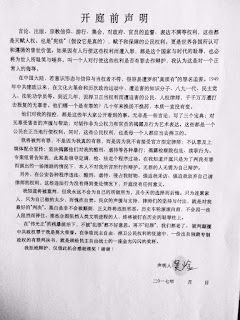
Wu Gan: Statement Before Trial

The rights of speech, publication, religious belief, procession, assembly, supervision of the government and officials, and expression of dissatisfaction are all human rights endowed by nature. In addition, the "Constitution" (assuming it's real), grants and guarantees civil rights. Furthermore, these are universal values recognized and followed by all countries in the world. If someone is convicted for exercising these rights, it will be a disgrace to this country and this era, and it will surely be ridiculed and spurned by the world. To ask a person to defend whether or not they are guilty of exercising these rights is, I think, an insult to any normal person.

In mainland China, if one's ideology and beliefs do not comport with those in power, it is easy to end up persecuted by getting framed through "trumped-up" charges. Since the establishment of the Communist Party of China in 1949, during the Cultural Revolution and previous political campaigns, intellectuals, the 1989 and 1990s, democrats, Falun Gong practitioners, etc. have been persecuted. In recent years, citizens and human rights lawyers have been persecuted for defending their legitimate rights, and thousands of innocent people who have been retaliated against. Who among them is guilty? For decades it has been old wine in new bottles, and the essential nature has not changed.

The accusations they made against me have all been publicly visible over the past few years. They are nothing more than some remarks, writing the Three Classics, solidarity and assistance for innocent victims, and exposés and performance art expression targeting public power and government officials run amok. These are the legitimate rights of a citizen. At the same time, these civil rights should be defended by everyone.

I will be convicted, not because I am really guilty, but because I refuse to accept a government appointed lawyer, because I will not plead guilty and cooperate with the media propaganda, because I insist upon exposing their torture, abuse, and other atrocities against me; because I expose the procuratorate's cover-ups and derelictions of duty.

The task force once told me that in this case the leadership is calling the tune, and the procuratorate and the judiciary are just going through the motions. I will not defend what I have said or done under circumstances where I know that the trial is merely a farcical performance where I will be found guilty. The innocent need not defend themselves.

In addition, a trial is meaningless when the police procedures employed various illegal procedures, torture, abuse, embezzling my property, forcing me to accept their questions, and forcing me to give up my right to hire a lawyer, and none of these illegal acts were investigated and dealt with.

I know there will be a heavy sentence, but I will never regret what I did and the choices I made today. I only feel guilt and remorse at having involved my family and have done too little. The voice and support of the people, and the persistence and dedication of the lawyers are the best "verdict" for me. Right and wrong will not be reversed, and justice will eventually triumph over evil. The wheel of history rolls forward and will not stop when some people try to block it. Those who try to obstruct the progress of human civilization will eventually be nailed to history's pillar of shame.

Under the brutal rule of "The Great, The Glorious, The Correct,"1 it is embarrassing not to be "criminalized." If we don't keep getting "criminalized" we'll all grow old. It is a great honor for me to be convicted of subverting the CCP regime. On the journey to fight for democracy and freedom and defend the rights of citizens, a guilty verdict from an autocratic dictatorship is a golden trophy awarded to a fighter for democracy and freedom.

I refuse to make a defense, and merely take this opportunity to thank you for this award! Thank you!

Declarant: Wu Gan

[Month and Date Missing from Source Material], 2017
  

Wu Gan's Pre-Trial Statement
 

In the judgment (see "State Trials of Speech in the PRC" pp. 192-229) the court cited 13 examples of Wu Gan's conduct that it determined formed the basis of his subversion. The first example the court gave in the judgment was "Utilizing Information Networks to Attack the State Regime and the Socialist System." (see State Trials of Speech in the PRC" pp. 197-200) According to the court "part of the content that Wu Gan posted on his Twitter account was: "The Butcher's Three Classics: 1: The Classic on Butchering Pigs for Petitioners. 2: The Classic on Drinking Tea. 3: The Classic on Petitioning Against Forced Demolitions and Land Appropriations." The court found that his publication of Three Classics were not protected speech under the PRC's Constitution:

Our country's Constitution grants citizens freedom of speech and the rights to criticize, suggest, and bring suit against State agencies and their staff. At the same time, it stipulates that when exercising their rights and freedoms citizens shall not harm the national, social, or collective interests and other legal freedoms of citizens. Wu Gan published articles and statements such as "Three Great Classics" on information networks that sensationalized hot-button case incidents, took advantage of issues to amplify contradictions, and fabricated rumors and distorted facts. This not only severely harmed the reputation of others, it also seriously disrupted social order and severely endangered state security. What purported to be reflecting complaints and demands was in reality subversion of state power that exceeded the legal limit of the legitimate exercise of rights and freedoms, and was the commission of an offense under relevant provisions of the criminal law.

Below is translation of "The Classic on 'Drinking Tea'" that Wu Gan posted on his Instagram on July 9, 2014. The original Chinese version can be found at the end of this blog post.

The Classic on "Drinking Tea"

Wu Gan

In a nation without democracy and freedom, "drinking tea" is the only way to truly become a citizen. "Drinking tea" usually refers to being interviewed by public security or state security officials because of your speech or your civic actions. In fact, most of the time there is no tea to drink, not even plain boiled water. I believe it is necessary to overcome the fear of "drinking tea," and learn to how to handle dealings with the machinery of dictatorship. After my initial experience of terror at "drinking tea," I have subsequently grown accustomed to it. Of course, this "Classic on Tea Drinking" is merely my personal opinion, and I am just sharing my experience with everyone who will be "drinking tea." The situation will vary depending on the person and the environment.

When "drinking tea" one is usually faced with two types of people, the State Defense Department of the Public Security Bureau (domestic security defense) and the Security Office of the State Security Bureau. One will be "invited to tea" by the Security Office only if matters are related to foreign countries, while the State Defense Department is responsible for domestic affairs. State Defense is the one generally making an appearance, while the Security Office remains relatively low-key and rarely makes an appearance. Because they are human beings, they are also divided into several categories, but they are all people who perform the tasks of the machinery of dictatorship, so they can be mainly divided into 3 categories:

  1. Brutal Type: This kind of person is of low quality and generally has psychological problems. He regards power as a tool of violence, has no humanity, and enjoys persecution and violence. He proves his authority and existence by deriving pleasure and satisfaction from perpetrating evil and violence.

  2. Understanding Type: This person knows that what they are doing is disgraceful work, and also clearly understands the nature of the machinery of dictatorship. He understands that the regime has no future, and so he will not take the initiative to commit violence and evil. He takes his job as a way to earn a living, and undertakes those duties that are required of him.

  3. Mechanical Type: This person has been deeply brainwashed, and their thinking conforms to the machinery of dictatorship. He treats what is wrong as what is right, and believes he is doing a very honorable job.

"Drinking tea" usually involves them coming to you or letting you go to them. Usually, it mostly means a warning. They uses warnings, instilling fear, and creating burdens to make you retreat and give up fighting for civil rights. They will also teach you political lessons, imbuing viewpoints that they think are correct, such as:

  • "You have a good life, why do you care about those things?"

  • "Now that the country has been making progress, you must also believe in the government and the Party. In the reform process, there will be such and such problems, It's normal, I believe the Party can solve it."

  • "So-and-so is a hostile element, a bad person, you have to be vigilant and don't associate with him."

  • "There is a deep water behind the so-and-so incident, and there are foreign forces involved, you have to be careful not to be used. ."

  • "If you don't obey, we'll be welcome next time."

  • "You have to think more about your family."

"Drinking tea" sometimes involves taking notes, investigations of the ins and outs of a certain event, and occasionally and demand for asks for a Letter of Assurance.

The foregoing are the types of people one must face when "drinking tea," as well as the main content of "drinking tea." What follows is my discussion about what to pay attention to when "drinking tea."

Since you can't escape the machinery of dictatorship, you can only choose to dance with wolves, so "drinking tea" sometimes requires wisdom and preparation. Before becoming a true citizen, you must do the following three things before "drinking tea":

  1. Confirm that you can bear the consequences for what you have done, and whether you are prepared to be harassed and intimidated, be placed under house arrest, be "invited to tea," be re-educated through labor, or even be sentenced to prison.

  2. When you fight for civil rights, you must act honorably, openly, and justly.

  3. Have you prepared for the loss of of your freedom with information release channels, lawyers' assistance, family members and outside contact information, etc., because often you will be taken away and locked up after "drinking tea."

Points to note when "drinking tea":

  1. Be neither humble nor arrogant, don't let your terror and fear show, and try not to be deceived and provoked in the face of violence or insults.

  2. When you are asked something, only discuss your own part, try not to talk about others, try to pretend to be confused. The best way to plead your case is to say "I can't remember," "I forget", "I don't understand", and "I don't follow."

  3. Tell them that what you are doing is upright, honorable, and just, and that you have made various arrangements.

  4. Do your utmost not to have personal grievances with them, and tell them clearly that if you decide to something, you will bear the consequences yourself. Also ask them not to turn public affairs into personal animus. The spirit of contract remains a necessity.

  5. Do your utmost not to insult their person, try not to be antagonistic, and try not to humiliate the people you deal with on the Internet unless they humiliate you.

  6. If an individual holds a personal grudge, it is recommended to investigate them privately. As you well know, I personally have no objection to exacting justice and revenge through original blood relatives.

  7. Under no circumstances believe their words, let alone try to persuade them. Never believe that there is anything they won't do.

  8. Whether or not to write a Letter of Assurance is dependent on your own situation. Sometimes you can write one in order to end an unnecessary entanglement,. The Letter of Assurance is generally used by them show their leadership that they have completed a task. The Letter of Assurance you write when you are under duress does not bind you, and there is no need to abide by it.

  9. When getting involved in public affairs it is best to do so from an external location in order to avoid unnecessary troubles caused by local interests.

  10. They will sometimes find your employer, family, and friends to create pressure and put burdens in your lap. Dealing with this kind of burden is the most difficult, but also the most necessary. So try to let the people around you know what you're doing. Let them know you're doing the right thing, not something shady. It is difficult to get their support, but by striving for their understanding and respect it can reduce stress and misunderstandings.

On the road to becoming a citizen, you are either "drinking tea" or on the way to "drinking tea." When everyone no longer fears "drinking tea," but regards "drinking tea" as a kind of honor, then society will progress.

Example No. Seven in the court judgment was "Sensationalizing the Case of Yu Shiwen and Others Disturbing the Peace" (see State Trials of Speech in the PRC" pp. 209-211), which involved Wu Gan traveling to the city of Zhengzhou to protest the detention of Yu Shiwen (于世文) and several others (referred to online collectively as the "Ten Gentlemen") who had themselves been in Zhengzhou protesting the wrongful convictions of four individuals for murder (the four would indeed eventually be exonerated by a PRC court, see Killer Linked with Notorious Jiangxi Murder gets Death Penalty, China Daily). One of the targets of Wu Gan's "performance art" was Huang Baowei (黄保卫), who testified that while he was serving as the Director of the Public Security Bureau of Zhengzhou, Wu Gan "denigrated and cast aspersions about him on the Internet for no reason. He successively produced 'citations' on the Internet, and mobilized Internet users to engage in the 'performance art' of shooting leg guns at [him]." 

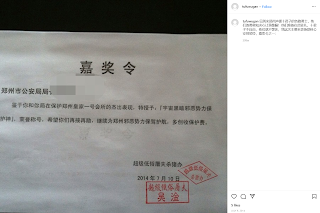
Below is translation of a "citation" that Wu Gan posted on his Instagram on July 9, 2014. The original Chinese version can be found at the end of this blog post.

Instagram Text: Seeing the warriors from all walks of life who came to support the ten gentlemen, I admire their bravery and determination! They are ready to be here. If the ten gentlemen are not freed, they will not give up. This time, I mainly commend the leaders of the Zhengzhou Public Security Bureau. One of the citations:

CITATION

Zhengzhou Public Security Bureau [TEXT OBSCURED IN ORIGINAL]

In view of the outstanding performance of you and your bureau in protecting the Zhengzhou Royal No. 1 Club, I hereby confer upon you the honorary title of "Guardian of the Dark Evil Forces of the Universe." I hope you will continue to work hard and continue to escort the evil forces in Zhengzhou and generate more income and protection fees.

Pig Slaughtering Office of the Super Vulgar Butcher 

July 10, 2014

Wu Gan's Citation for Huang Baowei as posted on Wu Gan's Instagram account.

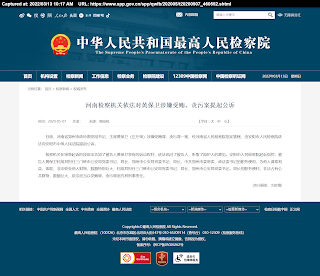
Coincidentally, on May 7, 2020, the website of the Supreme People's Procuratorate published an article titled "Henan Procuratorate Prosecutes Huang Baowei's Suspected Bribery and Corruption Cases" (河南检察机关依法对黄保卫涉嫌受贿、贪污案提起公诉). According to that article:

A few days ago, the People's Procuratorate of Anyang filed a public prosecution with the Intermediate People's Court of Anyang in accordance with the law regarding the case of former Party Secretary and Chairman of the Zhengzhou Municipal Political Consultative Conference in Henan, Huang Baowei (at the department level), being suspected of bribery and corruption.
During the review and prosecution stage, the procuratorate informed defendant Huang Baowei of his procedural rights, interrogated the defendant in accordance with the law, and heard the opinions of defense counsel. The People's Procuratorate of Anyang charged:

Defendant Huang Baowei took advantage of his positions as Secretary and Director of the Party Committee of Public Security Bureau of Sanmenxia, Secretary and Director of the Party Committee of the Public Security Bureau of Zhengzhou, Member of the Standing Committee of the CPC Zhengzhou Municipal Committee, and Secretary of the Political and Legal Committee of the Communist Party of China, to seek benefits for others, ask for and illegally accept other people's property, The amounts involved are particularly large.
He took advantage of his positions as the Party Secretary and Director of the Public Security Bureau of Sanmenxia, the Party Secretary and Director of the Public Security Bureau of Zhengzhou, to take illegal possession of public property. The amounts involved were large.
He should be charged with the crime of accepting bribes and embezzlement and bear criminal liability in accordance with the law.


Procuratorate's Announcement that Huang Baowei is Under Investigation

Wu Gan's Self Defense Statement Before Trial

吴淦:开庭前声明(附 影印件)

2017年08月09日

言论、出版、宗教信仰、游行、集会,对政府、官员的监督、表达不满等权利,这些都是天赋人权。也是"宪法"(假设它是真的),赋予和保障的公民权利。更是世界各国所认可和遵循的普世价值。如果因有人行使这些权利而遭入罪,都是这个国家与时代的耻辱,也必将为世人所耻笑与唾弃。叫一个人对行使这些权利是否有罪去作辩护,我认为这是对一个正常人的侮辱。

在中国大陆,若意识形态与信仰与当权者不符,很容易遭罗织"莫须有"的罪名迫害。1949年中共建政以来,在文化大革命和历次政治运动中,遭迫害的知识分子、八九一代、民主党人、法轮功学员等。到近几年,因捍卫正当权利而遭迫害的公民、人权律师,千千万万遭打击报复的无辜者,他们哪一个是有罪的?几十年来换汤不换药,本质一直没有变。

他们对我的指控,都是这些年大家公开看到的亊。无非是一些言论,写了三个宝典;对无辜受害者的声援与帮助;对胡作非为公权力和官员的揭蕗及行为艺术表达。这些都是一个公民在正当地行使权利。同时,这些公民权利,也是每一个人都应当去捍卫的。

我将被判有罪,不是因为我真的有罪,而是因为我不肯接受官方指定律师;不认罪及上媒体配合宣传;坚决揭露他们对我的酷刑、虐待等各种暴行;揭露检察院包庇、渎职行为。

专案组曾告知我,此案是领导定调,检、法走个程序过场。在我知道开庭只是为了判我有罪而演出的一场闹剧的情况下,本人不对我所言所行作辩护。无罪的人无需为自己辩护。

另外,在公安各种程序违法、酷刑、虐待、侵占我财物、强迫我采访、强迫我放弃自己请律师的权利,这些违法行为没有得到査处情况下,开庭没有任何意义。

我知道将被重判,但我永远不会为自己的所做所为,及今天的选择而后悔。只为连累家人,只为自己做的太少,而愧疚自责。民众的声接与支持,律师们的坚持与付出,就是对我最好的"判决"。黑白是非不会被颠倒,正义终将战胜邪恶。历史车轮滚滚向前,不会因一些人阻挡而停住。那些企图阻挡人类文明进程的人,终将被钉在历史的耻辱柱上。

在"伟光正"的残暴统治下,不被"犯罪"都不好意思。再不"犯罪"我们都老了。被判颠覆中共政权罪于我是莫大荣誉,在争取民主自由、捍卫公民权利的征途中,一份出自独栽专制政权的有罪判决书,就是颁给民主自由战士的一座金光闪闪的奖杯。

我拒绝辩护,仅借此机会感谢颁奖!谢谢!;

声明人:吴淦(签名)
二0一七年月曰

Wu Gan's Classic on Drinking Tea

"喝茶"宝典 

吴淦

在没有民主自由的国度,"喝茶"是想成为一个真正公民的必经之路,"喝茶"通常指因为你的言论或你的公民行动被警察、国安约谈,其实多数时候是没有茶喝的,甚至连白开水都没有。战胜"喝茶"恐惧,学会跟专政机器打交道我觉得很有必要,我也是从起初的"喝茶"恐惧到经历到后来习以为常的。当然这个"喝茶宝典"只是我个人的一些看法,只是把经验与各位即将被"喝茶"的人一起分享,情况会因为自身和所处的环境不同而异。

"喝茶"通常是面对公安局国保(国内安全保卫)和安全局国安两类人,如果和外国有关联,才会被国安"喝茶",国保负责国内的事。国保一般都在台面上,国安比较低调和不常露面。因为是人,所以他们也分好几类,但他们都是执行专政机器任务的人,故主要可以分为3类:

(1)残暴型:这种人素质低,一般心理有问题,把权力当成施暴工具,没有人性,以迫害和施暴为乐,通过作恶和施暴以此来证明自己的权威和存在,从作恶施暴中得到快感和满足。

(2)明白型:知道自己所从事的是一种不光彩的工作,也清醒地明白这专政机器本质,也知这政权来日不多,所以不会主动施暴和主动作恶,把这工作当混饭,有任务就执行。

(3)机器型:被洗脑灌输很厉害,思维和专政机器一致,会把错误的东西当正确来做,认为自己在从事很光荣的工作。

"喝茶"通常是他们上门找你或让你去他们那里,一般是警告意味比较多,通过警告、制造恐惧、制造包袱让你退却和放弃争取公民权利,他们也会对你上政治课,灌输他们认为正确的观点,比如:"你自己生活好了,去管那些事情干嘛?""现在国家一直在进步,你也要相信政府和党。在改革进程中会出现这样那样的问题,很正常,相信党能解决。""某某人是敌对分子,是坏人,你要警惕,不要和他交往。""某某事件背后水很深,有外来势力参与,你要注意不要被利用。""你如果再不听话,下次我们就不客气了。""你要为家人多考虑着想"等等。"喝茶"有时会做笔录,调查某一件事的来龙去脉,有时还要求写保证书。

以上是"喝茶"要面对的人的类型和"喝茶"的主要内容,下面我谈谈"喝茶"要注意哪些东西。

既然你无法摆脱专政机器,只能选择与狼共舞,所以"喝茶"有时也需要智慧和做好准备。成为真正公民前,在"喝茶"前你要做好以下3点:

(1)确认你所做的事情是你所能承担的、是否做好了准备,比如被骚扰恐吓、被软禁、被"喝茶"、被劳教甚至被判刑。

(2)你在做那些公民权利争取时,一定要做到阳光、公开、正义。

(3)你是否做好了你如果失去自由后信息发布的渠道、律师帮助、家属和外界联系方式等等准备,因为很多时候"喝茶"完就被带走关起来。

"喝茶"中要注意的事项:

(1)不卑不亢,不要显示出你恐惧害怕心态,面对暴力或侮辱,尽量不要上当被激怒。

(2)问你事情的时候,只说你自己的部分,别人的尽量不要去说,尽量装糊涂。"记不清"、"忘记了"、"不了解"、"搞不懂"都是最好的托词。

(3)告诉他们,自己所从事的事情是光明磊落、阳光的,是正义的,自己也做好了各种准备。

(4)尽量不要和他们个人结下个人恩怨,明白告诉他,如果你决定要做,自己会承担后果,也请他们个人不要把公事变私仇,有些契约精神还是需要的。

(5)尽量不要去侮辱他们人格,尽量不要对立,尽量不要在网上去羞辱和你打交道的人,除非他们羞辱了你。

(6)如果个人结下私仇,建议去私下了解调查他,原始血亲正义复仇我个人不反对,这你懂得。

(7)千万不要相信他们的话,更不要试图去说服他们。千万不要相信他们有什么事做不出来。

(8)写不写保证书,根据你自己的情况而定,有时为了结束无谓的纠缠,可以写。保证书一般是他们拿去交差用,你在被胁迫情况下所写的保证书,不对你有约束作用,没有必要去遵守。

(9)介入公共事务,最好是异地介入,避免地方利益引起的不必要麻烦。

(10)他们有时会找你单位、家人、朋友,制造压力,让你有包袱,对这类包袱处理是最难的,也是必须面对的,所以你尽量让你身边的人知道你在做什么,让他们知道你在从事阳光正义的事情,而不是见不得人的事情。得到他们支持是很难的,但要争取他们的理解和尊重,这样可以减轻压力,减少误会。

成为公民的道路上,你不是在"喝茶",就是即将要去"喝茶"的路上,每个人都不怕"喝茶"了,都把"喝茶"当成一种荣光,这社会就进步了。

Wu Gan's Citation to Huang Baowei

见到来声援十君子的各路勇士,他们的勇敢和决心让我佩!他们准备在此,十君子不自由,他们就不罢休,我这次主要来表扬郑州公安局领导,嘉奖令之一:

嘉奖令

郑州市公安局局

鉴于你和你局在保护郑州皇家一号会所的杰出表现,特授予:「宇宙黑暗邪恶势力保护神」,荣誉称号,希望你们再接再励,继续为郑州邪恶势力保驾护航,多创收保护费。


超级低俗屠夫杀猪办

2014年7月10日

Government Statement: Henan Procuratorate Prosecutes Huang Baowei's Suspected Bribery and Corruption Cases

https://www.spp.gov.cn/spp/qwfb/202005/t20200507_460552.shtml

河南检察机关依法对黄保卫涉嫌受贿、贪污案提起公诉
时间:2020-05-07作者:来源:高检网

日前,河南省郑州市政协原党组书记、主席黄保卫(正厅级)涉嫌受贿罪、贪污罪一案,经河南省人民检察院指定管辖,由安阳市人民检察院依法向安阳市中级人民法院提起公诉。

检察机关在审查起诉阶段依法告知了被告人黄保卫享有的诉讼权利,依法讯问了被告人,听取了辩护人的意见。安阳市人民检察院起诉指控:被告人黄保卫利用其担任三门峡市公安局党委书记、局长,郑州市公安局党委书记、局长,中共郑州市委常委、政法委书记的职务便利,为他人谋取利益,索取、非法收受他人财物,数额特别巨大;利用其担任三门峡市公安局党委书记、局长,郑州市公安局党委书记、局长的职务便利,非法占有公共财物,数额巨大,依法应当以受贿罪、贪污罪追究其刑事责任。

Friday, February 25, 2022

Yu Wensheng's Writings Deemed to Have Incited Subversion

Yu Wensheng (余文生) was civil rights lawyer based in Beijing. His clients included Wang Quanzhang (王全璋), another civil rights lawyer who was also convicted of speech-related offenses. Yu was awarded the Franco-German Prize for Human Rights and the Rule of Law on November 21, 2018.

According to PRC government documents, on January 20, 2018, Yu was detained by the Public Security Bureau of Beijing, Shijingshan Division on suspicion of committing the crime of obstructing an official in the exercise of their duty. On January 24, 2018, he was taken into criminal detention by the Public Security Bureau of Tongshan District, Xuzhou on suspicion of committing the crime of inciting subversion of state power. On the 27th of that month he was ordered placed under residential confinement at a designated location. On April 19, 2018, the People's Procuratorate of Xuzhou authorized his arrest on suspicion of committing the crimes of inciting subversion of state power and obstructing an official in the exercise of their duty.

On June 17, 2020 the Intermediate People's Court of Xuzhou, Jiangsu found Yu guilty of committing the crime of inciting subversion of state power, and sentenced him to a fixed term imprisonment of four years and three years deprivation of political rights. A full translation of the court judgment is available here: http://blog.feichangdao.com/2021/07/709-YuWensheng-Judgment.html.

On December 13, 2020, the High People's Court of Jiangsu rejected Yu's appeal, and upheld the Intermediate Court's judgment.

Below are translations of two of the documents that the PRC court cited as evidence of his inciting subversion. Specifically, the court said:

On the afternoon of October 18, 2017, the defendant Yu Wensheng cooked up the "Lawyer Yu Wensheng's Open Letter" and posted it on "Facebook" and "Twitter." It denigrated our country's Party and State leaders, and repudiated the Party's leadership. On January 16, 2018, Yu Wensheng once again posted that article on "Facebook" and "Twitter." In the early morning of January 18, 2018, Yu Wensheng cooked up the "Yu Wensheng's Open Letter on a Proposal to Amend the Constitution" and published it on "Facebook" and "Twitter," repudiating the organizational form of our country's existing regime and the leadership of the Party and the foundations of the socialist system. 

The lower court's judgment did not provide any analysis explaining why these open letters were not protected speech under either Article 35 or Article 41 of the PRC Constitution, which provide:

  • Article 35. Citizens of the People’s Republic of China enjoy freedom of speech, of the press, of assembly, of association, of procession and of demonstration.
  • Article 41. Citizens of the People’s Republic of China have the right to criticize and make suggestions regarding any State organ or functionary.

Proposal to Recall Xi Jinping at the 19th National Congress of the Communist Party of China and Comprehensively Implement Political Reform

An Open Letter from Lawyer Yu Wensheng

Delegates to the Nineteenth Congress of the Communist Party of China:

Since the 18th National Congress of the Communist Party of China in 2012, China's human rights have deteriorated, the rule of law has regressed, torture has become rampant, and unjust imprisonment has become widespread. The CPC authorities speak of freedom, democracy, equality, and the rule of law. In reality, China has no freedom, no democracy, no equality, and no rule of law. What it does have are powerful officials and corruption run amuck.

In 2013, the CPC authorities suppressed the "New Citizens Movement" and arrested citizens who demanded "official property disclosure" on a large scale. In 2014, the CPC authorities suppressed the "Hong Kong Occupy Central" movement, and Beijing and Guangzhou conducted sweeping arrests of citizens who "supported Hong Kong Occupy Central." In the "7.09" Incident in 2015, the CPC authorities conducted sweeping arrests of "human rights lawyers" and "human rights defenders." Over the past five years, the CPC authorities have tortured and killed innocent compatriots; in the "Qing'an Incident," "Leiyang Incident", etc., the murderers went unpunished. Over the past five years the CPC authorities have continued to persecute "Falun Gong," burn "crosses," and suppress freedom of belief. Over the past five years "evil laws" have become rampant, with the "National Security Law," the "Cybersecurity Law", etc. oppressing dissenting citizens who would defend their rights, punishing for speaking out, and protecting the interests of the powerful.

Looking back over the 97-year history of the CPC, looking back over the 68-year history of the CPC established government, the autocratic centralization and extreme corruption, who cares about the life and death of the people? The inhumane crimes they have committed are legion!

As the paramount leader of the Communist Party of China, Xi Jinping has been in power for five years. He has gone against the tides of history, has turned back the clock, has strengthened totalitarian rule, and he is no longer suitable to remain in office. As a Chinese lawyer, Yu Wensheng proposes that the 19th National Congress of the Communist Party of China should remove Xi Jinping, go with the tides of history, comprehensively implement political reform, build a free, democratic, human rights, and law-based China, and return power to the people.

Lawyer Yu Wensheng

October 18, 2017 in Beijing

Source: Yu Wensheng's Twitter Account - https://twitter.com/yuwensheng/status/952955040574029824

A Citizen's Proposal for a Constitutional Amendment

Yu Wensheng's Open Letter to the Second Plenary Session of the 19th National Congress of the Communist Party of China


The CPC Central Committee and Each Member:

Because the CPC has some constitutional amendments brewing for January 18 and 19, 2018, Yu Wensheng, formerly a lawyer of the People's Republic of China who has been engaged in legal work for nearly 20 years, puts forward the following constitutional amendment opinions for the reference of the CCP ruling authorities.

1. It is proposed to delete the "Preamble to the Constitution." The "Preamble to the Constitution" has no actual binding force or actual constitutional significance in the constitution and law, and in practice will create disputes and ambiguities. It is proposed that the relevant content of the "Preamble to the Constitution" has utility be "converted into articles" or included in a "Constitutional Interpretation," with the other content to be deleted.

2. It is proposed that the Chairperson of the State be determined through competitive elections. The State Chairperson is the head of State, and an uncontested election is similar to an appointment. It is not a meaningful election, and lacks any credibility whatsoever for the country, civil society, and other nations throughout the world.

3. It is proposed that the Chairperson of the Military Commission be abolished, and some of its functions and powers be merged into the powers of the Chairperson of the State. It is proposed that the President of the Supreme Court and the Procurator-General of the Supreme Procuratorate be nominated by the Chairperson of the State and approved by the National People's Congress. Since the Chairperson of the State, the Chairperson of the Military Commission, the President of the Supreme Court, and the Procurator-General of the Supreme Procuratorate are all elected by the National People's Congress, the way they are elected affects the authority of the Chairperson as the head of state, and is not conducive to the Chairperson's representation of the country internally and externally. The Chairperson of the State should automatically have the highest command of the military, and the abolition of the post of the Chairperson of the Military Commission and its incorporation into the purview of the Chairperson of the State can strengthen military execution and military legitimacy.

4. It is proposed to abolish the Military Commission and that its powers to be merged into the Ministry of National Defense and under the leadership of the State Council. The army is the army of the country, and the army cannot be above the country. As the highest administrative organ of the country, the State Council should lead the army on behalf of the country.

5. It is proposed that a dedicate chapter should be established in the Constitution stipulating a "Party Administration System." Any political party shall register with the State administrative agency (the Ministry of Justice or the Ministry of Civil Affairs), any political party must be subject to the State administrative agency, and no political party may be above the highest organ of power (the National People's Congress).

6. It is proposed that the Political Consultative Conference be disbanded as it is without a constitutional basis.

Proposed by: Yu Wensheng

January 18, 2018, in Beijing

Source: Yu Wensheng's Twitter Account - https://twitter.com/yuwensheng/status/953701041396105216

建言中共十九大罢免习近平、全面推行政治体制改革

余文生律师公开信

中国共产党第十九次代表大会各位代表:

自2012年中共十八大以来,中国人权恶化、法治倒退、酷刑泛滥、冤狱横生。中共当局言自由、民主、平等、法治,实际中国无自由、无民主、无平等、无法治,有的是权贵当道、贪腐横行。

2013年中共当局镇压"新公民运动",大规模抓捕要求"官员财产公示"的公民; 2014年中共当局镇压"香港占中"运动,北京、广州大规模抓捕"支持香港占中"的公民;2015年"709"事件,中共当局大规模抓捕"人权律师"人权捍卫者"。五年来,中共当局虐杀无辜同胞,"庆安事件"雷阳事件"等等,凶手逍遥法外;五年来,中共当局继续迫害法轮功"、火烧"十字架",镇压信仰自由;五年来,"恶法"横行,《国家安全法》《网络安全法》等等,打压维权异议公民,依言论治罪,维护权贵利益。

回首中共97年历史,回首中共建政68年历史,专制集权、腐败透顶,哪管人民死活,它犯下的"反人类"罪行,馨竹难书!1

习近平作为中共最高领导人,五年执政,不顺应历史潮流,开历史倒车,强化极权统治,其已不适合继续留任。余文生作为中国律师,建言中共十九大罢免习近平,顺应历史潮流,全面实行政治体制改革,建立建设自由、民主、人权、法治中国,还政于民。

余文生律师
2017年10月18日于北京

关于修宪的公民建议

余文生致中共十九大二中全会的公开信


中共中央委员会及各位委员:

由于中共2018年1月18、19日酝酿修宪,余文生作为从事法律工作近20年的中华人民共和国前律师,提出以下修宪意见,供中共执政当局参考。

一、建议删除“宪法序言”。“宪法序言”在宪法及法律上不具有实际约束力和实际宪法意义,在实际应用上会产生争议和歧义,建议将“宪法序言”的相关有用内容“条文化”或纳入“宪法解释”,其他内容予以删除。

二、建议国家主席差额选举产生。国家主席作为国家元首,等额选举类似于任命,没有任何选举意义,对国家、对公民社会、对世界各国都不具有公信力。

三、建议取消军委主席,其部分职权并入国家主席职权范围;建议最高法院院长、最高检察院检察长由国家主席提名,全国人大通过产生。由于国家主席、军委主席、最高法院院长、最高检察院检察长都是全国人大选举产生,其产生方式,影响了国家主席作为国家元首的权威性,不利于国家主席对内对外代表国家。国家主席应该自动具备军队最高指挥权,取消军委主席职位,并入国家主席职权范围,可以加强军事执行力及军事合法性。

四、建议取消军事委员会,其职权并入国防部,并受国务院领导。军队是国家的军队,军队不能凌驾于国家之上,国务院作为国家最高行政机关,理应代表国家领导军队。

五、建议宪法设专章规定“政党管理制度”。任何政党都应在国家行政机关(司法部或民政部)登记,任何政党都必须接受国家行政机关管理,任何政党都不能凌驾于最高权力机关(全国人民代表大会)之上。

六、建议撤销没有宪法依据的政治协商会议。

建议人:余文生
2018年1月18日于北京 

Sunday, October 31, 2021

Translation: New York Times v. Sullivan with PRC Characteristics

Intermediate People's Court of Yulin, Shaanxi


Administrative Decision


(2020) Shaan 08 Administrative Final No. 521


Translator's Summary: The court found that police did not violate Yuan's rights when they subjected him to administrative detention for reposting an article to his personal social media accounts that police determined defamed a Communist Party cadre. The court held that as a journalist Yuan had a duty to verify the contents of the article.

Appellant (plaintiff in the original trial) Yuan Jianmeng, male, born [INTENTIONALLY OMITTED], 1982, Han ethnicity, born in Taiyuan, Shanxi, residing in Yingze District, Taiyuan.

Entrusted representative Zhang Jinzhen is a lawyer at the Shanxi Wenying Law Firm.

Appellee (defendant in the original trial) Public Security Bureau of Yulin, Hengshan Division.Address: Shaanxi Yulin, Huancheng North Road, Hengshan District, Unified Social Credit Code: 1161080001******.

Legal representative He Guoyu, director.

Person in charge of the court appearance Lu Jianjiang, deputy director.

Entrusted representative Luo Bin, a police officer at the Division's Legal Department.

Entrusted representative Hui Hao, a police officer at the Division's cyber security brigade.

Appellee (defendant in the original trial) Public Security Bureau of Yulin. Address: Shaanxi Yulin, No. 4, Fushi Road, Yuyang District. Unified Social Credit Code: 11610800016*******.

Legal representative Qiu Zuman, Director.

Entrusted representative Zhang Hao and Wang Long are police officers at the Bureau's Legal Department.

In relation to a public security administrative punishment case, appellant Yuan Jianmeng did not accept the People's Court of Yuyang, Yulin's (2019) Shaan 0802 Administrative First Instance No. 70 administrative judgment, and filed an appeal with this Court. After this Court docketed the case, it formed a collegial panel in accordance with the law and tried this case. The trial has now concluded.

In his lawsuit appellant Yuan Jianmeng requested the court in the trial of first instance:

1. Rescind the Heng Public (Cyber Security) Administrative Punishment Decision (2019) No. 67 administrative punishment decision rendered by defendant Public Security Office of Hengshan on January 29, 2019;

2. Rescind the Yu Public Reconsideration Decision (2019) No. 11 reconsideration decision rendered by the Public Security Bureau of Yulin on April 28, 2019; and

3. The litigation costs in this case be born by defendant No. 2.

The court in the original trial ascertained at trial that: Plaintiff Yuan Jianmeng was a reporter for the Shanxi Newspaper Group's Development Herald New Horizons Weekly. On January 25, 2019, the plaintiff did, without undertaking any verification, repost an article with the title "The 'Big Knife Brigade' In Hengxing Township, Did the King of the District Committee Really Serve the People?" from the Wechat public account "Brilliant City Recommendations" to his own registered Sina Weibo blog "Understanding Chang'an Street" and also pushed it to his personal Weibo account "Understanding Baiwan Zhuang," where it was clicked on over 1,300 times. This constitutes illegal defamatory facts.

In accordance with Article 42(2) of the "Public Security Administrative Punishments Law," on January 29, 2019, defendant Public Security Office of Hengshan rendered the Heng Public (Cyber Security) Administrative Punishment Decision (2019) No. 67 administrative punishment decision, imposing a punishment on the plaintiff of eight days administrative detention. The plaintiff did not accept this, and applied to the defendant Public Security Bureau of Yulin for reconsideration. On April 28, 2019 that office rendered the Yu Public Reconsideration Decision (2019) No. 11 reconsideration decision, and in accordance with the provisions of Article 28(1)(i) of the "Administrative Reconsideration Law of the People's Republic of China" (hereinafter referred to as the "Administrative Reconsideration Law"), sustained the aforementioned Administrative Punishment Decision rendered by the defendant Public Security Office of Hengshan. The plaintiff still did not accept this, and filed a lawsuit with this Court, raising the aforementioned claims.

The court in the original trial held that, in accordance with the provisions of Article 7 of the "Public Security Administration Punishment Law," the public security agency of the local people's governments at or above the county level are responsible for the administration of public security within their administrative area. The jurisdiction of public security cases are stipulated by the public security department of the State Council. Article 9 of the "Procedures for the Handling of Administrative Cases by Public Security Agencies" of the Ministry of Public Security stipulates that administrative cases shall be under the jurisdiction of the public security agency in the place where the illegal act occurs. Hengshan District is the primary place where the consequences of the offense in this case occurred, which is under the jurisdiction of the Public Security Division of Hengshan. Therefore, that office has the statutory authority to investigate and handle violations of public security administration that are implicated in this case.

Article 12 of the "Administrative Reconsideration Law" stipulates that if someone is dissatisfied with a specific administrative action of a working agency of a local people's governments at or above the county level, the individual may choose to apply for administrative reconsideration to the people's government at the same level as the department, or apply for administrative reconsideration to the competent department at the next higher level. The Public Security Bureau of Yulin, as the upper-level competent department of the Public Security Division of Hengshan, has the statutory authority to accept the plaintiff’s administrative reconsideration application, and to conduct a corresponding review and processing of administrative actions made by the Public Security Division of Hengshan.

The point of dispute in this case is whether or not the appellant's conduct constitutes a fabrication of facts to defame a third party under Article 42(2) of the "Public Security Administrative Punishments Law of the People's Republic of China." This Court interprets what is meant by the illegal act of "a fabrication of facts to defame a third party" as that offense is set forth in Article 246 of the "Criminal Law of the People's Republic of China" "(hereinafter referred to as the "Criminal Law"), and with reference to the provisions of Article 1 of the "Interpretation of the Supreme People's Court and the Supreme People's Procuratorate on Several Issues Concerning the Specific Application of Law in the Handling of Defamation Through Information Networks and Other Criminal Cases" (hereinafter referred to as the "Interpretation").

According to Article 1 of the "Interpretation" and the identified actions of the plaintiff that have been punished, the key to resolving the point of dispute in this case lies in whether the plaintiff, when reposting the article with the content about Wang Xiaoli, acted in a matter that consistent with the second paragraph of that article: "with clear knowledge that facts are fabricated that will harm the reputation of a third party." In this regard, the plaintiff claimed that the evidence of the second defendant was not sufficient to meet the clear knowledge requirement, and the plaintiff verified the authenticity of the article by looking up the source on the Internet. The second defendant argued that the plaintiff was a journalist and had a higher duty of verification with respect to reposting content, and failing to fulfill that duty amounts to having clear knowledge.

This Court finds that clear knowledge is the subjective mental state of the actor, and includes both "knew" and "should have known." The defendant’s evidence on facts did not show that the plaintiff knew exactly that the content of Wang Xiaoli in the reposted article was fabricated, so it is necessary to examine whether the plaintiff "should have known." "Should have known" is a conjecture as to the plaintiff's subjective attitude. It must be comprehensively judged based on various evidentiary materials, including the information that was disseminated, as well as the identity, occupation, and life experience of the actor.

First, the content about Wang Xiaoli that was posted was "Wang Chengbao long oppressed the masses and harmed one party, under the protective umbrella and the inaction of the Secretary of the Hengshan District Committee, Wang Hao…" and "The Secretary of the Hengshan District Committee, Wang Hao...served as a protective umbrella for underworld forces." Those are charges that Wang Xiaoli is suspected of serious crimes, but suspicions of citizens' crimes have to be based on investigations and determinations made by relevant State law enforcement agencies in the fulfillment of their authorized duties. If the plaintiff fails to verify with relevant departments and there is no judgment from law enforcement agencies in the reposted article, then on the basis of common legal knowledge one could recognize that the authenticity of this charge is unreliable.

Second, the plaintiff is a journalist. According to Article 18 of the "Administrative Measures for Journalist Accreditation," which stipulates the professional standards of journalists, "Journalists who use journalist accreditation to engage in news gathering activities shall abide by laws and regulations and journalistic professional ethics, and ensure that news reports are true, comprehensive, objective, and fair. They shall not compile and distribute false reports,  publish false news, or conceal news facts that should be reported." He should have a higher level of awareness and judgment regarding the authenticity and objectivity of the information published, so he has a greater ability to recognize the baselessness of the charges against Wang Xiaoli in the forwarded article. Although the plaintiff claimed that his forwarding behavior was not an act done his professional capacity, this fact does not affect his cognitive ability, and the defense is not sustained.

Finally, the plaintiff admitted that the blog account he used to repost the article was registered at his place of work, which also indicates that the plaintiff had a higher duty of caution in disseminating information through this account.

In summary, if the plaintiff has the capability and qualifications to verify the charge of the suspected crime that he reposted, but does not use basic verification methods, it can be determined that he should have known that the charge was not true.
Defendant Public Security Office of Hengshan lawfully reached the same conclusion based on the evidence collected during the administrative punishment process.

After receiving the reconsideration application from the plaintiff, the Public Security Bureau of Yulin fulfilled the procedures of acceptance, notification response, and verification, and ultimately rendered a reconsideration decision and served it in accordance with the law.

It was ascertained at trial that the Bureau’s administrative reconsideration procedure complied with the law and was not improper, and this determination was sustained by the court. The plaintiff's request to revoke the defendant's reconsideration decision lacked corresponding basis, and the court did not sustain it.

Accordingly, after discussion and decision by the court's adjudicative committee, in accordance with the provisions of Articles 69 and 79 of the "Administrative Procedure Law of the People's Republic of China," the judgment was: All of plaintiff Yuan Jianmeng's claims were rejected. The case acceptance fee of 50 yuan would be borne by plaintiff Yuan Jianmeng.

Appellant Yuan Jianmeng did not accept the aforementioned judgment and appealed making the following requests:

1. Rescind the judgment in the trial of first instance, and render a judgment rescinding the Heng Public (Cyber Security) Administrative Punishment Decision (2019) No. 67 administrative punishment decision and the Yu Public Reconsideration Decision (2019) No. 11 reconsideration decision rendered by the appellees.

2. All litigation fees to be borne by the defendant in the original trial承担.

Facts and Reasoning:

1. The facts determined in the judgment of the trial of first instance lacked evidentiary support. At 7:55 pm on January 25, 2019, appellant found the article titled "The 'Big Knife Brigade' In Hengxing Township, Did the King of the District Committee Really Serve the People?" while browsing the WeChat public account "Brilliant City Recommendations." Appellant the reposted the article on his Sina Weibo blogs "Understanding Chang'an Street" and "Understanding Baiwan Zhuang," and it was subsequently clicked on and viewed by others. Appellant was not the original author of the article involved. He just reposted an existing article from a website to his own blog, and he conducted searches on Baidu and other websites before collecting it on the blog to confirm that it was an article that had already been publicly disseminated, reposted, and transmitted, and that it was information known to the public-at-large. He had already fulfilled the duty of verification of the reposted article involved in the case, and Beijing Online, Zhejiang Online, domestic news and other websites, as well as the "Democracy and Law" magazine, had also reported some of the facts described in the article.

Therefore, appellant does not have a subjective motive to intentionally infringe on the reputation of others. The court of first instance, however, inferred the existance of appellant's subjective intent based on his identity as a journalist. This is contrary to legal common sense.

Everyone is equal before the law, and the law does not expressly stipulate that citizens who are journalists must have the obligation to verify when reposting and collecting articles. The court of first instance committed an error when it applied different legal treatment based on a citizen's identity.

In addition, the judgment in the original trial clearly determined that "the defendant's evidence about facts did not show that the plaintiff knew exactly that the content about Wang Xiaoli in the reposted article was fabricated." Appellee, as an administrative organ, had the legal obligation to produce evidence of illegal conduct. It is obviously not in accordance with laws and regulations for appellee to determine that appellant violated the law and impose administrative punishment when evidence was insufficient. Furthermore, the court in the trial of first instance cannot use a citizen's identity to infer that the appellee's administrative punishment was legal

2. The judgment in the trial of first instance applied the law incorrectly. Article 42(2) of the "Public Security Administrative Punishments Law of the People's Republic of China" and the "Interpretation of the Supreme People's Court and the Supreme People's Procuratorate on Several Issues Concerning the Specific Application of Law in the Handling of Defamation Through Information Networks and Other Criminal Cases" stipulate that the fabrication of facts to defame a third party must be "with clear knowledge that facts are fabricated that will harm the reputation of a third party." This stipulation makes it clear that the subjective aspects of the illegal conduct must be intentional. The evidence provided by appellee clearly proves that appellant checked this article on other websites before reposting. Appellant fulfilled his duty of verification for that article, and subjectively there existed no intent to infringe on the reputation of others and no knowledge that there were fabricated false facts, and appellant did not anticipate the result. Intent means knowing subjectively and hoping that a result will occur. It is obvious that there is an inconsistency between the appellant's subjectivity and objectivity, and it does not constitute an intentional violation of law. The court of first instance's finding that the appellant "should have known" was a conjecture regarding the subjective attitude of the appellant.

Appellant believes that "should know" is what the individual "should have known" according to an individual's age, occupation, social life experience level, etc. Where an individual "should have known" but did not actually do not know, at most it can only constitute careless negligence, and not intent with clear knowledge. Where an actor should have known but there is insufficient evidence to prove their knowledge, it should not be regarded as what the individual "should have known."

The court of first instance only determined that the appellant "knew or should have known" based on  his identity as a journalist. It only inferred that the appellant had the capability and qualifications to verify the article he is suspected of having reposted in violation of the law, but failed to adopt basic verification measures, from the fact that he registered a blog and an account at his place of work. From the foregoing it incorrectly concluded the appellant should have known that the subject of the charges were untrue. Appellant doesn't know Wang Xiaoli, has never been to Shaanxi, and lacks the basic qualifications to conduct a verification as far as geography and interpersonal relationships are concerned. What's more, Appellant only reposted and collected on his own blog, and did not subjectively deliberately spread or disseminate. As far as that article is concerned, appellant in fact subjectively did not know it to be false, and appellee has no evidence proving what exactly the appellant knew, and therefore it should not be regarded as something he "should have known."

The court in the trial of first instance made reference to the provisions of Article 18 of the "Administrative Measures for Journalist Accreditation," but the object of these administrative measures applies to journalists in their use of their press cards to engage in news interviews and news broadcasts. It does not specifically regulate individual journalists who collect articles on their own blogs in their personal capacity. The court of first instance's application of the law was inappropriate.


The Heng Public (Cyber Security) Administrative Punishment Decision (2019) No. 67 administrative punishment decision rendered by the Public Security Bureau of Yulin, Hengshan Division and the Yu Public Reconsideration Decision (2019) No. 11 reconsideration decision rendered by the Public Security Bureau of Yulin have no legal basis. In accordance with the provisions of Article 70(2) of the Administrative Litigation Law, the people's court should rule to rescind the administrative acts of the Appellee.

Appellee Public Security Bureau of Yulin, Hengshan Division argues:

1. The facts determined by the court in the trial of first instance were clear and the evidence was copious. Appellant Yuan Jianmeng was a reporter for the Shanxi Newspaper Group's Development Herald New Horizons Weekly. On January 25, 2019, he did, without undertaking any verification, repost an article with the title "The 'Big Knife Brigade' In Hengxing Township, Did the King of the District Committee Really Serve the People?" from the Wechat public account "Brilliant City Recommendations" to the Sina Weibo blog "Understanding Chang'an Street" registered and used by him, and also pushed it to his personal Weibo account "Understanding Baiwan Zhuang," where it was clicked on 1,168 and 183 times, respectively. Yuan Jianmeng, as someone who worked as a journalist, spread the unverified information on a blog and a Weibo account that greatly affected the normal work and life of the Hengshan District Communist Party Committee Secretary Wang Xiaoli himself.

2. Yuan Jianmeng disseminated fact that he clearly knew harmed the reputation of third party but that had yet to be proven to be factual through an investigation. His actions constitute defamation. Yuan Jianmeng reposted an article with the title "The Big Knife Brigade"In Hengxing Township, Did the King of the District Committee Really Serve the People??" that made a connection between "The Big Knife Brigade," which was suspected of committing crimes, and Wang Xiaoli, the Hengshan District Party Committee Secretary. His goal in doing so was grab eyeballs and increase clicks. The content in the article "Wang Chengbao long oppressed the masses and harmed one party, under the protective umbrella and the inaction of the Secretary of the Hengshan District Committee, Wang Hao…" and "The Secretary of the Hengshan District Committee, Wang Hao...served as a protective umbrella for underworld forces" were charges that Wang Xiaoli was suspected of committing severe crimes.

Whether a citizen is suspected of a crime has to be based on investigations and determinations made by relevant State law enforcement agencies in the fulfillment of their authorized duties. Yuan Jianmeng failed to verify anything with relevant departments and there were no opinions from law enforcement agencies in the reposted article. He merely searched for an article titled "The Big Knife Brigade" on websites such as Baidu. Having naturally concluded that the contents of the article had been publicized by others, and had been reposted and disseminated, he naturally concluded that the content of this article was common knowledge among the public, and reposted this article on the Sina Weibo blog that he personally used and registered and his personal Weibo account.

An adult member of the general public can recognize that the authenticity of the charges against Comrade Wang Xiaoli in the article are unreliable based on common legal knowledge. As a journalist, Yuan Jianmeng had the duty to verify and identify the information he published and reposted, and he should have a higher level of awareness and judgment as to the authenticity and objectivity of information that he disseminates. He had a greater ability to recognize the baselessness of of the charges against Wang Xiaoli.

Yuan Jianmeng had the capability and qualifications to verify the suspected crimes charged in the article he reposted, but he failed to employ basic verification methods, and from this it can be determined that he should have known that the content of those charges was untrue. His act of reposting unverified information that damaged the reputation of a third party corresponds with the fabrication of facts to defame a third party in the offense of defamation in Article 246 of the "Criminal Law of the People's Republic of China" as interpreted in Article 1 of the "Interpretation of the Supreme People's Court and the Supreme People's Procuratorate on Several Issues Concerning the Specific Application of Law in the Handling of Defamation Through Information Networks and Other Criminal Cases."

3. Our division applied the law correctly in this case, and the specific administrative penalties imposed were appropriate, fair. and just.  On January 25, 2019, Yuan Jianmeng did, without undertaking any verification, repost and disseminated an untruthful article, and his actions were suspected of being defamatory. Because his illegal actions did not constitute the commission of an offense under the "Criminal Law of the People's Republic of China," on January 29, 2019 our division subjected Yuan Jianmeng to eight days administrative detention in accordance with the provisions of Article 42(2) of the "Public Security Administrative Punishments Law of the People's Republic of China," and delivered him to the Hengshan District Detention Center to execute it on the same day.

In summary, the facts in the Heng Public (Cyber Security) Administrative Punishment Decision (2019) No. 67 administrative punishment decision rendered by our division are clear, the evidence is conclusive and copious, the law was applied correctly, and the procedures were lawful.

The judgment rendered by the court in the trial of first instance rejecting the appellant's claims was reasonable and lawful.

It is requested that the court in the trial of second instance reject the appeal in accordance with the law and uphold the judgment in the original trial.

Defendant Public Security Bureau of Yulin argued:

1. The facts of appellant's illegal actions facts are clear, the evidence is conclusive, and the Public Security Bureau of Yulin, Hengshan Division applied the law correctly, employed lawful proceedures, and applied appropriate punishment. The facts determined by the court in the trial of first instance were clear, and the evidence was copious.

2. The procedures of our bureau in rendering the administrative reconsideration decision were lawful, and the law was applied correctly. In accordance with the provisions of Articles 17 and 23 of the "Administrative Reconsideration Law of the People's Republic of China," on March 26, 2019 our bureau accepted Yuan Jianmeng's administrative reconsideration application in which he maintained he did not accept the Heng Public (Cyber Security) Administrative Punishment Decision (2019) No. 67 administrative punishment decision rendered by the Public Security Bureau of Yulin, Hengshan Division on January 29, 2019, and in accordance with the law notified the Public Security Bureau of Yulin, Hengshan Division to respond and submit relevant materials.

In accordance with the provisions of Article 22 of the "Administrative Reconsideration Law of the People's Republic of China," after the Public Security Bureau of Yulin, Hengshan Division sent the case files and written responses to our bureau, the police from the legal department of our bureau reviewed the case. On April 28, 2019, after legal department completed its review, the person in charge of the city's public security bureau convened the Law Enforcement Management Committee to discuss and study the matter, and determined that the facts regarding the Public Security Bureau of Yulin, Hengshan Division's handling of the case were clear, the evidence was copious, the procedures were lawful, and the law was applied correctly. It rendered a decision to sustain, and in accordance with the law, mailed the administrative reconsideration decision to appellant Yuan Jianmeng.

In summary, the administrative penalty decision rendered by the Public Security Bureau of Yulin, Hengshan Division and the administrative reconsideration decision rendered by our bureau have clear facts, copious evidence, lawful procedures, and correctly applied laws. The judgement in the trial of first instance had clear facts and correctly applied laws. It is requested that the appeal be rejected and the judgment in the original trial be upheld.

During the trial of second instance appellant Yuan Jianmeng produced a screenshot of a web page in order to prove: There existed actual facts relevant to the case, which were affirmed with the signatures and fingerprints of ordinary people. Appellant had fulfilled his duty of verification, and it should be deemed authentic content.

The opinion of appellee the Public Security Bureau of Yulin, Hengshan Division with respect to the evidence examined is: The time of the screenshot report is not clear, and the portion that is clearly visible is not related to the article the appellant reposted. The villagers' fingerprints cannot prove the authenticity of the content. The authenticity should be have been acknowledged by an official agency, and journalists should go to the scene to verify the authenticity of news. It does not acknowledge the probative value of the evidence.

The opinion of appellee the Public Security Bureau of Yulin with respect to the evidence examined is: It does not acknowledge the authenticity, relevance, and probative value of the evidence.

This Court certifies the aforementioned evidence as follows: The content contained in the screenshot was not issued by a statutory authority. Moreover, the content contained in the screenshot is not consistant with the content of the article reproduced by Appellant, and it is insufficient to substantiate the authenticity of the content of the article reproduced by Appellant. It is also insufficient to prove that appellant fulfilled his duty of verification, and it is not accepted as probative.

The facts ascertained in the trial of second instance were consistent with the facts ascertained at the trial of first instance, and are affirmed by this Court.

This Court finds: The point of dispute in this case is whether or not the appellant's conduct constitutes a fabrication of facts to defame a third party under Article 42(2) of the "Public Security Administrative Punishments Law of the People's Republic of China." With respect to this, pursuant to the provisions of Article (1) of the "Interpretation of the Supreme People's Court and the Supreme People's Procuratorate on Several Issues Concerning the Specific Application of Law in the Handling of Defamation Through Information Networks and Other Criminal Cases" (Judicial Interpretation(2013) No. 21), if the conduct of an actor involves fabricated facts that damage the reputation of others which are disseminated on information networks, it may be regarded as fabricating facts to defame others. In determining the authenticity of information, the disseminator shall bear the necessary burden of proof, especially in circumstances where the disseminated information may have an adverse effect on others and the public interest. This is the boundary for citizens' freedom of speech, and it is also the boundary for citizens to exercise their rights of supervision and criticism. It is also necessary to safeguard the legitimate rights and interests of others, social stability, and public order and fair practice.

According to the facts ascertained in this case, on January 25, 2019, the appellant reposted an article with the title "The 'Big Knife Brigade' In Hengxing Township, Did the King of the District Committee Really Serve the People?" from the Wechat public account "Brilliant City Recommendations" to the Sina Weibo blog "Understanding Chang'an Street" registered and used by him, and also pushed it to his personal Weibo account "Understanding Baiwan Zhuang," where it was clicked on over 1,300 times. The reprinted article alleged that "Wang Chengbao long oppressed the masses and harmed one party, under the protective umbrella and the inaction of the Secretary of the Hengshan District Committee, Wang Hao…" and "The Secretary of the Hengshan District Committee, Wang Hao...served as a protective umbrella for  underworld forces." The dissemination of the aforementioned information would obviously lower the reputation and social evaluation of the government agencies and personnel involved. When publishing the aforementioned assertions, however, appellant did not provide any authoritative corroborating determinations rendered by law enforcement agencies such as supervisory agencies, judicial agencies, prosecutorial agencies, etc. During the investigation by the public security agency and subsequent litigation, appellant also failed to provide probative evidence on which to base a judgment. Under these circumstances, the information released by him cannot be said to be true, and it is difficult to establish the reason why he believes that he has fulfilled his obligation to verify the content of the reposted content. Appellant should bear the corresponding adverse consequences for his own behavior.

Based on the facts it had ascertained, appellee Public Security Bureau of Yulin, Hengshan Division determined that Appellant’s behavior constituted a defamation, and in accordance with Article 42(2) of the "Public Security Administrative Punishments Law of the People's Republic of China" it imposed an administrative penalty of five days detention.2 There is nothing improper in its determination of the facts, its application of the law, or the degree of punishment it imposed.

The Public Security Bureau of Yulin reconsideration upholding the punishment decision was correct.

In summary, appellant’s claims lack a factual and legal basis, and the original judgment is rejecting appellant’s claims was correct, and is sustained by this Court.

Therefore, in accordance with the provisions of Article 89(1) of the "Administrative Procedure Law of the People's Republic of China," the judgment is as follows:

The appeal is rejected, and the judgment in the original trial is upheld.

The case acceptance fee of 50 yuan in the trial of second instance shall be borne by appellant Yuan Jianmeng.

This judgment shall be the final judgment.

Chief Adjudicator  Ma Yurong
Adjudicator  Wang Jing
Adjudicator  Liu Hongmei

May 29, 2020

Clerk  Kou Yanyan

 陕西省榆林市中级人民法院


行政判决书


(2020)陕08行终52号


上诉人(原审原告)原建猛,男,1982年 [INTENTIONALLY OMITTED]出生,汉族,山西省太原市人,住太原市迎泽区。


委托代理人张晋珍,山西文英律师事务所律师。

被上诉人(原审被告)榆林市公安局横山分局。住所地:陕西省榆林市横山区环城北路,统一社会信用代码:1161080001******。

法定代表人贺国钰,局长。

出庭负责人鲁建江,副局长。

委托代理人罗斌,系该局法制大队民警。

委托代理人惠浩,系该局网络安全保卫大队民警。

被上诉人(原审被告)榆林市公安局。住所地:陕西省榆林市榆阳区肤施路4号。统一社会信用代码:11610800016*******。

法定代表人邱祖满,局长。

委托代理人张皓、王龙,系该局法制支队民警。

上诉人原建猛因治安行政处罚一案,不服陕西省榆林市榆阳区人民法院(2019)陕0802行初70号行政判决,向本院提起上诉。本院受理后,依法组成合议庭审理了本案。现已审理终结。

上诉人原建猛向一审法院起诉请求:一、撤销被告横山公安分局2019年1月29日作出的横公(网安)行罚决字〔2019〕67号行政处罚决定书;二、撤销被告榆林市公安局2019年4月28日作出的榆公复决〔2019〕11号复议决定书;三、本案诉讼费用二被告承担。

原审法院经审理查明:原告原建猛为山西报业集团发展导报新视界周刊记者。2019年1月25日,原告在未经核实的情况下,将微信公众号“城市精彩推荐”上的题为《“大刀队”横行乡里,区委王效力真的为民效力了吗?》的文章转载在自己注册的新浪博客“长安街知事”并同步推送至其个人微博账号“百万庄知事”,点击量达到1300多次,构成诽谤违法事实。被告横山公安分局根据《治安处罚法》第四十二条第(二)项之规定,于2019年1月29日作出横公(网安)行罚决字〔2019〕67号行政处罚决定,对原告处以行政拘留八日的处罚。原告不服,向被告榆林市公安局申请复议,该局于2019年4月28日作出榆公复决〔2019〕11号复议决定书,依据《中华人民共和国行政复议法》(以下简称《行政复议法》)第二十八条第一款第(一)项之规定,维持了被告横山公安分局作出的前述行政处罚决定书。原告仍不服,向本院提起诉讼,提出前述诉讼请求。

原审法院认为,依据《治安管理处罚法》第七条的规定,县级以上地方各级人民政府公安机关负责本行政区域内的治安管理工作。治安案件的管辖由国务院公安部门规定。公安部《公安机关办理行政案件程序规定》第九条规定,行政案件由违法行为地的公安机关管辖。横山区系本案违法行结果主要发生地,属横山公安分局管辖地,故该局对涉案违反治安管理的行为具有进行调查、处理的法定职权。

《行政复议法》第十二条规定,对县级以上地方各级人民政府工作部门的具体行政行为不服的,由申请人选择,可以向该部门的本级人民政府申请行政复议,也可以向上一级主管部门申请行政复议。榆林市公安局作为横山公安分局的上一级主管部门,具有受理原告的行政复议申请,针对横山公安分局作出的行政行为进行相应审查并进行处理的法定职权。

本案的争议焦点在于原告转载文章的行为是否构成《治安管理处罚法》第四十二条第(二)项规定的捏造事实诽谤他人。对该违法行为的含义,本院参照《最高人民法院、最高人民检察院关于办理利用信息网络实施诽谤等刑事案件适用法律若干问题的解释》(以下称《解释》)第一条对《中华人民共和国刑法》(以下称《刑法》)第二百四十六条规定的诽谤罪中“捏造事实诽谤他人”的解释。

根据《解释》第一条和已查明的原告被处罚的行为,解决本案争议焦点的关键在于原告在转发文章时对其中关于王效力的内容是否符合该条第二款:“明知是捏造的损害他人名誉的事实”。对此,原告称二被告证据不足以证明该要件,且原告通过网络检索出处的方式核实了文章的真实性。而二被告辩称原告是记者,对转载内容有更高的核实义务,但未尽该义务,属于明知。本院认为,明知是行为人的主观心态,包括“知道”和“应当知道”两种情形。被告关于事实方面的证据中没有显示原告确切知道转发文章中关于王效力的内容系被捏造,故需要审查原告是否“应当知道”。“应当知道”是对原告主观态度的推测,必须依据各方面的证据材料,综合被传播的信息、行为人的身份、职业、生活经历等多方面的因素,综合评判。首先,被传播的王效力的内容为“王成宝长期欺压群众、为害一方,而他背后的保护伞,横山区委书记王效力的不作为……”、“横山区委书记王效力……充当黑恶势力的保护伞”,是对王效力的涉嫌严重犯罪行为的指控,而公民的犯罪嫌疑需要以国家相关执法部门的职权行为作为调查和认定的前提,原告在不向相关部门核实,且被转发文章中亦无执法部门判定意见的情况下,根据一般法律常识能够认识到此种指控的真实性不可靠。其次,原告是记者,参照《新闻记者证管理办法》第十八条“新闻记者使用新闻记者证从事新闻采访活动,应遵守法律规定和新闻职业道德,确保新闻报道真实、全面、客观、公正,不得编发虚假报道,不得刊播虚假新闻,不得徇私隐匿应报道的新闻事实”对记者职业准则的规定,其应当具有对所传播信息的真实性、客观性更高的认知水平和判断能力,故对被转发文章中对王效力指控的不真实性有更强的辨识能力。虽原告称其转发行为非职务行为,但此节事实对其认知能力并无影响,该抗辩不成立。最后,原告承认其转发文章所用博客账户在其单位注册,该情节同样表明原告通过该账户传播信息有更高的谨慎义务。综上,原告有能力和条件对其转发的涉嫌犯罪的指控进行核实的情况下,而未采用基本的核实手段,可以判定其应当知道该指控不真实。被告横山公安分局依据其在行政处罚程序中搜集的证据作出相同判断合法。

榆林市公安局在接到原告的复议申请后,履行了受理、通知答复、核查等程序,最终作出复议决定并依法送达,经审查该局履行行政复议程序符合法律规定,并无不当,本院予以支持。原告要求撤销被诉复议决定的请求事项缺乏相应依据,本院亦不予支持。

据此,经本院审判委员会讨论决定,依照《中华人民共和国行政诉讼法》第六十九条、第七十九条之规定,判决:驳回原告原建猛的全部诉讼请求。案件受理费50元,由原告原建猛负担。

上诉人原建猛不服上述判决,上诉请求:一、撤销一审判决,并判决撤销被上诉人作出的横公(网安)行罚决字〔2019〕67号行政处罚决定书和榆公复决〔2019〕11号复议决定书。二、本案诉讼费由原审被告承担。事实与理由:一、一审判决认定事实缺少证据支持。2019年1月25日晚上19点55分,上诉人在浏览微信公众号“城市精彩推荐”网站时发现了题为《“大刀队”横行乡里,区委王效力真的为民效力了吗?》的文章,于是上诉人将该文转载在自己的新浪博客“长安街知事”和“百万庄知事”,后被人点击查看。上诉人并非涉案文章的原创者,只是将网站上已有的文章转载于自己博客之中,并在收藏博客之前已在百度等网站上进行搜索,证实早已被人公开发表,已被转发、传播的文章,是大众所知的信息,对涉案文章的转载已尽到了核实义务,而且北京在线、浙江在线、国内新闻等网站以及《民主与法制》杂志也曾对该文章中所叙述部分事实进行过报道,因此,上诉人在主观方面不具有故意侵害他人名誉的动机,但原审法院根据上诉人是记者身份推断上诉人主观存在故意有违法律常识。法律面前人人平等,法律也并未明文规定记者身份的公民转载收藏文章必须有核实义务,原审法院依据公民身份,适用法律上差别对待是错误的。而且原审判决中已明确认定:“被告关于事实方面的证据中没有显示原告确切知道转发文章中关于王效力的内容系被捏造”,被上诉人作为行政机关,对于该违法行为有举证的法定义务,被上诉人在证据不足的情况下认定上诉人违法并给予以行政处罚显然不符合法律规定,一审法院更不能运用公民身份推断判决被上诉人行政处罚行为合法。二、一审判决适用法律错误。《治安管理处罚法》第四十二条第(二)项规定和《最高人民法院、最高人民检察院关于办理利用信息网络实施诽谤等刑事案件适用法律若干问题的解释》的捏造事实诽谤他人必须是“明知是捏造的损害他人名誉的事实”,该规定明确了违法行为主观方面必须是故意。被上诉人提供的证据中明显证明上诉人在转发之前在其它网站上查阅有此文章,上诉人对该文章已尽到了核实义务,主观不存在故意侵害他人名誉,也不知道是捏造的虚假事实,对于造成的结果上诉人并未预知到。故意是指主观方面知道,也希望结果的发生。显然上诉人主观方面与客观方面不一致,不构成故意违法。原审法院认定上诉人“应当知道”是对上诉人主观态度的推测。上诉人认为“应当知道”是按照行为的年龄、职业、社会生活经验水平等“本应知道”,对于“本应知道”但实际上确不知道的,至多也只能构成疏忽大意的过失,而非明知的故意。对于行为人本应知道但无充分证据证明其知道的,不应认定为“应当知道”。原审法院只是以上诉人是记者身份认定“知道或应当知道”,并以上诉人在单位注册博客、账号,就推断上诉人有能力和条件对其转发的涉嫌犯罪的文章进行核实的情况下,而未采用基本的核实手段,断定上诉人应当知道所指控不真实是错误的。上诉人不认识王效力,也从未去过陕西省,从地理和人际关系上均不具备基本的核实条件。更何况上诉人只是转发收藏于自己博客中,并不是主观故意散布或传播。对于该文章上诉人主观上确实不知其为虚假,而且被上诉人确无证据证明上诉人确切知道,故不应当认定为“应当知道”。一审法院参照《新闻记者证管理办法》第十八条的规定,但该管理办法适用对象是记者使用记者证从事新闻采访刊播新闻的规定,并末对记者个人以个人名义收藏文章到自己博客行为作具体规定,一审法院明显适用法律不当。榆林市公安局横山分局横公(网安)行罚决字〔2019〕67号行政处罚决定书和榆林市公安局作出的榆公复决〔2019〕11号行政复议决定书没有法律依据,依照行政诉讼法第七十条第二项的规定,人民法院应当判决撤销被上诉人作出的行政行为。

被上诉人榆林市公安局横山分局辩称:一、一审法院认定事实清楚,证据充分。上诉人原建猛系山西报业集团发展导报新视界周刊记者。2019年1月25日,原建猛在未经核实的情况下,将微信公众号“城市精彩推荐”上的题为《“大刀队”横行乡里,区委王效力真的为民效力了吗?》的文章转载在自己注册使用的新浪博客“长安街知事”并同步推送至其个人微博账号“百万庄知事”,点击量分别为1168次和183次。原建猛作为一名新闻工作者,将未经核实的信息发布在博客和微博账号上进行扩散,给中共横山区委及王效力本人正常工作、生活造成较大影响。二、原建猛明知是未经查证属实的损害他人名誉的事实仍然进行传播,其行为构成诽谤。原建猛转载的题为《“大刀队”横行乡里,区委王效力真的为民效力了吗?》的文章将涉嫌违法犯罪的“大刀队”与横山区委书记王效力联系到一起,以达到博人眼球增加点击量的目的。文章中“王成宝长期欺压群众、为害一方,而他背后的保护伞,横山区委书记王效力的不作为……”;“横山区委书记王效力……充当黑恶势力的保护伞”等内容,是对王效力的涉嫌严重犯罪行为的指控。公民有无犯罪嫌疑需要国家执法部门的职权行为作为调查和认定的前提。在未向有关部门核实,且被转发文章中无执法部门判定意见的情况下,原建猛仅仅是在百度等网站上进行搜索标题为“大刀队”的文章,就当然认为该文章中的内容被人公开发表,已被转发、传播,当然认为该篇文章中的内容是大众所知的信息,将该篇文章转载在自己注册使用的新浪博客和其个人微博账号上。一般的成年大众根据一般法律常识都能认识到文章中对王效力同志指控的真实性不可靠。原建猛作为一名新闻工作者,有对自己发表、转发的信息核查辨认的义务,应当具有对所传播信息的真实性、客观性更高的认知水平和判断能力,故对被转发文章中对王效力指控的不真实性有更强的辨识能力。原建猛在有能力和条件对其转发的涉嫌犯罪的指控进行核实的情况下,未采用基本的核实手段,可以判定其应当知道该指控内容不真实,其转发未经查实的损害他人名誉信息的行为符合《最高人民法院、最高人民检察院关于办理利用信息网络实施诽谤等刑事案件适用法律若干问题的解释》第一条对《中华人民共和国刑法》第二百四十六条规定的诽谤罪中捏造事实诽谤他人的解释。三、我局办理本案适用法律正确,作出的具体行政处罚适当,公平、公正。2019年1月25日,原建猛将未经核实的不实文章进行转载扩散,其行为涉嫌诽谤。因其违法行为尚未触犯《中国人民共和国刑法》,2019年1月29日,我局根据《中华人民共和国治安管理处罚法》第四十二条第二项之规定对原建猛给予行政拘留八日的处罚,当日送达横山区拘留所执行。综上所述,我局作出横公(网安)行罚决字〔2019〕67号行政处罚决定,事实清楚,证据确凿充分,适用法律正确,程序合法。一审法院作出驳回上诉人诉讼请求的判决合理合法。请求二审法院依法驳回上诉,维持原判。

被告榆林市公安局辩称:一、上诉人违法行为事实清楚、证据确凿,榆林市公安局横山分局适用法律正确、程序合法、处罚适当,一审法院认定事实清楚、证据充分。二、我局作出行政复议决定程序合法,适用法律法规正确。根据《中华人民共和国行政复议法》第十七条、第二十三条之规定,我局于2019年3月26日受理原建猛不服榆林市公安局横山分局2019年1月29日作出的横公(网安)行罚决字〔2019〕67号行政处罚决定提起的行政复议申请,依法通知榆林市公安局横山分局答复和提交相关材料。根据《中华人民共和国行政复议法》第二十二条之规定,榆林市公安局横山分局将案卷材料和书面答复送往我局后,我局法制支队民警对该案进行阅卷审查,2019年4月28日,法制支队审查后,经市公安局负责人主持召开执法管理委员会议研究,认为榆林市公安局横山分局办理此案认定事实清楚,证据充分,程序合法,适用法律正确,作出维持决定,并依法将行政复议决定书邮寄送达上诉人原建猛。综上,榆林市公安局横山分局作出的行政处罚决定和我局作出的行政复议决定,事实清楚,证据充分,程序合法,适用法律正确,一审判决认定事实清楚,适用法律正确,请求驳回上诉,维持原判。

上诉人原建猛在二审期间提举了网页截图一份,用于证明:确实有案涉事实存在,有普通民众签字按手印确认。上诉人已尽核实义务,应为真实内容。

被上诉人榆林市公安局横山分局对该份证据的质证意见为:截图报道时间看不清楚,能看清楚的部分与上诉人转载文章没有关联性,村民按手印不能证明内容的真实性,真实性应经过官方认可,且新闻记者应当对新闻的真实性去现场核实。对其证明目的不予认可。

被上诉人榆林市公安局对该份证据的质证意见为:对证据的真实性、关联性、证明目的均不予认可。

本院对上述证据认证如下:截图所载内容并非法定有权机关发布,且截图所载内容与上诉人所转载文章的内容不一致,不足以证实上诉人所转载文章内容的真实性,亦不足以证明上诉人已尽核实义务,对其证明目的不予采纳。

二审经审理查明的事实与一审一致,本院予以确认。

本院认为:本案的争议焦点在于上诉人的行为是否构成《中华人民共和国治安管理处罚法》第四十二条第二项规定的捏造事实诽谤他人。对此,参照《最高人民法院、最高人民检察院关于办理利用信息网络实施诽谤等刑事案件适用法律若干问题的解释》(法释〔2013〕21号)第一条第一项之规定,行为人的行为如具备捏造损害他人名誉的事实,在信息网络上散布这一特征,即可认定为捏造事实诽谤他人。而在信息真实性的判定上,应当由散布者承担必要的证明责任,特别是所散布信息对他人和公共利益可能造成不良影响的情况下,更是如此。这是公民言论自由的边界,也是公民行使监督、批评权利的界限,更是维护他人合法权益、社会稳定及公序良俗所必须。根据本案查明的事实,上诉人于2019年1月25日将微信公众号“城市精彩推荐”上的题为《“大刀队”横行乡里,区委王效力真的为民效力了吗?》的文章转载在自己注册的新浪博客“长安街知事”并同步推送至其个人微博账号“百万庄知事”,点击量达到1300多次。该转载文章指称“王成宝长期欺压群众、为害一方,而他背后的保护伞,横山区委书记王效力的不作为……”;“横山区委书记王效力……充当黑恶势力的保护伞”等情形,上述信息的散布显然会对所涉政府机关及人员的名誉及社会评价造成贬损。然而上诉人在发布上述论断性信息的同时,却并未提供监察机关、审判机关、检察机关等执法部门发布的权威认定予以佐证,在公安机关调查及之后的诉讼过程中,上诉人也未提供据以作出论断的有效证据。在此情况下,其发布的信息难谓真实,其认为自己对所转载内容已尽核实义务的理由亦难以成立,上诉人应当对自己的行为承担相应的不利后果。被上诉人榆林市公安局横山分局基于查明的事实,认定上诉人的行为构成诽谤,进而根据《中华人民共和国治安管理处罚法》第四十二条第二项之规定,对其作出拘留五日的行政处罚,在事实认定、法律适用及量罚幅度方面,均无不当。榆林市公安局复议维持该处罚决定正确。综上,上诉人的诉请缺乏事实根据与法律依据,原审判决驳回上诉人的诉讼请求正确,本院予以维持。据此,依照《中华人民共和国行政诉讼法》第八十九条第一款第一项之规定,判决如下:

驳回上诉,维持原判。

二审案件受理费50元,由上诉人原建猛负担。

本判决为终审判决。

审判长  马玉荣

审判员  王 静

审判员  刘红梅

二〇二〇年五月二十九日

书记员  寇艳艳


Translation: Sun Daluo's Court Judgment for Sharing Books and Articles

The PRC government sentenced Sun Zhiming (孙志明, who wrote under the alias Sun Daluo (孙大骆)) to one year imprisonment for the crime of "di...